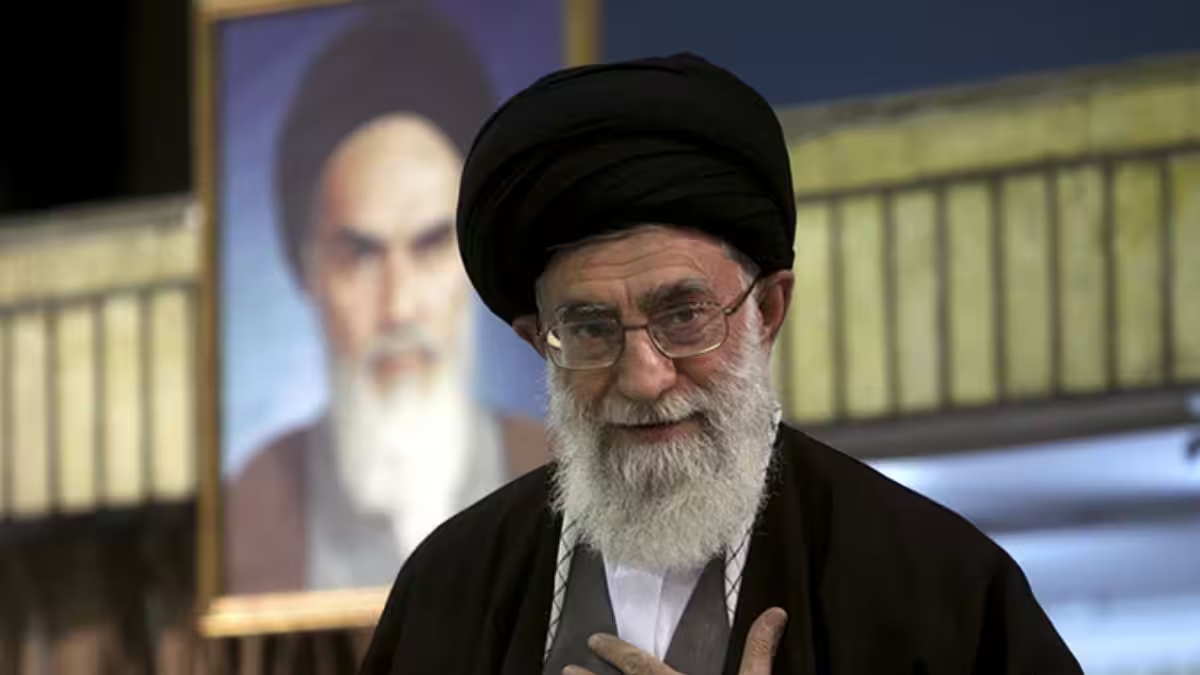
Ayatollah Ali Khamenei, Iran’s Supreme Leader, was reported dead on Saturday following US and Israeli strikes, triggering an outpouring of anger in Iran and reactions across West Asia and beyond.
On
Iranian television, a news anchor broke down in tears after announcing the leader’s death, declaring, “Revenge is coming soon.”
She added, “The devil of the world was celebrating, and everybody here has managed to brainwash, but this is not over. Trump is going to pay a price paid by no American President at all times, paid by no Zionist of all time, paid by no criminal of all time. Trump is going to see, because revenge is coming, and revenge is coming soon, and revenge is coming after Trump, after everybody who facilitated this assassination. He will pay the ultimate price, and it’s not only by the millions of Iranians, it’s not only by the millions in resistance countries, it’s also by those who have newly joined the resistance.”
Mourning intensified inside the Imam Reza Shrine as crowds reacted to reports announcing the death of Supreme Leader Ali Khamenei, filling the complex with grief and uncertainty.
BREAKING:
Mourning spreads inside the Imam Reza Shrine as crowds react to reports announcing the death of Supreme Leader Khamenei#Europost pic.twitter.com/D0nNXwft35— EuroPost Agency (@EuroPostAgency) March 1, 2026
Iranian state media reported early Sunday that the 86-year-old leader had died, without providing further details. The apparent demise of the second
leader of the Islamic Republic, who had no designated successor, is expected to create uncertainty over the country’s future and heighten fears of a broader regional conflict. The UN Security Council scheduled an emergency meeting.
The world reacts
US President Donald Trump said on social media that Khamenei was dead, describing it as “the single greatest chance for the Iranian people to take back their country.”
In a televised address, Israeli Prime Minister Benjamin Netanyahu said there were “growing signs” that Khamenei had been killed when Israel struck his compound early Saturday.
While
many nations avoided direct comment on the joint strikes, several condemned Tehran’s retaliation. Governments across Europe and West Asia criticised Iranian strikes on Arab neighbours while largely remaining silent on the US and Israeli military action.
Australia and Canada expressed support for the US strikes. Russia and China issued direct criticism.
European leaders call for renewed negotiations
In a joint statement, British Prime Minister Keir Starmer, French President Emmanuel Macron and German Chancellor Friedrich Merz urged the US and Iran to resume talks and said they favoured a negotiated settlement. They confirmed their countries did not take part in the strikes but remain in close contact with the US, Israel and regional partners.
“We condemn Iranian attacks on countries in the region in the strongest terms. Iran must refrain from indiscriminate military strikes,” they said. “Ultimately, the Iranian people must be allowed to determine their future,” they said.
At an emergency security meeting later, Macron stated France was “neither warned nor involved” in the strikes and stressed that issues surrounding Iran’s nuclear programme, ballistic activity and regional actions could not be resolved by military action alone.
The three countries have led diplomatic efforts concerning Iran’s nuclear programme.
Arab states and regional responses
The 22-nation Arab League described the Iranian attacks as “a blatant violation of the sovereignty of countries that advocate for peace and strive for stability.” The bloc has historically criticised both Israel and Iran over actions it says risk destabilising the region.
Morocco, Jordan, Syria and the United Arab Emirates denounced Iranian strikes targeting US military bases in Kuwait, Bahrain, Qatar and the Emirates.
Syria, previously one of Iran’s closest regional allies under former President Bashar Assad, condemned Iran in a foreign ministry statement, reflecting the new government’s attempts to rebuild relations with regional powers and the United States.
Saudi Arabia said it “condemns and denounces in the strongest terms the treacherous Iranian aggression and the blatant violation of sovereignty.” Oman, which has mediated talks between Iran and the US, said the US action “constitutes a violation of the rules of international law and the principle of settling disputes through peaceful means, rather than through hostility and the shedding of blood.”
Global reactions divided
New Zealand acknowledged that the US and Israeli attacks were preventing the Iranian regime from remaining an ongoing threat but stopped short of full endorsement. Prime Minister Christopher Luxon and Foreign Minister Winston Peters said in a joint statement: “The legitimacy of a government rests on the support of its people. The Iranian regime has long since lost that support.”
Russia’s Foreign Ministry described the strikes as “a pre-planned and unprovoked act of armed aggression against a sovereign and independent U.N. member state,” accusing Washington and Tel Aviv of pursuing regime change under the guise of nuclear concerns.
China said it was “highly concerned” and called for an immediate halt to military action and a return to negotiations, stating that “Iran’s sovereignty, security and territorial integrity should be respected.”
Canada’s Prime Minister Mark Carney expressed support for the military action, saying, “The Islamic Republic of Iran is the principal source of instability and terror throughout the Middle East.”
The UN Security Council scheduled an emergency session at the request of Bahrain and France.
Strikes and retaliation intensify tensions
The US and Israel launched a major attack on Iran on Saturday. Trump urged the Iranian public to “seize control of your destiny” by rising up against the Islamic theocracy that has governed the country since 1979.
Iran responded by firing missiles and drones towards Israel and US military bases across West Asia.
In the occupied West Bank, Palestinians appeared largely unfazed as Israel’s Iron Dome intercepted missiles overhead. Unlike Israeli cities, Palestinian areas lack warning sirens or bomb shelters. In Ramallah, marke…
End of Article