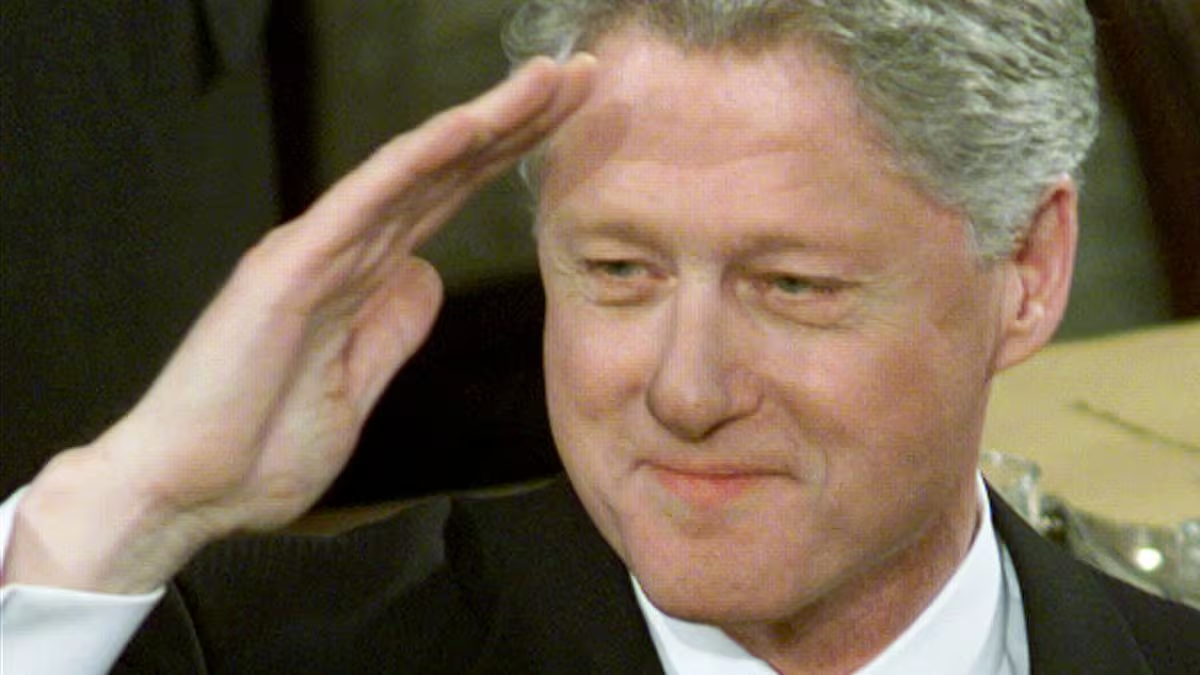
Bill Clinton testified before the House Oversight Committee over his links to Jeffrey Epstein, denied wrongdoing, and issued a public statement, as Democrats renewed calls for Donald Trump to appear before the panel
Former US President Bill Clinton said he testified before the House Oversight Committee over his connections to sex offender Jeffrey Epstein and released a statement afterwards, saying he did so out of duty to the country and the Constitution. The deposition was conducted behind closed doors as part of a congressional probe into figures linked to Epstein.
“I just finished testifying infront of the House Oversight Committee. I did it for two reasons. First – I love my country, including our Constitution, and America was built on the idea that no person is above the law, even president, especially presidents and that we should all live under the same set of rules,” he said.
VIDEO | Washington: Bill Clinton releases statement after testifying in front of House Oversight Committee over connections to Jeffrey Epstein.
“I just finished testifying infront of the House Oversight Committee. I did it for two reasons. First – I love my country, including… pic.twitter.com/tAeqQShnsr
— Press Trust of India (@PTI_News) February 28, 2026
Denial of wrongdoing
Clinton denied any wrongdoing during his appearance on Friday, as Democrats sought to shift attention towards Donald Trump and his own documented links to Epstein.
Clinton appears prominently in the Epstein files but has maintained that he severed ties well before Epstein’s 2008 conviction for sex offences.
“I saw nothing, and I did nothing wrong,” Clinton said in his opening statement, shared on social media.
Lawmakers react to deposition
The Republican chair of the House committee, James Comer, described the session as constructive.
“We believe this was a very productive deposition that President Clinton answered every question – or attempted to answer every question.”
Republican committee member Nancy Mace alleged there were “inconsistencies” in his testimony but did not provide specific examples.
Democrats renewed their call for Trump to appear before the panel.
“Let’s be real, we are talking to the wrong president,” said Democrat committee member Suhas Subramanyam, who also said Clinton had not dodged any questions.
In his
statement, Clinton did not mention Trump by name but said “no person is above the law, even presidents – especially presidents.”
Trump, speaking to reporters, said he likes Clinton “and I don’t like seeing him deposed,” while reiterating his scepticism about the proceedings.
No charges filed
Being named in documents released by the US Department of Justice does not in itself imply wrongdoing. Neither Clinton nor Trump has been accused of a crime or formally investigated in connection with the files.
Clinton’s testimony follows that of his wife, Hillary Clinton, who appeared before the panel on Thursday. She called for Trump to testify under oath.
The lawmakers should ask Trump “directly under oath about the tens of thousands of times he shows up in the Epstein files,” she said.
Closed-door hearings and calls for transparency
The depositions are being conducted in private. Bill Clinton compared the proceedings to a “kangaroo court”, while both he and Hillary Clinton have called for the hearings to be opened and televised.
Hillary Clinton said she had never known Epstein or visited the properties where he hosted celebrities and influential business and political figures, as well as allegedly trafficking young women and girls.
Bill Clinton has acknowledged extensive contact with Epstein but said he never travelled to the financier’s private Caribbean island.
Epstein was convicted in 2008 for soliciting sex from girls as young as 14. He died in a New York jail cell in 2019 before he could stand trial on sex trafficking charges. His death was ruled a suicide but has been the subject of conspiracy theories.
The Clintons initially rejected subpoenas compelling them to testify but agreed to appear after House Republicans threatened to hold them in contempt of Congress.
End of Article