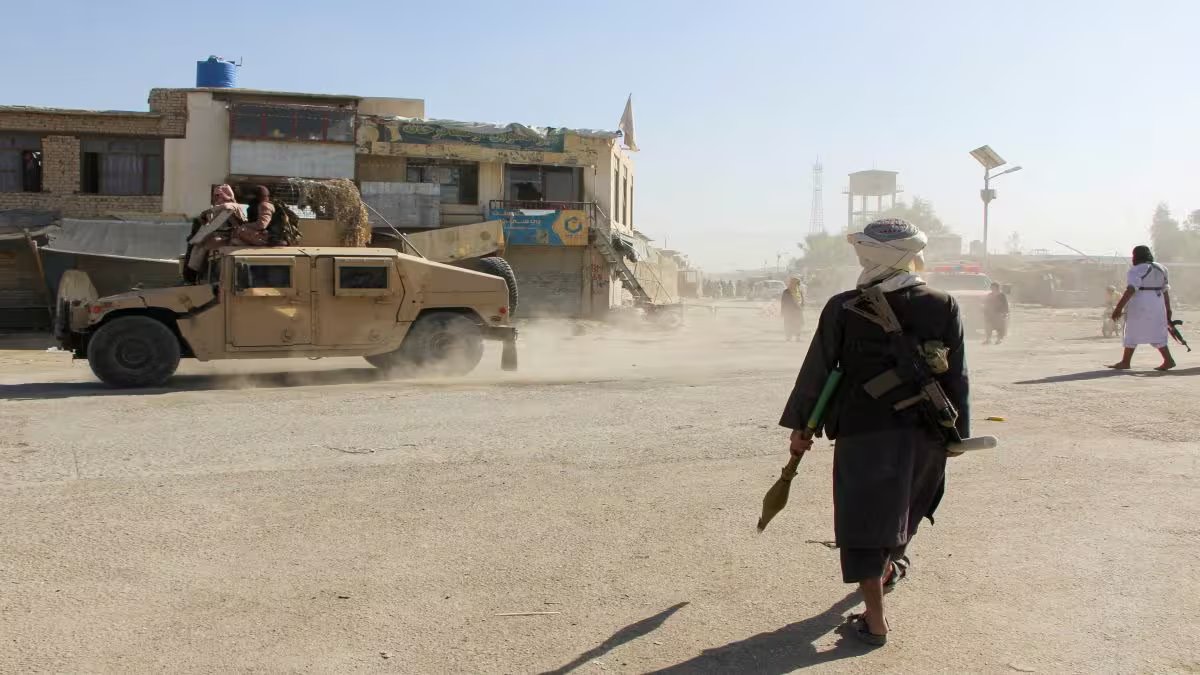
A war-like situation is unfolding between Afghanistan and Pakistan on Friday morning (February 27), with Islamabad bombing major cities in the neighbouring country, including the capital Kabul. Pakistan’s Defence Minister Khawaja Asif even posted on X, “Our patience has reached its limit. Now it is open war between us and you.”
Pakistan’s strikes come hours after Afghanistan launched a cross-border attack on Pakistan in the latest escalation of violence between the volatile neighbours.
Relations between the neighbours have plunged in recent months, with land border crossings largely shut since deadly fighting in October that killed more than 70 people on both sides.
But what’s going on? Why are the two sides fighting?
Afghanistan’s strikes on Pakistan
It all began on Thursday evening, around 8 pm local time, when the Taliban-led government launched an attack against Pakistan along the Durand Line. Afghanistan’s Taliban said that the cross-border strikes were in response to what it called deadly Pakistani airstrikes on Afghan border areas last Sunday (February 22). That attack resulted in the death of at least 18 people, including women and children, according to the Taliban.
“In response to the repeated rebellions and insurrections of the Pakistani military, large-scale offensive operations were launched against Pakistani military bases and military installations along the Durand Line,” said Afghanistan’s government spokesperson Zabihullah Mujahid on X.
Afghanistan’s defence ministry said its operations took place along the border in six provinces. It claimed the fighting lasted about four hours and ended at midnight.
BIG BREAKING💥
Afghan forces have captured several posts of the Pakistani military regime
According to reports, dozens of soldiers have been killed or wounded, & dozens more have been taken alive
Hundreds of ammunition & weapons have also fallen into the hands of Afghan forces pic.twitter.com/ghPAXNDNsI— Afghanistan Defense (@AFGDefense) February 26, 2026
In the strikes, Afghanistan claimed to have killed 55 Pakistani soldiers, including some whose bodies had been taken into Afghanistan, while “several others were captured alive.” It put its own casualties at eight killed and another 11 wounded. The ministry said it had destroyed 19 Pakistani army posts and two bases.
However, Pakistan’s Information Minister Attaullah Tarar has contested these figures. He said the number of troops killed was two, and three others were wounded. He added that 36 Afghan fighters had been reported killed.
Moreover, Mosharraf Ali Zaidi, spokesperson for Pakistan’s Prime Minister Shehbaz Sharif, denied that any Pakistani soldiers had been captured.
Pak launches ‘Operation Ghazab Lil Haq’ against Afghanistan
In retaliation for Afghanistan’s cross-border strikes, the
Pakistan air force launched airstrikes under ‘Operation Ghazab Lil Haq’, targeting major cities, including Kabul.
In the Afghan capital, AFP journalists heard jets and multiple loud blasts, followed by gunfire, over a period of more than two hours. Similarly, in Afghanistan’s southern city of Kandahar, where Supreme Leader Hibatullah Akhundzada is based, jets could be overhead.
Pakistan’s state broadcaster PTV reported that its military targeted the Afghan Taliban’s important military installations in Kabul, Kandahar, and Paktia. In those strikes, two brigade headquarters were destroyed in Kabul, while one corp headquarters and one brigade headquarters were destroyed in Kandahar. An ammunition depot and logistics base were destroyed in Kandahar, and a corp headquarters was destroyed in Paktia, reported PTV.
The Taliban government confirmed the Pakistani air strikes, with its spokesperson stating that “the cowardly Pakistani military has carried out airstrikes in certain areas of Kabul, Kandahar, and Paktia”, adding that no casualties were reported, a contrast to claims made by Pakistan’s interior minister. According to Pakistan’s Mohsin Naqvi, 133 Afghan Taliban members were killed, and more than 200 others were wounded. He added that 27 Afghan Taliban posts had been destroyed and nine Afghan Taliban posts had been captured.
In a post on X, Naqvi wrote: “The cowardly enemy struck in the darkness of night. The Afghan Taliban made a despicable attempt to target innocent civilians.
“The nation stands shoulder to shoulder with the armed forces. The Afghan Taliban made a terrible mistake by attacking. They will have to face serious consequences. We will not allow our security to be compromised.”
Pakistan President Asif Ali Zardari said the country would not compromise on peace and territorial integrity. “Our armed forces’ response is comprehensive and decisive. Those who mistake our peace for weakness will face a strong response — and no one will be beyond reach,” he warned
Pakistan Prime Minister Shehbaz Sharif also lauded the country’s military, saying its forces are “fully capable of thwarting any aggressive intentions”. “There will be no compromise on the defence of the beloved homeland and every aggression will be met with a befitting reply,” he wrote on the Pakistani government’s X account.
Months and months of violence
The violence on Friday follows months of violence between the two nations. Last October,
deadly clashes broke out between the two sides in which dozens of soldiers, civilians, and suspected militants were killed.
A Qatari-mediated ceasefire between the two countries has largely held, but the two sides have still occasionally traded fire across the border. Several rounds of
peace talks in November failed to produce a formal agreement.
At the heart of the issue is security, with Pakistan accusing Afghanistan of harbouring armed groups led by the
Pakistan Taliban (TTP), on its soil. The TTP emerged in 2007 and is distinct from the Taliban in Afghanistan but shares deep ideological, social, and linguistic ties with the group.
For Pakistan, the TTP poses a serious security concern; in 2025, they perpetrated more than 1,000
violent incidents across Pakistan. Islamabad has accused the Taliban government in Afghanistan of not doing enough to curb the TTP. As Pearl Pandya, South Asia senior analyst at the US-based Armed Conflict Location & Event Data, told Al Jazeera, “The Afghan Taliban appear unwilling to seriously crack down on the TTP, partly due to prior affinities between the two groups but also out of fear of TTP militants defecting to its main rival, the Islamic State Khorasan Province.”
However, the Afghan Taliban denies sheltering the TTP.
With inputs from agencies
End of Article