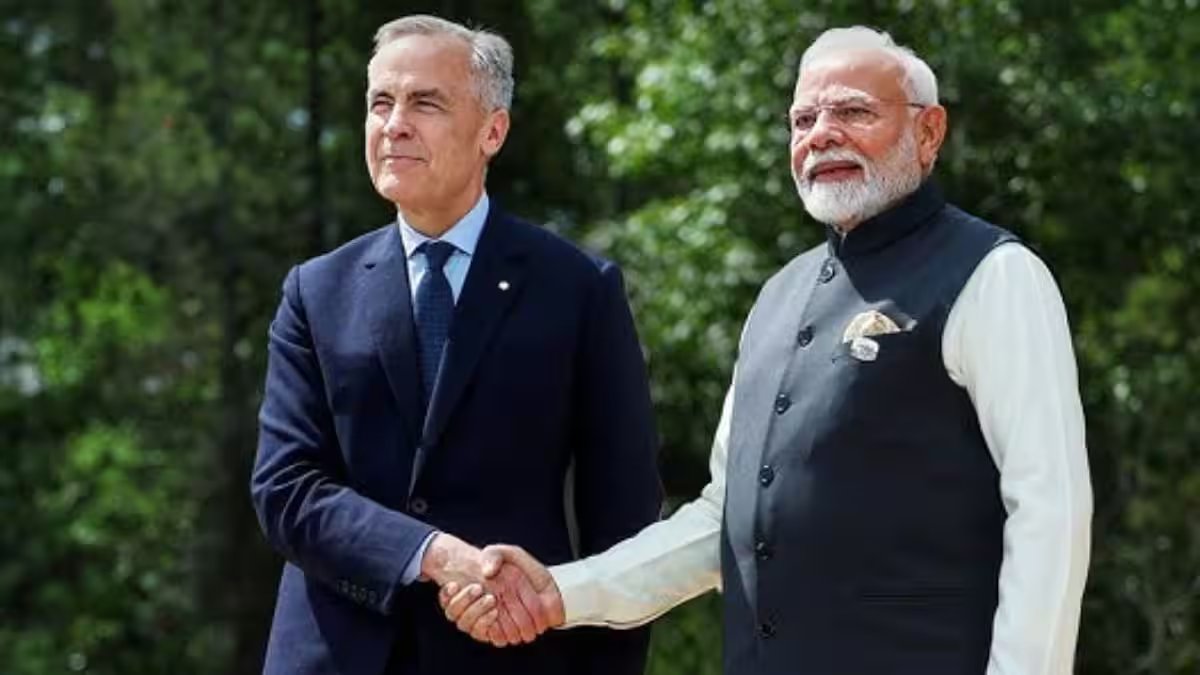
Canadian Prime Minister Mark Carney begins Asia tour starting in India, aiming to double bilateral trade by 2030 and reduce economic dependence on the United States amid tariffs and ongoing trade uncertainty.
Canadian Prime Minister Mark Carney departed for Asia on Thursday for a three-nation visit beginning in India, where he aims to expand bilateral trade as relations with the United States remain strained.
Carney’s stop in India represents another attempt to rebuild ties that sharply deteriorated after Ottawa accused New Delhi of being linked to actions against Sikh activists on Canadian soil. India has denied the allegations.
The broader trip, which also includes Australia and Japan, reflects Carney’s strategy to reduce Canada’s heavy economic dependence on its southern neighbour. In 2024, before US President Donald Trump returned to office and introduced sweeping tariffs that disrupted global trade, over 75 percent of Canadian exports were destined for the United States. Bilateral trade that year totalled more than $900 billion.
While Trump has largely maintained the North American trade agreement negotiated during his first term — keeping roughly 85 percent of US-Canada trade free of tariffs — he has also imposed sector-specific duties that have weighed on key industries. Concerns persist in Ottawa that abandoning the wider trade framework could severely impact Canada’s economy.
To cushion against such risks, Carney has prioritised expanding commercial ties with Europe and Asia. He has announced plans to more than double two-way trade with India to Can$70 billion ($51 billion) by 2030.
University of Toronto public policy expert Drew Fagan said diversifying trade partnerships is a prudent move, encouraging Canada to pursue opportunities in alternative markets when possible. However, he warned that stronger links with countries such as India would not fully compensate for a potential breakdown in US trade relations.
“It’s not a solution. It’s not a replacement and it never will be,” Fagan said.
– Transnational repression –
Carney left Ottawa on Thursday morning en route to Mumbai.
He is expected to meet with business groups in the Indian city over the weekend before heading to New Delhi for talks with Prime Minister Narendra Modi, a meeting that will be closely watched.
Before Carney took office last year, Ottawa accused Modi’s government of direct involvement in the 2023 killing of Hardeep Singh Nijjar, a naturalized Canadian citizen who advocated for an independent Sikh state called Khalistan.
Former prime minister Justin Trudeau’s government further charged India with directing a campaign of intimidation against Sikh activists across Canada.
India has denied those allegations.
Canadian Foreign Minister Anita Anand was asked Monday if Canadian concerns about transnational repression would feature at the New Delhi talks.
“Yes, that is always at the forefront of our minds,” Anand told reporters in Ottawa.
Carney’s hopes for trade growth with Australia and Japan are more modest, but his office said cooperation over critical mineral supply chains will be a priority.
Advanced economies have made a push to deepen critical mineral cooperation, especially in the processing of rare earth elements essential to power many high-tech products.
China currently has dominant control of rare earth supply chains, a concern that Canada highlighted throughout its just-concluded G7 presidency.
With inputs from agencies
End of Article