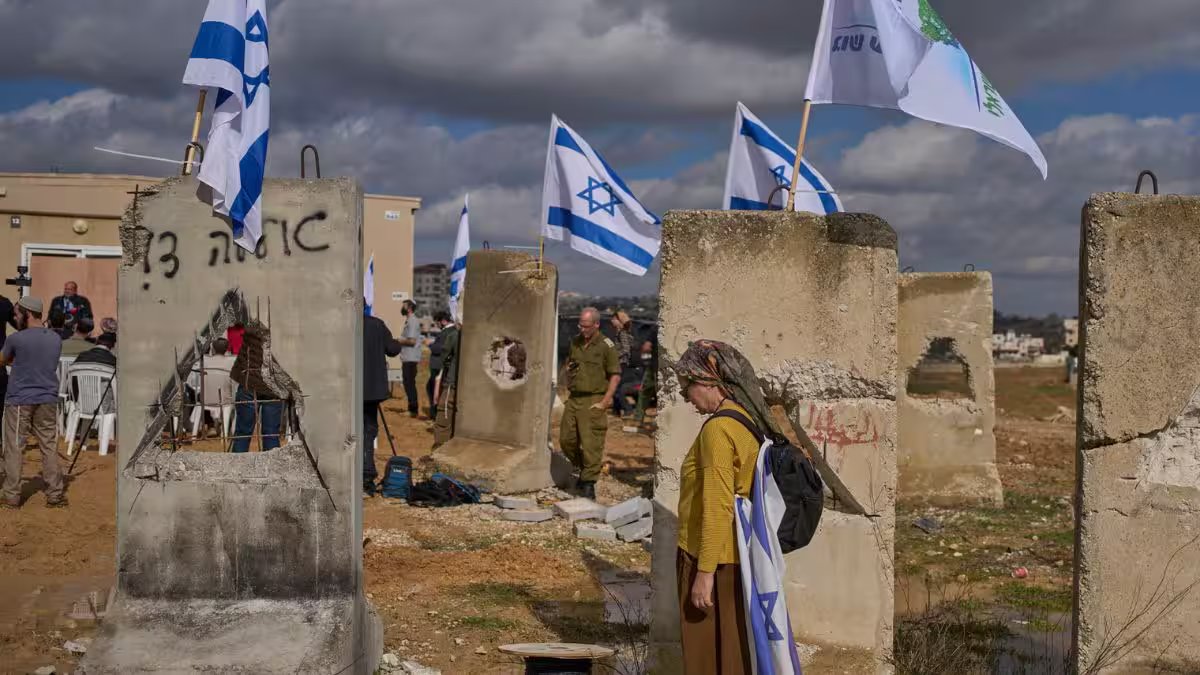
In a move criticised as de facto recognition of Israel’s control of West Bank, the United States has announced it will offer passport services in Jewish settlements in occupied West Bank. Jewish settlements are deemed illegal under the international law.
In a move criticised as de facto recognition of Israel’s control of West Bank, the United States has announced it will provide passport services in Jewish settlements in occupied West Bank.
Jewish settlements in West Bank are deemed illegal in the international law and critics have seen the decision as de facto recognition of the occupation. For decades, the United States —the Donald Trump administration— has also recognised these settlements as illegal.
The US Embassy in Jerusalem on Friday said it will set up a daylong passport camp in the Jewish settlements of Efrat and Beitar Illit in the coming months — the former is a fast-growing settlement and the latter is home to ultra-Orthodox Jews, central to Prime Minister Benjamin Netanyahu’s far-right coalition.
While such camps are normal in Palestinian cities likes Ramallah and Tybeh, it is the first time that a camp is being held in a settlement.
Israeli politicians have already framed the decision as a precursor to American recognition of these settlements and Israeli annexation. Yuli Edelstein, a settler, lawmaker, and a former parliamentary speaker, hailed the decision as “a blessed step of tremendous importance” and said it “adds to the international legitimacy of our right to the regions of our homeland in Judea and Samaria” — biblical names for West Bank that Israel’s far-right uses for West Bank.
Edelstein went on to say that Israel now needed to take “the next step” and apply its sovereignty there as well — a reference to the annexation of West Bank.
Notably, the US decision has come weeks after Netanyahu’s government
advanced territorial control in West Bank that has been condemned as ‘de facto annexation’ of the territory. More than 100 countries and international organisations condemned the move.
Israel occupied West Bank in 1967 after the Six Day War and hundreds of thousands of Jewish settlers have since settled there. The international community largely considers these settlements as illegal as Article 49 (6) of the Fourth Geneva Convention of 1949 bans an occupying power from forcibly transferring its population into an occupied territory.
As per latest estimates, around 500,000 Jewish Israelis live in around 200 settlements in West Bank that occupy around 10 per cent of the occupied territory. Settlements and outposts have vastly grown under Netanyahu’s tenure and are seen as an impediment to the creation to any future Palestinian state under the two-state solution as they squeeze the land available for such a state.
‘Political statement of legitimisation of Israeli settlements’
The American decision cannot be seen as anything other than a “political statement of legitimization of Israeli settlements in the West Bank”, Michael Sfard, an expert on international human-rights law, told The New York Times.
Efrat is a “very small bedroom community” that is just eight miles from the US Embassy in Jerusalem, Sfard noted.
“All their services they get from Jerusalem. If they want to see a movie, they go to Jerusalem. This cannot be construed in any way other than as a political statement of legitimization of Israeli settlements in the West Bank,” said Sfard.
Even though officials told The Times that the official position had not changed on West Bank, the decision essentially goes against
President Donald Trump’s repeated statements about not allowing Israel to annex either West Bank or Gaza Strip.
Daniel C Kurtzer, a former US. ambassador to Israel, told The Times that the decision amounted to recognition “of Israel’s galloping annexationist policies and actions in the occupied territories” and “a mockery of Trump’s professed opposition to Israel’s annexation intentions”.
End of Article