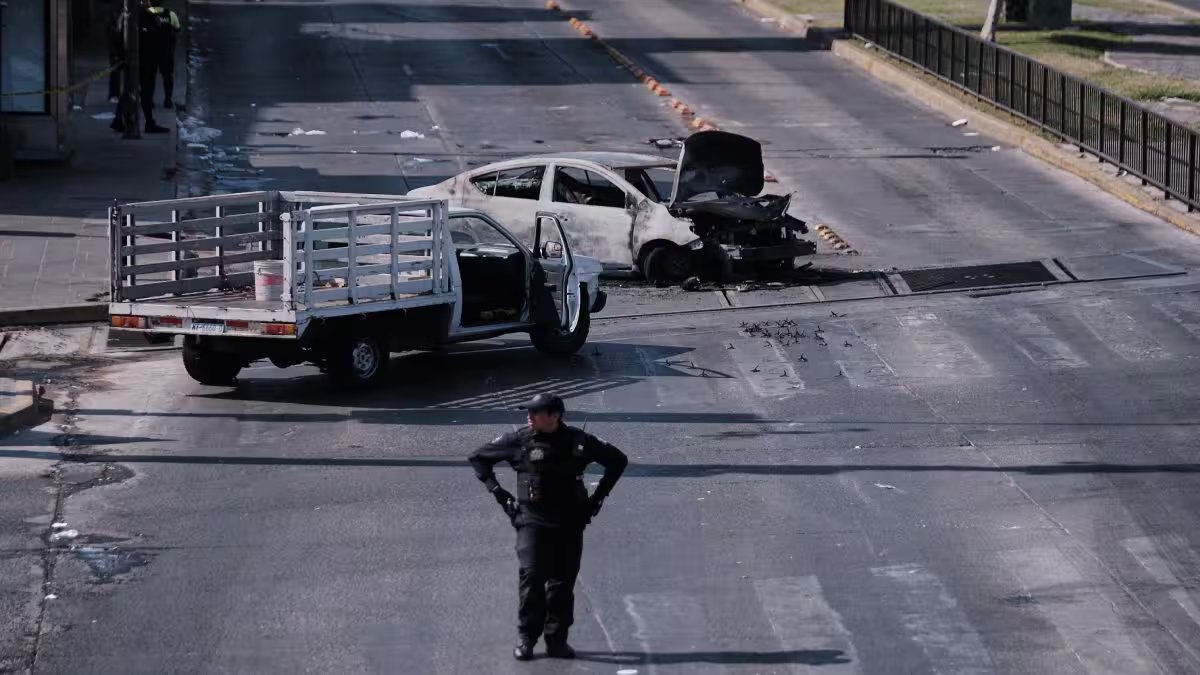
The country of Mexico is on the boil; a wave of violence has swept the nation following an operation that led to the killing of one of the world’s most wanted drug traffickers, the Mexican cartel boss known as “El Mencho”.
The drug lord, whose real name is
Nemesio Rubén Oseguera Cervantes, was killed on Sunday (February 22) in the western state of Jalisco along with at least six alleged accomplices from his powerful and notorious criminal organisation: the Jalisco New Generation Cartel (CJNG).
The killing of El Mencho has shed light on the various Mexican drug cartels that have been functioning in the country since the 1970s. In fact, Latin American drug cartels grew after the 1980s when the US government successfully broke up the Caribbean-based smuggling rings used by Colombian cocaine traffickers. At the time Mexicans couriers, who worked with Colombians, began wholesaling the drugs themselves.
Today, Mexico’s drug cartels are all-powerful — they are responsible for thousands of deaths each year through the drugs they peddle. Moreover, they are also responsible for political corruption, assassinations, and kidnappings.
But which cartels operate in Mexico and how deadly are they?
Which are the most powerful cartels in Mexico?
Jalisco New Generation Cartel: Led by notorious El Mencho, the New Generation Jalisco Cartel (CJNG) is one of the most powerful and violent cartels in Mexico and is responsible for a significant portion of fentanyl and other illicit drug flows into the United States and around the world.
It split from the all-powerful Sinaloa cartel around 2009 and has grown to become one of Mexico’s dominant drug trafficking organisations. Estimated to have around 15,000 to 20,000 members, the cartel is believed to be raking in billions of dollars annually through its numerous criminal activities such as drug trafficking, extortion, fuel theft, kidnapping, illegal logging and mining, and migrant smuggling.
The group is also known for its extreme, high-profile, and brutal violent methods. They often leave dismembered or burned bodies as a way to intimidate the masses in Mexico. There have also been reports that its members have been forced to cannibalise its victims as part of training.
In 2015, the El Mencho-led cartel also downed an army helicopter with a rocket-propelled grenade. Moreover, the group has been responsible for many high-profile attacks on government officials. In 2020, the cartel attempted to assassinate Mexico City Police Chief Omar García Harfuch, who now serves as Mexico’s Secretary of Security and Civilian Protection. While travelling to a meeting in an armoured SUV, Garcia was attacked by CJNG members who had high-powered rifles, grenades, and body armour, according to Mexico News Daily. He survived, but two of his bodyguards and an uninvolved woman were killed.
The CJNG is reported to use fake job advertisements to recruit members, then forcing the unsuspecting applicants to join the cartel. The cartel is alleged to have tortured or killed those who tried to resist or escape.
Sinaloa cartel: Also known as the Pacific Cartel, the Federation, and the Golden Triangle, the Sinaloa cartel is one of Mexico’s oldest and most powerful drug trafficking groups with considerable influence in the Mexican government and public institutions.
It was founded in the 1980s by notorious drug lord Joaquín “El Chapo” Guzmán and garnered a fierce reputation for violence and outfought several rival groups.
According to US officials, Sinaloa became the biggest supplier of illegal drugs to the US during Guzman’s reign. Moreover, it has been involved in the slaughter, torture, and ruthless killing of rival gang members. It also had access to a huge arsenal of weapons, including a rocket-propelled grenade launcher and Guzmán’s own gold-plated AK-47.
Despite
Guzman’s arrest and being handed down a life sentence in 2019, the Sinaloa Cartel remains hugely powerful. It still dominates north-west Mexico and is reported to have a presence in cities ranging from Buenos Aires to New York.
Los Zetas: Besides the Sinaloa and CJNG cartels, others also operate in Mexico, such as the Los Zetas. It was formed as the enforcement arm of the drug-trafficking Gulf Cartel but broke away and became independent in 2010.
The Zetas became particularly well-known for their brutality, often torturing and decapitating their victims. By 2012, the Zetas had reached the height of their powers. They were named as the country’s biggest drug gang, overtaking their bitter rivals, the Sinaloa, and were thought to operate in more than half of the Mexican states.
The group also broadened its role, extending its activities to smuggling people, kidnapping, extortion, and arms trafficking. Los Zetas and other cartels were also responsible for the theft of more than $1 billion in oil from Pemex, Mexico’s national oil company.
However, by 2015, the Zetas saw a decline in their power, allowing rival groups to assert dominance.
Gulf Cartel: It is the oldest drug cartel in Mexico, founded in 1984 and peaking in the early 2000s before it fractured after its then-leader was arrested in 2003.
At its peak in the 1990s, the Gulf Cartel’s drug trafficking activities raked in billions of dollars each year. It maintained its network by engaging in political corruption and bribery as a means to keep officials on side.
First led by Juan García Abrego, the Gulf Cartel fell into the hands of Osiel Cardenas Guillen after 1996. It was Guillen who built up the cartel’s military wing; he recruited a number of corrupt special forces soldiers and pushed an even more violent approach.
According to the Counter Terrorism Guide, as of 2025, the Gulf Cartel has three rival factions: Los Escorpiones, whose leader was captured by Mexican authorities in January 2024; Los Metros; and Los Ciclones.
Juárez Cartel: Also considered one of the oldest criminal organisations in Mexico, the Juárez Cartel has focused on drug trafficking, but has expanded into other criminal activities such as human trafficking, kidnapping, local drug distribution, and extortion.
Based in the city of Juárez in the state of Chihuahua, northern Mexico, the Juárez Cartel is also known as the
Vicente Carrillo Fuentes Organization (VCFO), after its leader.
Other smaller cartels: There’s the Tijuana Cartel, also known as the Arellano-Felix Organisation. There’s also the La Familia Michoachana, a cartel formed in the west-central Mexican state of Michoachan, which has sometimes portrayed itself as a revolutionary or vigilante organisation aimed at fighting against drugs. In 2009, then US President Barack Obama designated the group’s members as “significant foreign narcotics traffickers” and imposed financial sanctions on it under the Foreign Narcotics Kingpin Designation Act.
How powerful are the drug cartels in Mexico?
Mostly known for trafficking of cocaine, heroin, marijuana, and synthetic drugs such as amphetamine, these drug cartels are very powerful. According to one estimate, the cartels rake in between $25 billion and $30 billion a year, employing 450,000 people in vast networks that take in street and prison gangs.
Experts note that there are a number of factors that contribute to the proliferation of drug cartels in Mexico. Many of the cartels are supported by the country’s top officials, as the cartels use a portion of their vast profits to pay off judges, police, and politicians.
They also coerce officials into cooperating; assassinations of journalists and public servants are relatively common.
How has Mexico tried to curb these cartels?
In the recent past, Mexico’s governments have tried to curb these drug cartels by deploying security forces. However, that has led to more violence.
The current Mexican President,
Claudia Sheinbaum, has focused mainly on using social programmes to address the root causes of crime. However, in late 2024, she also took on a more aggressive approach with a substantial deployment of military and naval troops, as well as special forces and heavy weaponry, to areas particularly affected by these drug trafficking groups.
Sheinbaum has called on the United States to help crack down on cartel activity. And as part of its efforts to crack down on drug cartels, the Trump administration added several Mexican cartels, such as the Sinaloa, to the US list of foreign terrorist organisations, as well as expanded its use of a covert drone programme to find and identify fentanyl labs in Mexico.
Interestingly, it was a new US-military-led task force specialising in intelligence collection on drug cartels that played a significant role in the operation that led to El Mencho’s death on Sunday.
With inputs from agencies
End of Article