A scenario analysis by Citrini Research flags long-term structural risks to India’s services surplus even as official data show strong export growth and macro stability
A fresh scenario analysis by US macro analysts at Citrini Research has sounded a note of caution over the long-term durability of India’s IT export-led growth model, warning that rapid advances in artificial intelligence (AI) could, over time, undermine the country’s labour-cost advantage and strain the rupee.
The report sketches a hypothetical 2028 stress scenario in which AI coding agents sharply compress global software development costs, stablecoins built on networks such as Solana and Ethereum disrupt traditional payment rails, and the S&P 500 plunges 38 per cent from its peak. While not a base-case forecast, the exercise is designed to highlight structural vulnerabilities in economies reliant on services exports — with India a key example.
“Indian developers cost a fraction of their American counterparts. But the marginal cost of an AI coding agent has collapsed to, essentially, the cost of electricity,” the report said, arguing that wage arbitrage — the bedrock of India’s software exports for over two decades — could erode far more quickly than markets currently anticipate.
In its stress case, large Indian IT firms such as Tata Consultancy Services, Infosys and Wipro see contract cancellations accelerate through 2027. The rupee tumbles 18 per cent against the dollar within four months as the services surplus — a key pillar of India’s external balance — evaporates, prompting preliminary discussions with the International Monetary Fund by early 2028.
Services engine holds firm — for now
For now, however, official data paint a picture of resilience rather than retreat.
The
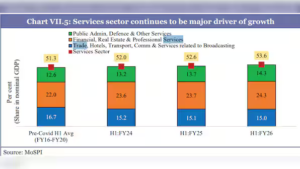
Economic Survey 2025–26 notes that services exports growth more than doubled to 14 per cent during FY23–FY25, compared with 7.6 per cent in the pre-pandemic FY16–FY20 period. The sector now contributes more than half of Gross Value Added (GVA), underlining its centrality to India’s growth story.
In FY26, services expanded 9.1 per cent, according to the first advance estimates, acting as the primary driver of overall GVA growth. India has also climbed to become the world’s seventh-largest exporter of services, with its share in global services trade rising from 2 per cent in 2005 to 4.3 per cent in 2024.
In H1 FY26, services exports grew at around 10 per cent. Software services — which account for more than 40 per cent of total services exports — posted average growth of 13.5 per cent during FY23–FY25, a marked acceleration from 4.7 per cent in FY16–FY20.
Foreign direct investment trends further reinforce the sector’s weight. Services accounted for 80.2 per cent of total FDI inflows during FY23–FY25, up from 77.7 per cent in the pre-pandemic period, with information and communication services and professional services drawing the largest shares.
The IT-ITeS industry remains substantial despite a moderation in growth. Nasscom estimates industry revenues at $283 billion in FY25 (including hardware), reflecting 5.1 per cent year-on-year growth — an improvement from 3.9 per cent in FY24.
While Citrini’s scenario envisages accelerating contract cancellations and currency pressure, the current macro backdrop remains stable in early 2026. Services exports have cushioned the impact of subdued global goods trade, though services trade growth moderated to 8 per cent during April–November FY26 amid global policy uncertainty.
Structural question, not imminent crisis
Citrini Research’s exercise stops short of predicting an imminent shock. Instead, it poses a deeper structural question: what happens if AI meaningfully compresses the marginal cost of software development globally?
India’s IT model has historically been anchored in labour cost differentials and scale. If AI agents reduce coding and maintenance costs toward near-zero marginal expense, pricing power, billing rates and employment elasticity could come under pressure. Given that services exports finance a large share of India’s persistent merchandise trade deficit, any sustained erosion would carry currency implications.
For now, the data suggest continued momentum. Services remain a high-growth, relatively low-volatility anchor in an uncertain global environment.
End of Article