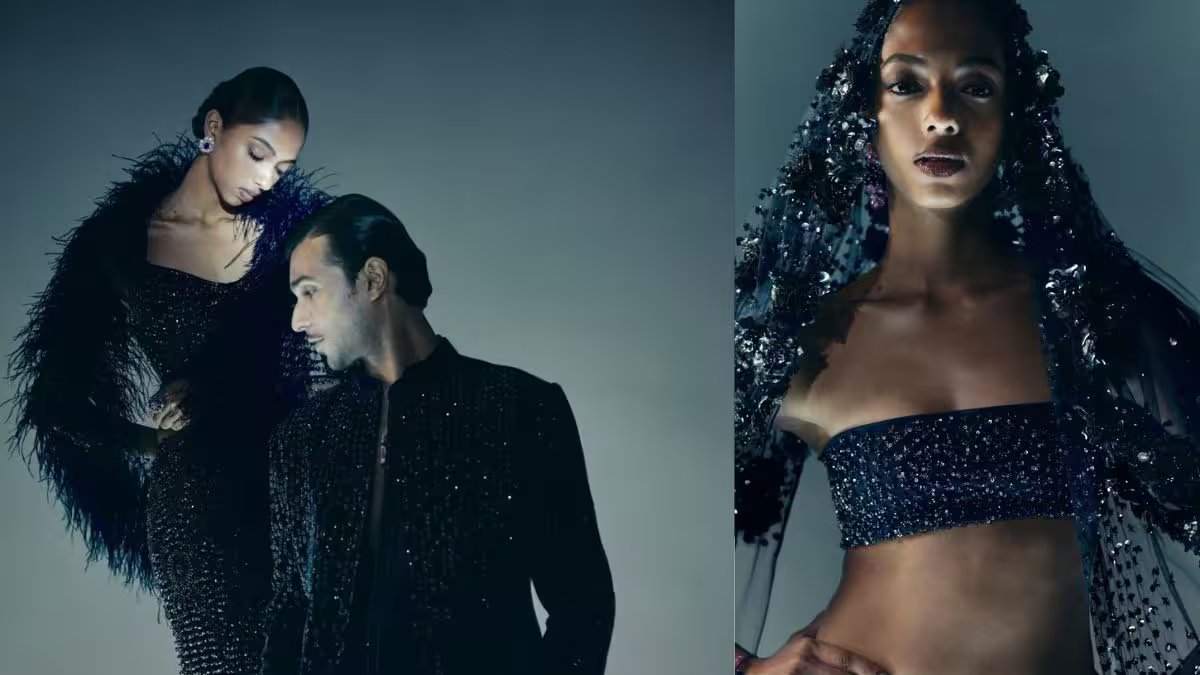
Rahul Khanna’s speaks to Firstpost’s Lachmi Deb Roy on behalf of Rohit Gandhi and Rahul Khanna for their new collection, Abyssal. Prelude to the Lakme Fashion Week, Rahul Khanna talks about India’s unique position in the world fashion order.
In an EXCLUSIVE interview with Firstpost, Rahul Khanna discusses about the process that went behind the creation of Abyssal, on treating couture as an experience rather than an object and most importantly where does India stand in the world fashion order. He mentions why couture has never been about just the finished garment. It begins long before a garment takes form. It starts with a thought that evolves into research, mood boards, fabric studies and swatches.
Rohit Gandhi and Rahul Khanna collection comes together through surface ornamentation that echoes the ocean – pearls, diamantes, and unusual crystal shapes hand-embroidered like artefacts discovered on the ocean floor. These elements do not decorate the garment; they belong to its environment. Light catches on them like frost, creating sparks across fluid, sculptural silhouettes.
Veils of sheer textiles dissolve into one another, creating depth and phases of revelation. Here, the veil is not concealment; it is a method of perception. Colour moves subtly through ocean ombre, a blend of abyssal blues, mineral greys, frost whites, and deep charcoals that echo light diffusing through water, allowing couture to be unveiled the way the abyssal world reveals itself: patiently, reverently.
Edited excerpts from the interview****:
What was the thought process that went behind getting the entire collection together?
We began with the idea of building an atmosphere rather than individual garments. For us, a couture collection must feel cohesive and every silhouette, surface detail should belong to the same visual story. With Abyssal, we were interested in exploring how structure and fluidity could coexist. The process involved refining and editing continuously until the collection resonated with our vision for this spring summer.
What is your idea of contemporary Indian ceremonial dressing?
Contemporary Indian dressing for ceremonies is about honouring the significance of the occasion while interpreting it through a modern lens. Celebration is no longer defined by excess alone. It is also defined by intention because today’s clients are far more discerning. They understand proportion, silhouette, craftsmanship and expect ceremonial wear to reflect their individuality rather than a prescribed formula.
Your thoughts on couture as an experience rather than an object?
Couture has never been about just the finished garment. It begins long before a garment takes form. It starts with a thought that evolves into research, mood boards, fabric studies and swatches. It moves through draping, pattern-making, fittings, refinements, surface development, and meticulous detailing. Every stage demands time and precision. When we speak of couture as an experience, we’re referring to this entire journey and the dialogue between designer, atelier and client. By the time the final piece is ready, it carries layers of intention and collaboration. That depth of process is what gives couture its meaning.
Where do you see India in the world fashion order?
India holds a unique position because of its depth of craftsmanship. What is changing now is confidence. Indian designers are no longer looking outward for validation but rather defining their own language while engaging globally. The world recognises technique and India has that in abundance. The next step is continuing to refine how we present that strength on an international platform.
Fashion vs Style — what is your take?
Fashion is cyclical and reactive while style is deeply personal and reflects who you are over time. As designers, we naturally engage with fashion but our work has always been focused on building a clear design language rooted in structure, proportion, and restraint. Trends may influence the surface, but style shapes the foundation which a brand’s identity rests on.
End of Article