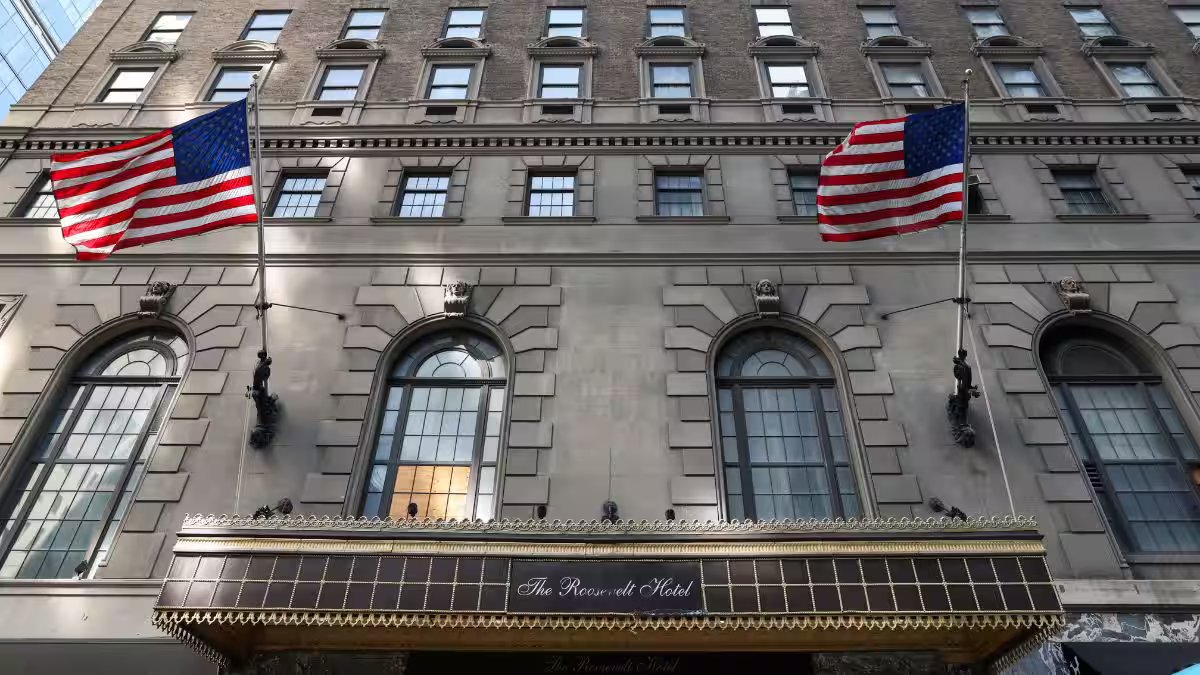
Pakistan has moved to reposition one of its most valuable overseas assets by entering into a cooperation framework with the United States for the redevelopment of New York’s Roosevelt Hotel.
The initiative centres on transforming a long-shuttered Midtown Manhattan landmark into a revenue-generating asset.
The agreement outlines cooperation on the operation, upkeep, refurbishment and redevelopment of the property.
Pakistan’s finance division has framed the move as part of its privatisation agenda, stating, “The objective remains to secure maximum value for this property in alignment with the government’s privatisation strategy while strengthening Pakistan-United States economic ties.”
The memorandum of understanding (MoU), however, does not specify commercial terms, financial commitments or a timeline for execution, leaving open key questions about how the project will be funded and implemented in practice.
Who owns NYC’s iconic Roosevelt Hotel?
The Roosevelt Hotel occupies a strategic location in Midtown Manhattan, near Grand Central Terminal.
Opened in 1924 as part of a broader plan to develop the district around the transport hub, the hotel was named after former US president Theodore Roosevelt and has changed ownership multiple times across its century-long history.
Pakistan entered the picture in 1979,
when its national carrier, first took the property on lease before later acquiring full ownership.
For decades, the hotel operated as a premium hospitality venue. That chapter ended in 2020, when it stopped functioning as a luxury hotel.
In the period that followed, the building was repurposed as a reception
and shelter centre for asylum seekers, with New York City using the site as part of its response to rising arrivals under right-to-shelter provisions.
Islamabad has assessed the property’s value at over $1 billion, making it one of the country’s most significant overseas investments. Rather than pursuing a rapid divestment, officials have signalled that redevelopment offers a pathway to unlock greater long-term value.
The Roosevelt Hotel is now positioned as a key component in Pakistan’s wider plan to restructure and privatise state-owned assets — a process tied directly to its $7 billion programme with the International Monetary Fund.
The government has argued that a hasty sale could undervalue the asset, particularly given its location in one of the world’s most expensive real estate markets.
What does the US-Pakistan memorandum cover?
The cooperation framework was formalised through an MoU between Pakistan and the United States that lays out plans for joint engagement on the property’s operation, maintenance, renovation and redevelopment, reported Reuters.
The Pakistani government has said the arrangement is intended to align with its privatisation strategy while also strengthening economic ties with Washington. The MoU was negotiated by US Special Envoy Steve Witkoff under the leadership of US President Donald Trump.
The agreement was executed on the US side by the administrator of the United States General Services Administration (GSA), Edward C Forst, and on Pakistan’s side by Finance Minister Muhammad Aurangzeb.
The signing was witnessed by Pakistan’s Prime Minister Shehbaz Sharif and Witkoff. Despite the formal ceremony, the document does not spell out any financial structure, investment commitments or revenue-sharing arrangements.
The MoU also assigns a facilitation role to the US GSA, an agency whose primary function is managing federal property and procurement for US government departments.
Its publicly stated remit does not typically extend to commercial redevelopment of foreign state-owned assets. The absence of clarity on the legal or administrative basis for the GSA’s involvement has left open questions about the operational framework of the project.
The lack of financial specifics means the redevelopment plan remains at a conceptual stage, with concrete funding models yet to be disclosed.
Why didn’t Pakistan sell the hotel right away?
Pakistan International Airlines’ approach to the Roosevelt Hotel has evolved repeatedly over the years. At various points, officials indicated that the property could be sold outright, reopened as a hotel, or redeveloped in partnership with external investors.
This shifting strategy has fuelled debate within the real estate community in New York, where analysts have argued that an open-market sale of the land alone could command a price in the region of $1 billion.
Two years ago, PIA engaged the global brokerage firm JLL to advise on options for the property, including a potential sale. That move was interpreted as part of a broader push to dispose of non-core assets as Pakistan sought to shore up its finances.
The current pivot towards redevelopment, rather than immediate divestment, reflects the government’s belief that the asset could generate higher value over time if repositioned through renovation and partnership.
However, the redevelopment route also implies a longer wait before meaningful cash flows materialise.
For a government operating under fiscal stress and under IMF-mandated reform conditions, the trade-off between long-term value maximisation and near-term liquidity remains a central policy dilemma.
Can Pakistan afford to redevelop Roosevelt Hotel?
The Roosevelt Hotel initiative is unfolding against a backdrop of continued financial strain for Pakistan. By February 2026, the country has moved away from the immediate risk of default that loomed in 2023, but its economic position remains fragile.
Public debt stands at approximately Rs 80.5 trillion, equivalent to about $288 billion, pushing the debt-to-GDP ratio to roughly 70.7 per cent, well above the 60 per cent ceiling mandated by Pakistan’s Fiscal Responsibility and Debt Limitation Act.
A significant portion of government revenue is absorbed by debt servicing. Interest payments alone consume between 40 per cent and 45 per cent of federal income, leaving limited fiscal space for spending on infrastructure, education or healthcare.
For the 2025-26 fiscal year, Pakistan faces external financing needs estimated between $19.4 billion and $25 billion to meet its obligations.
Foreign exchange reserves held by the State Bank of Pakistan stand at around $16.2 billion, covering only two to three months of imports. While inflation has moderated sharply to 5.8 per cent as of January 2026 from a peak of 38 per cent in 2023, the adjustment has come after painful austerity measures.
GDP growth is projected in the range of 3.75 per cent to 4.75 per cent, a modest recovery that still lags behind population growth. The current account has returned to a deficit of $1.07 billion for July-January FY26 as imports have risen, reversing a previous surplus.
Pakistan is halfway through a $7 billion Extended Fund Facility with the IMF. A staff-level review scheduled for February 25, 2026, is a critical milestone for securing the next $1 billion tranche of funding.
Compliance with IMF conditions has required the government to raise electricity tariffs and broaden the tax base, measures that have increased the cost of living and added to political pressure on the administration.
Beyond IMF funding, Pakistan’s short-term financial stability continues to rely on rollovers of deposits from partner countries, notably China, Saudi Arabia and the UAE.
Combined deposits from China and Saudi Arabia of roughly $9 billion help prevent a sharp decline in foreign reserves. The UAE has recently granted only a 60-day extension on a $2 billion loan, raising the interest rate to 6.5 per cent, signalling more cautious terms even from traditional partners.
This reliance on rollovers shows why Islamabad is under pressure to convert dormant assets into sources of revenue.
The Roosevelt Hotel, estimated by Pakistan to be worth more than $1 billion, stands out as a potential lever for generating value without immediately relinquishing ownership.
However, redevelopment typically requires upfront investment, detailed planning approvals, and coordination with local authorities and partners in New York’s highly regulated real estate environment.
The Roosevelt Hotel initiative is not occurring in isolation. Islamabad has been seeking to strengthen economic engagement with Washington, including securing US financing support for the Reko Diq copper and gold project in Balochistan.
The mining venture is viewed as a potential long-term source of export revenue for Pakistan, complementing efforts to address structural weaknesses in its balance of payments.
Sharif
was present in Washington for the inaugural meeting of Trump’s Board of Peace on Thursday.
With inputs from agencies
End of Article