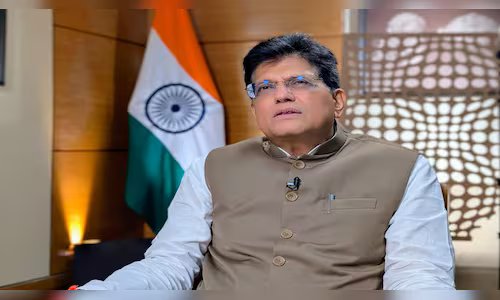
Commerce and Industry Minister Piyush Goyal has said that India’s expanding network of Free Trade Agreements (FTAs) has significantly improved market access for Indian exporters. He noted that nearly 70% of global GDP and two-thirds of global trade are now accessible to India through nine concluded FTAs, including the first tranche of the Bilateral Trade Agreement with the United States.
These agreements provide preferential access across sectors in 38 developed economies. Goyal highlighted that 37 of India’s FTA partner countries have a per capita income ranging between $25,000 and $200,000. He described the double-digit growth in merchandise exports in the first half of February as a sign of strong market confidence and proactive industry participation.
The Minister said the government’s mission is focused on simplifying processes for MSMEs, improving access to credit, strengthening quality standards, supporting compliance with international regulations, and expanding global logistics and warehousing infrastructure.
Read More: India’s UK, Oman FTAs likely by April; EU deal to operationalise by end-2026: Goyal
Initiatives such as overseas warehousing — including Bharat Mart in Dubai — are aimed at giving Indian exporters strategic access to markets across the GCC, Africa, Central Asia and Europe. He added that India could also establish warehouses in the US and the European Union to serve those markets, and in Malaysia or Singapore to cater to ASEAN and Australia.
Commerce Secretary Rajesh Agrawal emphasised the need for each Export Promotion Council (EPC) to develop a communication strategy on how exporters can leverage FTAs, warning that efforts to open the Indian market to imports would be ineffective if export opportunities are not fully utilised.
Referring to the recently concluded AI Summit, Goyal said advancements in artificial intelligence, machine learning, quantum computing, data centres and indigenous large language models would create significant opportunities for India’s youth and drive cross-sector investments. He noted that the sector has seen commitments worth $200 billion during the summit, in addition to $100 billion pledged earlier.
First Published: Feb 20, 2026 6:51 PM IST