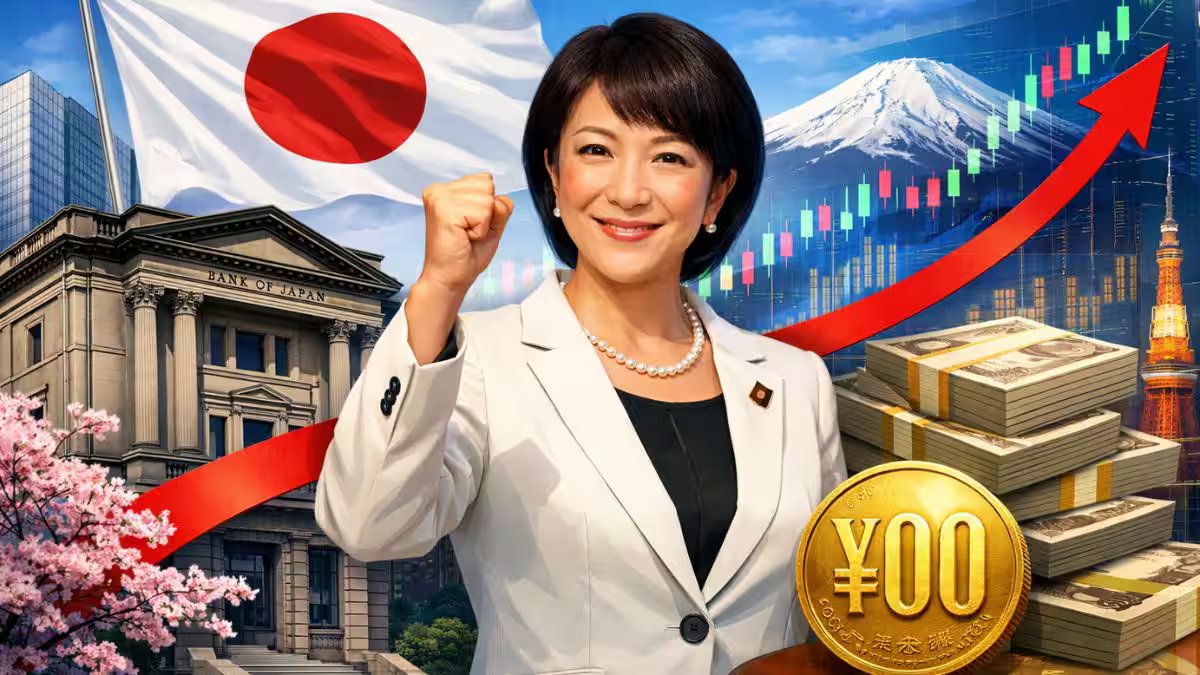
For nearly three decades, Japan has emerged as the poster child of economic stagnation—a $5 trillion economy grappling with near-zero inflation, low growth, and extraordinary monetary experimentation. It became the first advanced economy to institutionalise ultra-low and eventually negative interest rates as a macroeconomic response to the collapse of the asset bubble in the early 1990s.
As Japan wrestled with a rapidly ageing population, a shrinking workforce, ballooning public debt hovering around 227 per cent of GDP—the highest among developed economies—and a structurally weakening yen, the prolonged slowdown came to be known as the “Lost Decades.” It was a period marked by subdued domestic demand, entrenched deflationary psychology, and repeated but often hesitant policy interventions.
Yet, as the Japanese proverb goes, “Fall seven times, stand up eight.” After decades of stagnation, Japan now appears to be standing at a potential historical inflection point—attempting its eighth rise.
The International Monetary Fund recently advised Japan to continue hiking interest rates and avoid slipping back into ultra-loose monetary settings. It also cautioned against trimming the consumption tax—one of the major policy pillars Prime Minister Sanae Takaichi has pledged to revisit under what analysts are calling “Sanaenomics.”
Takaichi returned to power with what observers describe as one of the strongest electoral mandates in the post-war era. A firm believer in fiscal expansion as the pathway to revive domestic demand, she has proposed a two-year suspension of the 8 per cent consumption tax on food. According to CME Group, the measure would forgo roughly ¥5 trillion annually—about 0.8 per cent of GDP—in revenue.
However, the IMF sees any suspension of the consumption tax as an erosion of fiscal space, especially at a time when Japan’s debt sustainability remains under scrutiny.
Takaichi is not stopping there. She is advocating a bold expansionary package amounting to ¥21.3 trillion—roughly 3.7 per cent of GDP—targeted at national defence, artificial intelligence, semiconductors, quantum technology, shipbuilding, nuclear fusion, and cost-of-living relief. The thrust is strategic: strengthen technological sovereignty, secure supply chains, and stimulate domestic investment.
Economy-watchers have begun referring to her doctrine as “Sanaenomics”—a potential successor to the reform-driven but monetary-heavy “Abenomics” era. Unlike Abenomics, which relied heavily on monetary easing and structural reform rhetoric, Sanaenomics appears more fiscally assertive and strategically industrial in character.
Inflation & Rate Hikes
For decades, Japan struggled with deflation or near-zero inflation. It was only in 2022 that inflation sustainably crossed the 2 per cent target, prompting a gradual policy shift. Under the stewardship of Kazuo Ueda in April 2023, the central bank embarked on a new journey of gradually ending the negative interest rate regime and moving away from yield curve control, marking a drastic shift from the basic tenets of Abenomics.
However, the latest inflation data has complicated the policy trajectory. Japan’s annual core inflation—excluding volatile food and fuel—eased to around the 2 per cent mark in January, its lowest in two years. Headline inflation also slid from 2.1 per cent in December to 1.5 per cent in January, falling below the BOJ’s 2 per cent target for the first time in nearly four years.
This moderation in inflation poses a formidable challenge for the BOJ because if it chooses to tighten aggressively, that might strangle the recovery.
If it pauses prematurely, inflation expectations could slip again. The challenge is compounded by modest wage growth, which policymakers see as essential for achieving durable demand-driven inflation.
The Yen Story
The yen’s trajectory since 2012 has largely been downward, depreciating by over 50 per cent against the US dollar over the past decade-plus. Among major currencies, it has been one of the weakest performers, largely due to persistent yield differentials and Japan’s ultra-loose monetary stance.
The yen briefly strengthened following Takaichi’s electoral victory, but the move proved temporary. Takaichi’s aggressive fiscal expansion may impact the currency dynamics negatively. While strong growth prospects may attract capital, on the flip side, widening budget deficits push the government to borrow more, leading to heightened pressure on the yen.
Markets typically favour currencies backed by either shrinking fiscal deficits or accelerating growth. Under Takaichi’s expansionary blueprint, larger deficits could increase government bond supply and push yields higher. Alternatively, if spending successfully boosts growth, yields could rise for that reason as well. In both cases, higher yields translate into higher borrowing costs for a government already managing one of the world’s largest debt burdens.
Another consequential dynamic adding a twist to this is the narrowing yield gap between the US and Japan. As the US began monetary easing and Japan embarked on tightening, the interest rate differential has narrowed. However, in theory, this decline in the differential should ease pressure on the yen, making Japan a more attractive economy for traders and investors.
Yet the relationship has not functioned perfectly. Despite narrowing yield spreads, the yen has struggled to stage a sustained recovery. Structural factors—particularly Japan’s towering debt load, demographic drag, and reliance on energy imports—continue to weigh on currency sentiment.
According to IMF estimates, Japan’s debt-to-GDP ratio stands near 227 per cent, compared to roughly 129 per cent for the United States.
The Road Ahead
Japan currently faces a crossroads.
On one side, there is a possibility of faster growth through fiscal policies, technological advancement, and wage increases, which could lead to a stronger yen and renewed confidence in the Japanese economy’s future.
On the other side, there could be bigger structural deficits without corresponding productivity increases, which would lead to higher costs of servicing debt and, in turn, a weaker yen.
The success of Sanaenomics will ultimately depend on whether fiscal activism leads to sustained productivity growth or merely a temporary boost.
If Takaichi succeeds in turning strategic spending into long-term competitiveness in areas such as AI, semiconductors, and defence production, then Japan’s eighth economic rise might be more successful than its previous attempts.
End of Article