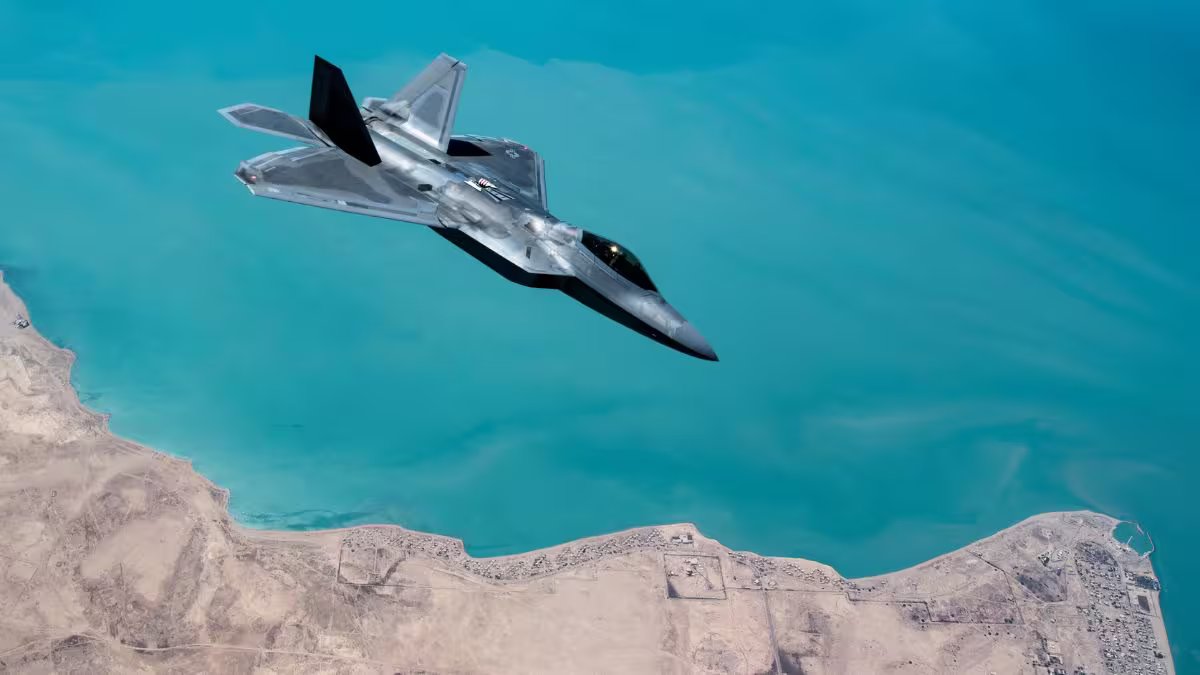
The United States has begun repositioning a large package of combat aircraft, naval strike forces, air-defence systems and command-and-control platforms across West Asia and the eastern Mediterranean, marking the most substantial concentration of American airpower in the region since the 2003 invasion of Iraq.
The movement of assets comes against the backdrop of escalating tensions with Iran, stalled nuclear diplomacy, and renewed warnings from US President Donald Trump that military force remains an option if negotiations fail.
Over the past several days, flight-tracking data and official confirmations have shown advanced US fighter jets, surveillance aircraft and coordination platforms arriving at key regional air bases.
What air and naval assets has the US positioned across the region?
Dozens of additional fighter aircraft and support platforms have been dispatched to Muwaffaq Salti Air Base in Jordan and Prince Sultan Air Base in Saudi Arabia, a report by the Wall Street Journal (WSJ) said.
The deployments include more F-35 and F-22 stealth fighters, alongside F-15 and F-16 jets that provide strike, air superiority and support roles.
These aircraft are supported by E-3 Airborne Warning and Control System platforms, which provide airborne surveillance and battle management, and E-11 Battlefield Airborne Communications Node aircraft, which enable real-time coordination between air, ground and naval forces. Additional squadrons of fighter aircraft are reported to be en route.
Beyond combat jets, command-and-control aircraft essential for managing complex, multi-day air operations are also being moved into the theatre. These platforms allow US commanders to direct air campaigns across wide geographic areas, integrate intelligence feeds, and coordinate strikes with naval and allied assets.
The Pentagon has also deployed extra land-based air-defence systems to protect US bases and allied infrastructure from missile or drone attacks.
At sea, the US Navy currently maintains 13 vessels across West Asia and the eastern Mediterranean. This includes the aircraft carrier USS Abraham Lincoln, supported by nine destroyers equipped to intercept ballistic missiles.
A second carrier strike group centred on the USS Gerald R Ford
is in transit toward the region with four guided-missile destroyers. Tracking data has shown the Ford moving near the Atlantic coast off Morocco, placing it on a potential route through the Strait of Gibraltar toward the eastern Mediterranean.
Analysts estimate it would take more than a week for the carrier to reach waters closer to Iran.
The scale of these deployments gives Washington the ability to mount sustained air operations over several weeks.
US officials have said the current posture would allow the military to go beyond the limited June 2025 operation that targeted three Iranian nuclear sites, which was described as a one-off strike rather than a prolonged campaign.
The buildup has also been supplemented by long-range strike capabilities that do not require permanent basing in West Asia. US B-2 stealth bombers are trained to conduct missions to the region directly from the continental United States or
from the joint US-UK base on Diego Garcia in the Indian Ocean.
Trump has publicly indicated that “it may be necessary for the US to use Diego Garcia,” and has also said that the Fairford air base in the United Kingdom could be used to support operations.
Other long-range US bombers have similar reach, allowing Washington to project power without concentrating all assets in forward locations.
Despite the scale of the current movement, US officials note that not all weapons required for potential strikes are physically present in the region, nor do they need to be.
Long-range platforms and standoff precision munitions allow the US military to strike targets from outside contested airspace, reducing reliance on large forward deployments.
How does this compare with past US wars in the region?
While the concentration of US assets
is the largest seen in West Asia since 2003, it remains significantly smaller than the force packages assembled for earlier conflicts, reported WSJ_._
During Operation Desert Storm in 1991, the United States deployed six aircraft carriers across the Persian Gulf and the Red Sea, and fielded approximately 1,300 aircraft from the Air Force, Navy and Marine Corps.
For the 2003 invasion of Iraq, the US Air Force alone positioned 863 aircraft in the region to support the initial air campaign and subsequent operations.
In contrast, the current posture involves the deployment of squadrons rather than entire wings of combat aircraft. The US Air Force is also smaller today than it was in the early 1990s and early 2000s, limiting the scale of forces that can be sustained overseas.
Unlike previous wars, there are no large US or allied ground forces positioned to follow up an air campaign, and there is no broad international coalition preparing for a coordinated military operation.
Officials have indicated that any campaign would rely primarily on air and naval power, potentially supported by limited allied participation.
Regional political constraints further differentiate the current situation from earlier conflicts. Saudi Arabia and the United Arab Emirates have restricted their airspace for potential US strikes, limiting the routes available for American aircraft.
As a result, many US warplanes are now concentrated in Jordan, increasing the strategic importance of bases there.
Technological change, however, offsets some of the reduction in scale. Advances in stealth design, precision-guided munitions, electronic warfare and space-based surveillance allow smaller numbers of aircraft to achieve effects that once required much larger formations.
Modern command-and-control platforms enable tighter coordination across air, sea and space domains, increasing the effectiveness of sustained air campaigns even with fewer assets deployed forward.
The ability to surge additional forces rapidly, including long-range bombers from outside the region, gives Washington the option to escalate or de-escalate without committing to the kind of massive build-up seen in previous wars.
What is happening backstage in the US?
The military buildup is unfolding as
talks between US and Iranian representatives in Geneva explore the limits on Tehran’s uranium enrichment activities. White House press secretary Karoline Leavitt said there had been “a little bit of progress” in those talks, but added, “We’re still very far apart on some issues.”
Iranian officials are expected to submit a more detailed written proposal in the coming weeks addressing US concerns raised during the discussions.
Trump has publicly set a narrow timeframe for diplomacy,
stating that 10 to 15 days should be sufficient for Iran to demonstrate whether it is prepared to reach a deal. At the same time, he has reiterated that failure to reach an agreement would have consequences.
“I don’t think they want the consequences of not making a deal,” he told reporters earlier in the week. He later added, “It’s proven to be, over the years, not easy to make a meaningful deal with Iran, and we have to make a meaningful deal. Otherwise, bad things happen.”
According to US officials, Trump has received multiple briefings outlining potential military courses of action should he decide to authorise strikes.
These options range from operations focused on nuclear and ballistic-missile infrastructure to broader campaigns aimed at Iran’s political and military leadership and its network of regional proxy forces.
All scenarios presented to the president involve sustained operations lasting several weeks rather than short, symbolic strikes.
US officials acknowledge, however, that Tehran is unlikely to accept restrictions on its missile programme, given its limited air force and reliance on missiles as a central element of deterrence. Trump has indicated that his primary concern is halting uranium enrichment.
Inside the administration, senior national security officials have convened in the White House Situation Room to review developments and assess readiness. Officials have said that the full complement of forces required for potential military action could be in position by mid-March.
At the same time, there is uncertainty within the administration about what would follow any bombing campaign. US Secretary of State Marco Rubio has told lawmakers that Washington lacks clarity on who would assume power in Tehran if Iran’s supreme leader were removed, with analysts suggesting the Islamic Revolutionary Guard Corps could emerge as a dominant force.
Some former military officers have argued that a negotiated outcome would be preferable to war, given the uncertainties surrounding escalation and post-strike dynamics. US and foreign officials, however, have expressed growing pessimism that Tehran will accept Washington’s demands in full.
Instead, they believe Iran may seek to suspend enrichment temporarily, potentially waiting out Trump’s term in office, reported WSJ.
Foreign officials familiar with Tehran’s calculations have said Iranian leaders view negotiations as a means to delay potential US action while preparing for the possibility that Trump could lose patience with prolonged talks and order strikes.
Trump has previously set red lines linked to the killing of peaceful protesters and mass executions in Iran, but has so far refrained from authorising strikes, choosing instead to re-engage diplomatically after last year’s conflict.
Regional officials have privately told Iranian counterparts that Trump’s public rhetoric should be taken seriously, urging Tehran to draw lessons from how he has handled other international disputes.
Some of these officials have also advised Washington to prioritise nuclear issues in the near term and defer demands on missiles and proxy groups to avoid derailing talks. At the same time, they have warned that even a limited US strike intended to pressure Tehran could prompt Iran’s leadership to withdraw from negotiations altogether.
How is Iran responding at home and across the region?
In a letter to the United Nations Security Council, Iran’s ambassador Amir Saeid Iravani stated that Tehran does not seek “tension or war and will not initiate a war,” but warned that any US attack would draw a direct response.
He added that “any US aggression will be responded to ‘decisively and proportionately,’” and wrote, “In such circumstances, all bases, facilities, and assets of the hostile force in the region would constitute legitimate targets in the context of Iran’s defensive response.”
Iran has also conducted military drills that highlight its ability to threaten key regional chokepoints. Earlier this week, Iranian forces
carried out live-fire exercises in the Strait of Hormuz, the narrow maritime corridor through which roughly one-fifth of the world’s traded oil passes.
Iran also held its annual
joint naval exercises with Russia in the Gulf of Oman and the Indian Ocean. Iranian state media reported that the drills were aimed at improving operational coordination and exchanging military experience.
Footage released during the exercises showed members of the Revolutionary Guard’s naval special forces boarding a vessel, units that have previously been involved in the seizure of ships in international waterways.
Domestically, Iran continues to face internal strain following mass protests earlier in the year that were violently suppressed by security forces.
Mourning ceremonies marking 40 days since the deaths of protesters have reportedly included renewed anti-government chants, despite warnings from authorities.
Iranian officials have stated that the current round of talks with the United States should focus solely on nuclear issues. Tehran has claimed that it has not been enriching uranium since last summer’s US and Israeli strikes, although international inspectors have been barred from verifying the extent of the damage to nuclear facilities.
Iran
has long maintained that its nuclear programme is peaceful, while the United States and other governments believe it is aimed at eventually developing weapons. Israel, which is widely believed to possess nuclear weapons, neither confirms nor denies that capability.
Israel, for its part, has been preparing for potential Iranian retaliation against any US action. Prime Minister Benjamin Netanyahu said, “We are prepared for any scenario,” and warned that if Iran attacks Israel, “they will experience a response they cannot even imagine.”
Netanyahu has consistently urged tougher US action against Iran, arguing that any agreement should go beyond nuclear limits to include restrictions on missile development and ties to armed groups such as Hamas and Hezbollah.
Poland’s prime minister has urged Polish citizens to leave Iran immediately, warning that evacuation could become impossible within hours or days.
Germany has relocated a mid-two-digit number of non-mission-critical personnel from a base in northern Iraq while maintaining a reduced presence to support training operations in Irbil.
With inputs from agencies
End of Article