US President Donald Trump is publicly cautioning the United Kingdom against proceeding with a sovereignty transfer of the Chagos Islands to Mauritius while retaining the strategic military base under a long-term lease.
The controversy is rooted in a 2025 agreement under which Britain will formally hand over sovereignty of the Chagos archipelago to Mauritius.
Under the same treaty, the UK will retain operational control of Diego Garcia through an initial 99-year lease, with the option to extend.
The base, which hosts joint UK-US military facilities, has for decades functioned as a critical hub for operations spanning West Asia, East Africa, and the Indo-Pacific.
Trump’s criticism was delivered through a Truth Social post in which
he urged Britain not to proceed with what he described as an unwise concession. His message, written in capital letters, stated: “DO NOT GIVE AWAY DIEGO GARCIA!”
He also linked the base’s future to potential military contingencies involving Iran, writing that it could be required to “eradicate a potential attack” from Tehran.
In the same post, Trump criticised the principle of leasing sovereign territory, adding, “I have been telling Prime Minister Keir Starmer, of the United Kingdom, that Leases are no good when it comes to Countries, and that he is making a big mistake by entering a 100 Year Lease with whoever it is that is ‘claiming’ Right, Title, and Interest to Diego Garcia.”
The remarks represented the latest turn in what has become a fluctuating American position on the agreement. While Washington had previously indicated support for the UK-Mauritius deal following internal reviews, Trump has repeatedly voiced personal scepticism.
In January, he characterised the arrangement as an act of “great stupidity.”
Earlier this month, he said he understood the political constraints facing British Prime Minister Keir Starmer, but added that he
would retain the option to “militarily secure” the base if circumstances required.
A spokesperson for the UK Foreign Office responded that the deal was “crucial to the security of the UK and our key allies.” The spokesperson added, “The agreement we have reached is the only way to guarantee the long-term future of this vital military base.”
Despite Trump’s public criticism, the United States Department of State reaffirmed Washington’s formal backing for the agreement this week, stating, “The United States supports the decision of the United Kingdom to proceed with its agreement with Mauritius concerning the Chagos archipelago.”
The department also announced that talks between the United States and Mauritius would take place next week, signalling continued diplomatic engagement on the issue.
What is the Chagos Islands dispute and how was it resolved?
The Chagos Islands form an archipelago in the Indian Ocean that became part of the British Empire alongside Mauritius in 1814 following the Treaty of Paris after the defeat of Napoleon.
In 1965, three years before Mauritius gained independence, Britain separated the Chagos archipelago from Mauritian territory and designated it as the British Indian Ocean Territory (BIOT).
At the time, London undertook that the islands would be returned to Mauritius once they were no longer required for defence purposes.
A joint UK-US military base was subsequently established on Diego Garcia, the largest island in the group.
To make way for the facility, the indigenous Chagossian population was forcibly removed during the 1960s and 1970s and resettled mainly in Mauritius and the Seychelles, with some later relocating to the United Kingdom in the early 2000s.
Since the 1980s, Mauritius has consistently challenged British control of the archipelago, pursuing its claims through international courts and tribunals.
In 2019, the International Court of Justice issued a non-binding advisory opinion stating that the decolonisation of Mauritius had not been lawfully completed when independence was granted in 1968. The court concluded that the UK was under an obligation to bring its administration of the archipelago to an end as rapidly as possible.
Following that ruling, Britain faced mounting legal and diplomatic pressure. Under the government led by former prime minister Rishi Sunak, the UK announced in 2022 that it would begin negotiations with Mauritius over sovereignty arrangements for the Chagos Islands.
Officials argued that Britain’s defence interests were best protected by achieving legal clarity, given the growing risk of further adverse rulings in international forums.
Negotiations between London and Port Louis continued through 11 formal rounds before Britain’s general election in July 2024.
After the Labour Party won that election, the two governments released a joint statement in October 2024 announcing that a political agreement had been reached. The treaty was formally approved and signed in May 2025 by Starmer and Mauritian Prime Minister Navin Ramgoolam.
Starmer later said that Britain faced poor prospects in legal proceedings if Mauritius pursued further action and that provisional legal measures could have been imposed within weeks.
UK officials also argued that without a formal agreement, Britain would lack the legal standing to prevent other countries from establishing facilities on the outer islands or conducting military exercises in proximity to Diego Garcia.
What is included in the agreement?
Under the 2025 agreement, Mauritius assumes sovereignty over the Chagos archipelago, while Britain retains control of Diego Garcia under an initial 99-year lease with an option to extend.
The UK will pay for this lease arrangement.
According to estimates provided by Whitehall, the average annual cost during the first 99 years is projected at £101 million in 2025-26 prices.
Using net present value calculations, the total projected cost of the financing package is estimated at £3.4 billion, though critics
have argued that the eventual figure could be higher.
Conservative Party leader Kemi Badenoch described the deal as a “surrender,” arguing that Britain was transferring territory and committing to large payments to Mauritius, which she claimed maintained close ties with China and Russia.
The party’s shadow defence secretary, James Cartlidge, said the Conservatives had not finalised such an agreement while in office because they opposed the idea of what he described as paying to lease back territory that Britain already controlled.
In Washington, the US government issued a statement following a comprehensive interagency review, concluding that the agreement “secures the long-term, stable, and effective operation of the joint US-UK military facility at Diego Garcia.”
During a meeting with Starmer in the Oval Office in February 2025, Trump said he was “inclined” to go along with the agreement and that he had “a feeling that it’s going to work out very well.”
The
shift in Trump’s tone has been linked to a deterioration in personal relations between the two leaders. Hours before Trump’s latest Truth Social post, Starmer had criticised Trump’s threats to impose tariffs on European countries that opposed his claim over Greenland, which is part of the Kingdom of Denmark.
Starmer told reporters that “threatening tariffs on allies is the wrong thing to do, completely wrong.” He later followed up with a phone call to Trump, which appeared not to have eased tensions.
Why does Diego Garcia matter?
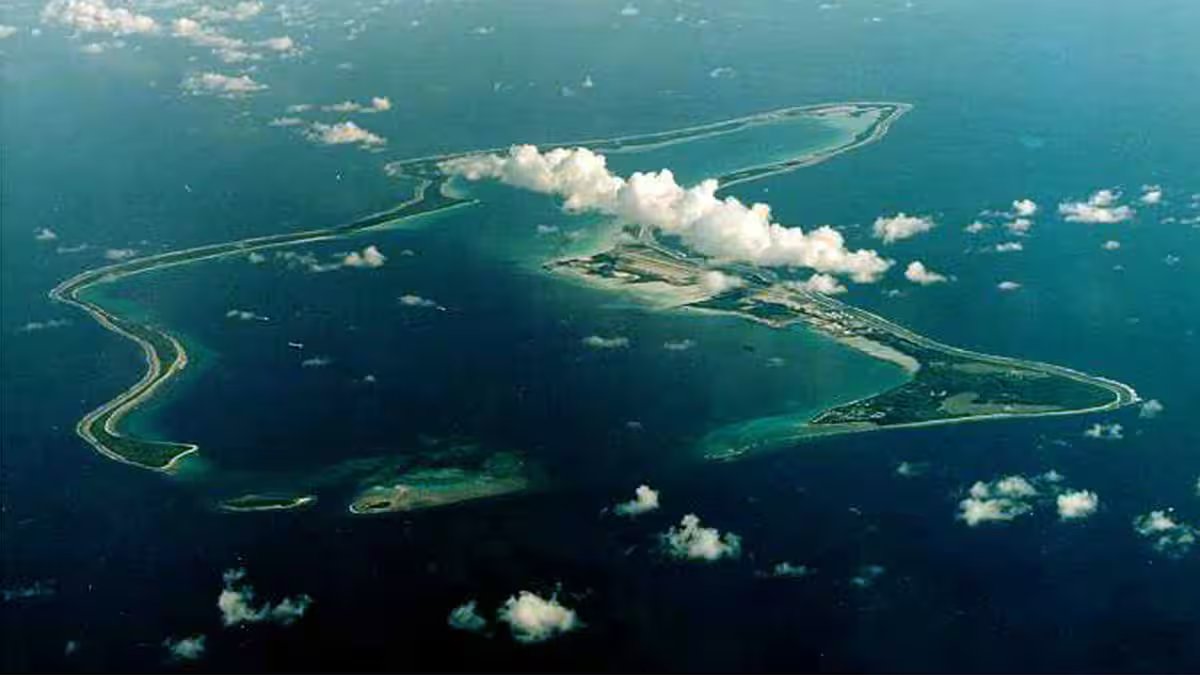
Diego Garcia is the largest island in the Chagos archipelago and the only permanently inhabited island within the BIOT. Its population of around 4,000 consists primarily of military personnel and contractors.
The island has hosted a joint UK-US military base since the 1970s and is one of two critical US bomber bases in the Indo-Pacific region, alongside Andersen Air Force Base in Guam.
Situated just south of the equator in the central Indian Ocean, Diego Garcia occupies a location that places it within operational reach of multiple strategic theatres.
It lies thousands of kilometres from the nearest major landmasses, including East Africa, South Asia, Southeast Asia, and Australia. The island forms part of the Chagos-Laccadive Ridge, an underwater mountain chain that also includes the Lakshadweep Islands and the Maldives.
It has reportedly been nicknamed the “Footprint of Freedom” by the US Navy.
The base’s geographic positioning allows it to function as a central logistics and power-projection hub. Its long runway can support heavy aircraft, including long-range bombers, enabling missions that extend deep into West Asia and across the Indo-Pacific without reliance on regional basing permissions.
The island’s lagoon serves as a deep-water port capable of hosting pre-positioned maritime supply vessels that can sustain large military formations for extended periods.
Beyond conventional military operations, Diego Garcia also plays a role in global surveillance and navigation infrastructure.
It hosts facilities linked to satellite tracking and space surveillance systems, as well as ground-based components of global positioning networks. These capabilities have made the base an integral node in US and UK military planning.
The island’s remoteness contributes to its strategic utility. There are no commercial flights, and maritime access is tightly regulated.
A BBC report published in September 2024 said that entry permits are issued only to individuals with official connections to the military facility or the British administration that oversees the territory, while journalists have historically been barred from visiting the base.
As of February 2026, Diego Garcia’s importance has grown amid escalating tensions in both West Asia and the Indo-Pacific. Additional air and naval assets have reportedly been moved to the base in response to regional security concerns.
What about the Chagossians?
The contemporary reality of Diego Garcia is inseparable from the unresolved legacy of the Chagossian people, who were displaced to enable the construction of the military base.
Up to 2,000 residents were removed from the archipelago during the 1960s and 1970s and resettled mainly in Mauritius and Britain.
Tensions resurfaced this week when British authorities issued removal orders against four Chagossians who landed on Ile du Coin, part of the Peros Banhos atoll, with the intention of establishing a permanent settlement.
A spokesperson at the UK Foreign Office described their arrival as an “illegal, unsafe stunt” that would not assist joint efforts between Britain and Mauritius to restart heritage visits to the archipelago.
Reform UK leader Nigel Farage said the four individuals were British passport holders seeking to “reclaim their birthright” and said he was exploring legal options to support them.
At a press conference in London, he stated, “They were this morning served an eviction notice on behalf of the British government, and told that unless they comply, they could face up to three years in prison.”
The removal orders, issued by an immigration official of the British Indian Ocean Territory, stated that the individuals were unlawfully present in the territory and would be removed.
The notices warned that returning after removal would constitute a criminal offence punishable by up to three years’ imprisonment, a fine of 3,000 pounds sterling, or both.
The 2025 agreement has been criticised by some members of the Chagossian community, who accuse Mauritius of decades of neglect. Mauritian authorities have denied these allegations.
The differing perspectives within the Chagossian diaspora reflect broader disagreements over whether the sovereignty transfer will ultimately improve prospects for resettlement, recognition, and restitution.
With inputs from agencies
End of Article