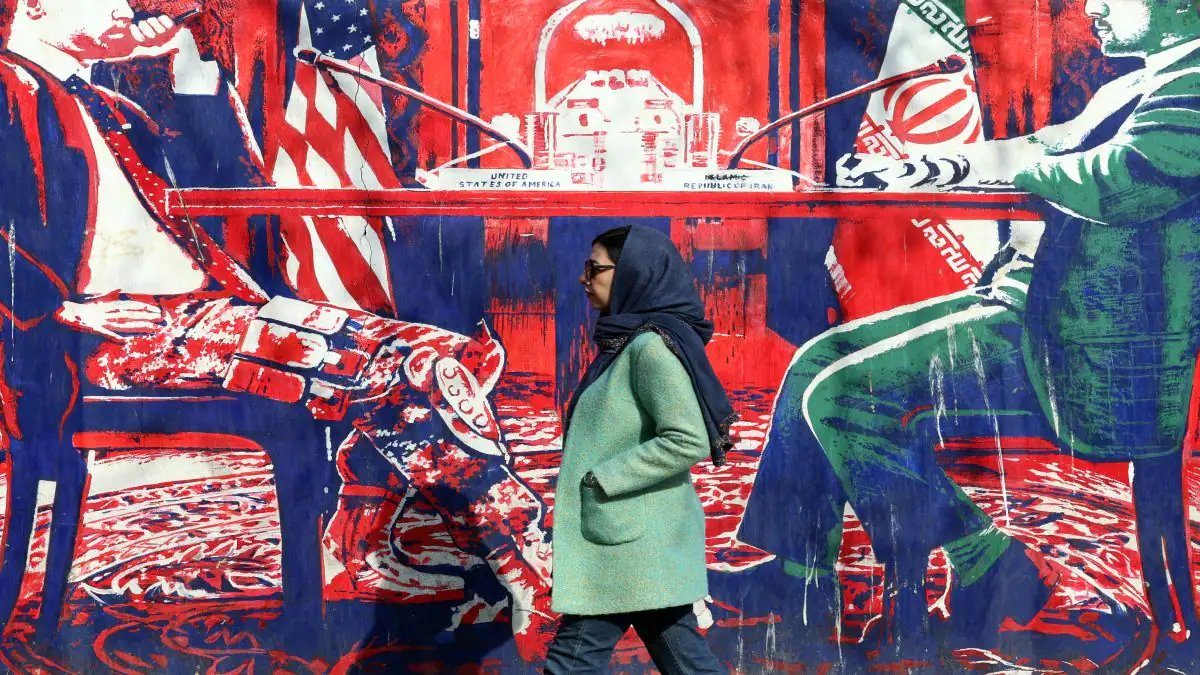
Two days ago, Iran and the United States held talks in Geneva, following which Tehran noted that it had reached “guiding principles” for a deal to avoid conflict. However, the war clouds are becoming darker and looming larger with reports emerging that the US military is prepared to strike the Islamic Republic as early as this weekend, though President Donald Trump has yet to make a final decision.
And the White House is fuelling fears of a war; Trump, on Wednesday (February 18), suggested the US might strike Iran in a post on his Truth Social site. Additionally, his White House Press Secretary Karoline Leavitt told reporters, “Iran would be very wise to make a deal with President Trump and with his administration.”
So, what’s going on? Will the US attack Iran over the weekend? We try to analyse the situation as it unfolds.
US to strike Iran as early as this weekend?
Multiple reports state that the US military is prepared for a strike on Iran as early as this weekend. CBS News reported that top national security officials told US President Trump that the military is ready for potential strikes on Iran as soon as Saturday (February 21), but the timeline for any action is likely to extend beyond this weekend.
CNN also reported the same, citing sources that said that the White House has been briefed that the military could be ready for an attack by the weekend. CNN reported that Top administration national security officials met on Wednesday in the White House Situation Room to discuss the situation in Iran. Trump was also briefed on Wednesday by special envoy Steve Witkoff and Jared Kushner, Trump’s son-in-law, about their indirect talks with Iran that occurred a day before.
“He (Trump) is spending a lot of time thinking about this,” said the source to CNN.
A report by Axios also quoted a Trump advisor as saying that there is a 90 per cent chance of a military action being launched in the next few weeks. “The boss is getting fed up. Some people around him warn him against going to war with Iran, but I think there is 90 per cent chance we see kinetic action in the next few weeks,” the advisor told Axios.
The media outlet added that, unlike the pinpoint operation in Venezuela, which saw the
capture of Nicolas Maduro, the operation in Iran — likely to be a joint one between the US and Israel — will be weeks long and much broader in scope than the Israeli-led
12-day war last June, which the US eventually joined to take out Iran’s underground nuclear facilities.
But is the US military prepared to strike Iran?
The reports of a possibility of the US attacking Iran this weekend come even as America continues its military build-up near Iran.
Following the redeployment of its aircraft carrier, the
USS Abraham Lincoln, to the Arabian Sea at the end of January, the US has been constantly amassing
heavy military forces near the Islamic Republic.
In the first week of February, the BBC reported that a dozen F-15 fighter jets, an MQ-9 Reaper combat drone, and several A-10C Thunderbolt II ground attack aircraft reached the Muwaffaq Salti Air Base in Jordan. Satellite imagery also showed the guided-missile destroyer ship, USS Delbert D Black, sailing through the Suez Canal in Egypt from the Mediterranean to the Red Sea, and a US Navy MQ-4C Triton surveillance drone operating over the Gulf. The presence of an E-11A communications aircraft, a P-8 Poseidon, and an E-3G Sentry surveillance and some reconnaissance planes was also reported in the region earlier. The US has also sent a second aircraft carrier to the region.
The US military has also moved air defences — including the Patriot missile defence and Terminal High Altitude Area Defense (THAAD) systems — into the region. Both systems can intercept Iranian ballistic missiles.
The Wall Street Journal, reporting on the military assets being moved, even stated that this is the greatest amount of air power in the region since the 2003 invasion of Iraq.
Preparations are also underway in Israel for the possibility of joining strikes with the United States, the New York Times reported, citing two defence officials.
What about Iran?
For its part, Iran is also fortifying many of its nuclear facilities. New satellite imagery and analysis from the Institute for Science and International Security (ISIS) reveal that
Tehran is using concrete and large amounts of soil to bury key sites.
Stalling the negotiations has its benefits:
Over the last two to three weeks, Iran has been busy burying the new Taleghan 2 facility at the Parchin military complex with soil. Once the concrete sarcophagus around the facility was hardened, Iran did not hesitate to move soil over… pic.twitter.com/AowjWFFd92— David Albright (@DAVIDHALBRIGHT1) February 17, 2026
At the Taleghan 2 facility inside the Parchin military complex, satellite imagery from February 13 shows a completed concrete shell around the main structure. Soil is now being piled over it. “The facility may soon become a fully unrecognisable bunker, providing significant protection from aerial strikes,” warned ISIS president David Albright.
Other satellite images from February 10 show efforts to harden tunnel entrances under Kolang-Gaz La Mountain, roughly two kilometres from the Natanz nuclear facility. Concrete is being poured over an extended western tunnel entrance. At an eastern portal, rock and soil have been pushed back and leveled to allow additional overburden — extra layers of rock, soil, or concrete to absorb the force of potential airstrikes. At the Esfahan nuclear complex, imagery from February 8 shows apparent efforts to conceal tunnel entrances.
Besides this, Iran has also sought to display its own military might, with its Islamic Revolutionary Guard Corps carrying out a series of war games on Monday in the
Strait of Hormuz.
Meanwhile, Iranian President Masoud Pezeshkian has insisted that the country doesn’t want war but suggested that it couldn’t accede to all of the demands by the US. “From the day I took office, I have believed that war must be set aside. But if they are going to try to impose their will on us, humiliate us and demand that we bow our heads at any cost, should we accept that?” said Pezeshkian on Wednesday.
And a day prior, Iran’s supreme leader, Ayatollah Ali Khamenei, posted an AI-generated image of the USS Gerald Ford in a maritime grave on social media, alongside a caption that read: “More dangerous than that warship is the weapon that can send that warship to the bottom of the sea.”
‼️A (US) warship is dangerous, but more dangerous is the weapon (Iranian missile) that can send it to the bottom of the sea.
Name one world leader who speaks with such extraordinary courage and unshakable conviction as Ayatollah Khamenei.
— Syed Zafar Mehdi (@mehdizafar) February 17, 2026
What next?
It’s uncertain what comes next.
Following talks on Tuesday, Iran is expected to submit a written proposal on how to resolve its standoff with the United States. Tehran’s top diplomat, Abbas Araghchi, said Iran was “drafting” a framework for future talks with the US.
However, no date has been set for a third round of talks.
It remains to be seen if diplomacy holds or conflict erupts.
With inputs from agencies
End of Article