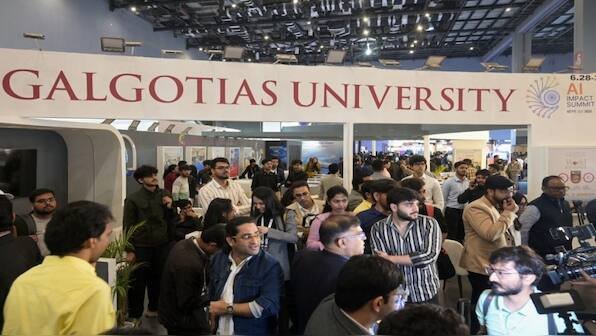
It was the cynosure of all until it wasn’t. We are talking about the Galgotias University robodog fiasco at the India AI Impact Summit in New Delhi, which resulted in organisers asking for the Noida-based institute to pack up and leave the expo area on Wednesday (February 18).
At the heart of the controversy is Professor Neha Singh from Galgotias University. She has come under fire from all corners, with even the institute blaming her for the entire fiasco. In fact, soon after the controversy erupted, Singh’s LinkedIn profile displayed the ‘open to work’ status.
But who is Neha Singh? How did she become the face of the robodog controversy? And what happens next?
Who is Neha Singh?
Neha Singh describes herself as the Head of Department – Communications at the School of Business, Galgotias University. On her LinkedIn profile page, she claims she has the ability to connect, inspire, and elevate others through her command of language.
“With a natural flair for language, articulation, and stage presence, I have spent years helping individuals unlock their voice and express themselves with clarity and impact. I believe the right words at the right time can truly change everything,” reads Singh’s bio on LinkedIn.
While she joined Galgotias University in 2023, Singh has previous work experience. Prior to this, she worked as an Assistant Professor at Sharda University in Greater Noida and also served as a Verbal Ability mentor at Career Launcher. She has also been associated with GITAM.
Singh holds an MBA from Devi Ahilya Vishwavidyalaya, completed in 2006, and a Bachelor of Commerce degree from the University of Allahabad.
How did Neha Singh emerge as face of robodog row?
The Galgotias University staff member became a famous face at Bharat Mandapam during the India AI Impact Summit 2026. In videos that have since gone viral, Singh introduces a four-legged robotic dog named “Orion.”
Dear Galgotias University,
Misleading 1: Your faculty Neha showcased the Robodog proudly as Orion (not the original product name)
Misleading 2: Continuously marketing of your university as if you built the product. You mentioned spending 350 Crore on AI etc. which in the… https://t.co/0INfJXMowE pic.twitter.com/SgjmbFsdwB
— Fundamental Investor ™ 🇮🇳 (@FI_InvestIndia) February 17, 2026
In the videos, Singh states, “This is Orion. This has been developed by the Centre of Excellence at the Galgotias University.” Soon, the robodog stole the spotlight — government social media handles, including that of the Ministry of Electronics and IT, shared video footage of the robot.
However, controversy soon erupted when, within hours,
social media users pointed out that the innovation was developed and commercially sold by a Chinese company,
Unitree, and not by Galgotias. In fact, the product was available in the market, priced at roughly $1,600.
On Wednesday, as criticism mounted,
Galgotias University was made to vacate its pavilion at the India AI Impact Expo.
#WATCH | Delhi | Galgotias University staff and officials vacate their stall at India AI Impact Summit expo, following row over display of Chinese-made robodog.
As per sources, the govt had asked Galgotias University to vacate the stall at the expo. pic.twitter.com/cqN5vBcgcN
— ANI (@ANI) February 18, 2026
S Krishnan, Secretary, Ministry of Electronics and Information Technology, said the government only wanted genuine work to be showcased at the summit. “We want genuine and actual work to be exhibited. We don’t want a controversial agency that has misled the public,” he said.
How did Neha Singh react to the row?
Following the fiasco, Neha Singh tried damage control. She told reporters that the controversy of the robotic dog may have emerged owing to her inability to express herself clearly. “The controversy happened because things may not have been expressed clearly. I take accountability that perhaps I did not communicate it properly, as it was done with a lot of energy and enthusiasm and very quickly, so I may not have come across as eloquently as I usually do,” she told reporters.
Singh added that her intent was never to claim that the university “manufactured” the robobog. “I have told everyone that we introduced it to our students to inspire them, to create something better on their own,” she said.
VIDEO | Delhi: Professor Neha Singh of Galgotias University responds to reports of the university being asked to vacate its stall at the AI Summit Expo, says, “The controversy happened because things may not have been expressed clearly. I take accountability that perhaps I did… pic.twitter.com/z5lOIzmDz1
— Press Trust of India (@PTI_News) February 18, 2026
“Also, the intent may not have been properly understood. One important thing is that the robodog clearly has its branding on top; we have not changed that. So, how can we claim that we manufactured it? I have told everyone that we introduced it to our students to inspire them to create something better on their own,” she added.
She further told Hindustan Times that even “if this had not been noticed by people, we would still have clarified. We cannot claim something that is not built by our students”.
And when asked where the robodog was, Singh noted that it had been moved back to the university labs for academic use. “It was procured to be in the labs for the students to do all the anatomy, all the research and development. It is there.”
How has Galgotias University reacted?
While Singh has taken accountability for her role in the fiasco, Galgotias University has pinned the blame on its staff. The institute said Singh was “ill-informed” and was not authorised to speak to the media.
“We at Galgotias University wish to apologise profusely for the confusion created at the recent Al Summit. One of our representatives, manning the pavilion, was ill-informed. She was not aware of the technical origins of the product and, in her enthusiasm for being on camera, gave factually incorrect information even though she was not authorised to speak to the press,” said Galgotias University in a statement.
It insisted there was no intent to misrepresent the innovation and that it remains committed to “academic integrity, transparency, and responsible representation” of its work.
With inputs from agencies
End of Article