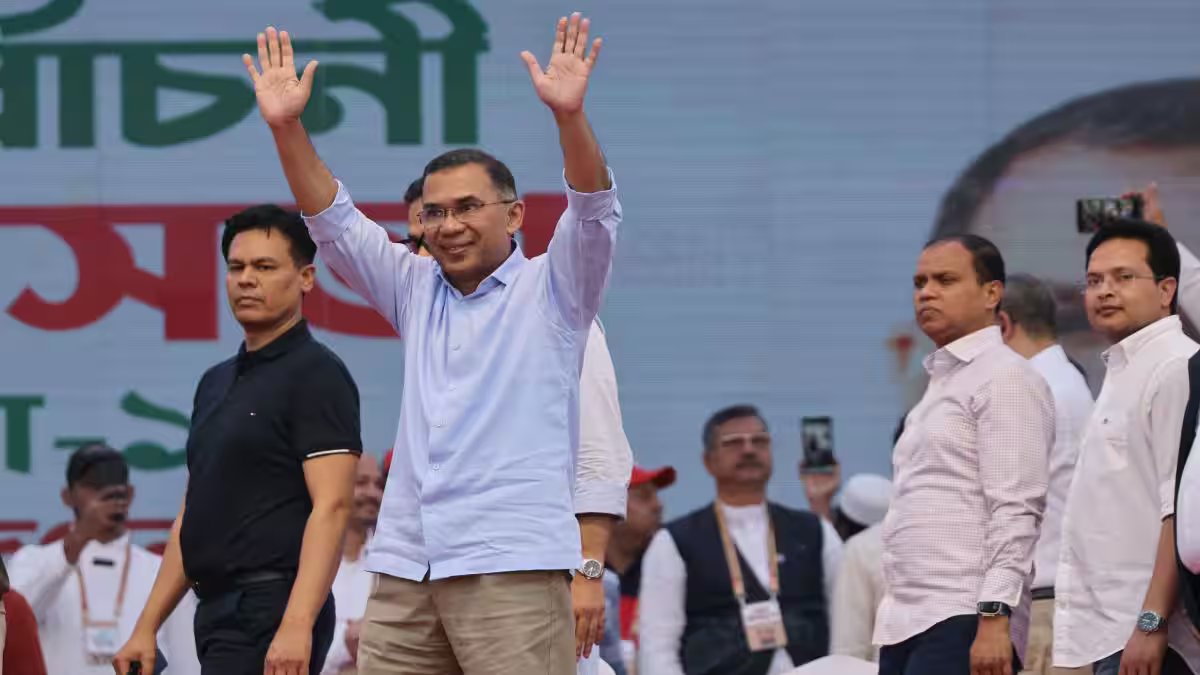
Bangladesh’s newly elected members of parliament took oath on Tuesday, marking a return of electoral democracy to the country after 18 months. Tarique Rahman is expected to be formally sworn-in as the prime minister later in the day.
Bangladesh’s newly elected members of parliament took oath on Tuesday, marking a return of electoral democracy to the country after 18 months.
Tarique Rahman, the presumptive Prime Minister of Bangladesh, was among 299 members elected to the parliament in the election held on February 12. Chief Election Commissioner AMM Nasir Uddin administered the oath to them.
As per the final tally, Rahman’s Bangladesh Nationalist Party (BNP)-led alliance won 211 out of 297 seats whereas Jamaat-e-Islami’s coalition won 77 seats.
The BNP is expected to choose Rahman, the son of late two-time Prime Minister Khaleda Zia, as the party leader later in the day and he is expected to be sworn in as the prime minister in the afternoon.
President Mohammad Shahabuddin would administer the oath to Rahman and the Cabinet. The composition of the Cabinet is not yet known.
BNP-Jamaat divide surfaces on day one
Even before the swearing-in of the government, differences among the newly elected MPs were on visible as Jamaat refused to take oath after BNP refused to take the pledge as the members of the ‘Constitutional Reform Council’ that is meant to implement the ‘July Charter’ — the constitution referendum package that voters approved with a 60 per cent vote in the election, according to the election commission.
Abdullah Mohammad Taher, the deputy chief of Jamaat, said a “parliament without the constitutional reform is meaningless”.
On its part, BNP MP Salahuddin Ahmed, who is also a member of the policy-making standing committee, said that they had not been elected as members of the Constitution Reform Council so there was no point of swearing an oath about such a council.
“None of us (BNP members) will take the second oath,” Ahmed said.
For the government’s swearing in, the BNP has invited around 1,200 domestic and foreign guests. Lok Sabha Speaker Om Birla will represent India at the swearing-in ceremony and are likely to be accompanied by Foreign Secretary Vikram Misri and Lok Sabha Secretary General Utpal Kumar Singh.
Maldives President Mohammed Muizzoo, Turkish Undersecretary Beris Ekinci, and Sri Lankan health and mass media minister Dr Nalinda Jayatissa would also attend the swearing-in.
Rahman has work cut out for him
In his speech after the result, Rahman said the victory belonged to everyone.
“This victory belongs to Bangladesh, belongs to democracy. This victory belongs to people who aspire to and have sacrificed for democracy,” said Rahman.
But Rahman also warned of the challenges ahead, including tackling the economic challenges that worsened under Yunus’ tenure.
“We are about to begin our journey in a situation marked by a fragile economy left behind by the authoritarian regime, weakened constitutional and statutory institutions, and a deteriorating law and order situation,” said Rahman.
Rahman will take over from an unelected interim government of Muhammad Yunus that had been widely criticised for failing to bring security and stability to the country. His first challenge would be to check the cyclic political violence in the country and targeted attacks on ethnic minorities.
Since anti-Sheikh Hasina groups anointed Yunus as Bangladesh’s interim leader after toppling the Awami League government in August 2024, Yunus has presided over the mainstreaming of extremist Islamist groups, cyclic political violence, and targeted violence against ethnic and religious minorities like Hindus, and continuing attacks on cultural and media institutions. With such pressing issues, Rahman has work cut out for him.
End of Article