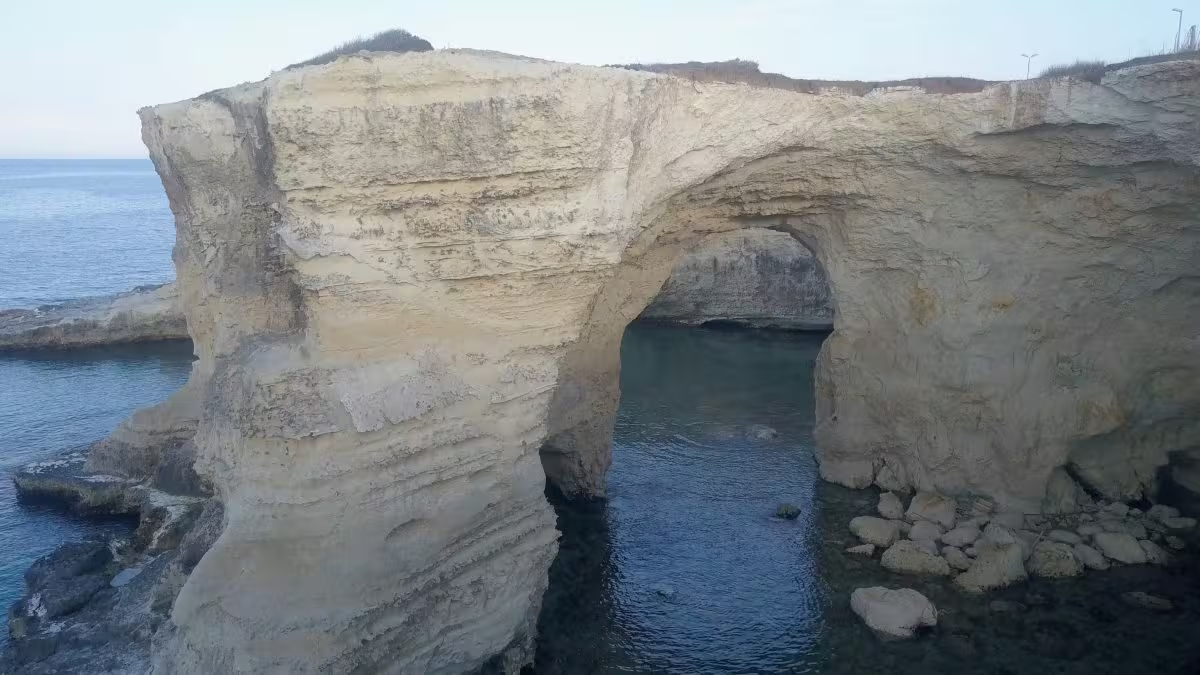
It is not only ironical that a tourist spot celebrated as a symbol of love collapsed on Valentine’s day, it also is an indication towards something grave. A famous rock structure on Italy’s Adriatic coast known as the “Lovers’ Arch” collapsed after days of bad weather.
While initial reactions have caught the fancy of social media users, the looming issue of climate change and it’s fatal effects cannot be ignored.
This incident has prompted local officials to warn that other stretches of the fragile coastline could be at risk.
The natural arch, part of the Sant’Andrea sea stacks near the town of Melendugno in the southern region of Puglia, had long been a popular backdrop for wedding proposals and tourist photos.
“This is an unwanted
Valentine’s Day gift,” Melendugno Mayor Maurizio Cisternino told the local Corriere Salentino newspaper, calling the collapse “a very hard blow” for the area’s image and for tourism.
Cisternino said days of heavy rain, strong winds and rough seas had battered the coastline and ultimately destroyed the arch. “Nature has taken back what it created,” he said.
Officials have warned that other parts of the rocky coastline could also collapse, with cracks visible along the cliff, underscoring the growing threat of coastal erosion.
Storms and heavy rain in recent days have also eaten away at long stretches of coastline on the Ionian Sea, from Ugento to the beaches of Gallipoli, damaging beach structures, causing small cliff falls and harming ports.
Weeks of terrible weather this year have also caused damage estimated at well over a billion euros in southern Italy, including a landslide that has forced more than 1,500 people to evacuate their homes in the Sicilian town of Niscemi.
Cultural Significance
The arch, officially known as Faraglioni di Sant’Andrea and affectionately dubbed the “arco degli innamorati,” was more than just a picturesque backdrop for postcards and selfies.
According to local legend, couples who shared a kiss beneath its stony curve were destined for eternal love. The site’s allure was irresistible: it became the go-to spot for marriage proposals, first kisses, and anniversary celebrations, cementing its place as one of Salento’s most iconic and photographed landmarks.
The site, once a strategic lookout used to warn of pirates, became a magnet for lovers during the late 18th century.
Climate change is to be blamed
In the days leading up to the collapse, southern Italy was battered by fierce winds, torrential rain, and surging seas, all brought on by the tail end of Storm Oriana. The region had already been feeling the aftershocks of Cyclone Harry, which struck in January 2026, leaving a trail of devastation in its wake.
These Mediterranean cyclones, known locally as medicanes, have become increasingly frequent and intense, fueled by rising sea temperatures—a symptom of the broader climate emergency facing the region and the world.
“With the Mediterranean experiencing among its hottest years on record in 2025, warmer seas are supercharging the atmosphere and fueling extreme events,” noted Christian Mulder, a professor of ecology and climate emergency at the University of Catania, in comments reported by
The Guardian.
Forbes writes, “…Yet with red weather alerts in place across Sicily, Sardinia and Calabria’s regions and no let up in the weather battering the winding coastlines of southern Italy, more erosion and devastation is expected to coastal infrastructure before any meaningful work can be done.
“We have lost one of our region’s defining characteristics, a symbolic asset,” Puglia’s regional president Antonio Decaro told reporters at the site on Monday.
“Unfortunately, natural processes are often accelerated by meteorological phenomena, such as the tail end of storm Oriana”, he said.
A larger issue
Global warming has battered many historical places around the world. In 2021, A famous rock formation off the Galapagos Islands known as Darwin’s Arch has collapsed. The Ecuadoran Ministry of Environment said it was due to “natural erosion”.
The Baja California Sur state government has increased its tourist tax. It is part of the government’s “Embrace It” program, introduced to help secure long-term funding for conservation and community development as international visitor numbers increase.
Palau is the only country which makes every tourist sign a pledge which is then attached to the passport. It is a unique approach to encourage sustainable tourism. It is the first nation on earth to change its immigration laws for the cause of environmental protection.
There are many such cases which point towards how overtourism, overconsumption and unsustainable ways of living have had a severe impact on tourist spots that are invaluable.
Impact on Tourism industry
The
tourism industry is one of the world’s largest. Key findings of the
Intergovernmental Panel on Climate Change in 2014 predicted that changing temperatures will make new regions more attractive to some tourists, and there will be some opportunities for new types of tourism. And options exist to adapt to the effects of climate change.
The report stated that these new opportunities are likely to be short-lived, and adaptation options limited. Furthermore, many adaptation responses are likely to be overwhelmed by climate change later this century, especially under high GHG
emission scenarios.
Some of these predictions are turning out to be true.
Experts find that the tourism sector will not be uniformly affected.
Urban tourism is less vulnerable than coastal tourism. Pilgrimage, family visits or
gambling will be less affected than beach tourism, angling, or nature watching.
The relative attraction of destinations to tourists will change as temperatures rise, while
climate change is already encouraging ‘last chance’ tourism to threatened environments.
With inputs from agencies
End of Article