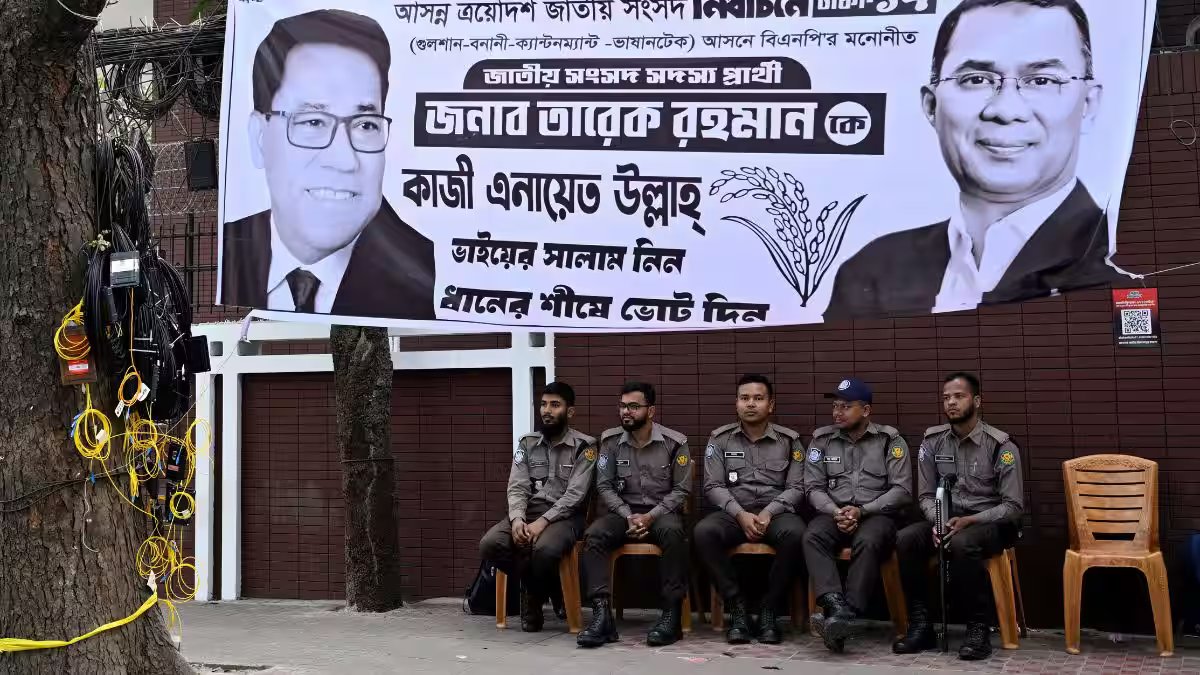
The Bangladesh Nationalist Party (BNP) has declared that it secured enough parliamentary seats to form the next government following the country’s first general election since the 2024 student-led uprising.
The vote, conducted on Thursday, February 12, is widely regarded as a defining moment in Bangladesh’s post-independence political history, not only because it marks the BNP’s return to power after nearly a decade and a half in opposition, but also because it follows the dramatic ouster of Sheikh Hasina’s Awami League government in August 2024.
Although the Election Commission has yet to issue the official consolidated results, multiple local media organisations have reported that the BNP has surpassed the 151-seat threshold required for a simple majority in the 300-member Jatiya Sangsad.
If final figures confirm this outcome, BNP will form a government on its own — without entering into a formal or informal alliance with Jamaat-e-Islami — something it has not done since the 1991 general election.
Why this Bangladesh election mattered for BNP
Many observers have viewed this election as a test of whether the energy of mass protest could be channelled into formal political change and whether electoral institutions could regain public confidence after years of allegations of manipulation and repression.
For much of the preceding 15 years, the BNP had remained outside the corridors of power, accusing the Awami League of orchestrating flawed elections and suppressing dissent.
The party had boycotted several previous polls, arguing that the playing field was neither free nor fair. The 2026 contest marked its full re-entry into competitive electoral politics in a transformed environment.
Ruhul Kabir Rizvi, the BNP’s senior joint secretary-general, issued a message congratulating citizens on what the party described as its electoral success.
At the same time, Tarique Rahman, the BNP’s chairman and prime ministerial nominee, appealed to supporters to refrain from victory parades and instead offer special prayers during the Friday congregational service.
Jamaat-e-Islami, which led an 11-party alliance in the contest, expressed reservations about delays in the announcement of official results. While the BNP appears to have secured a clear majority, the Islamist alliance is reported to have won at least 60 seats, according to local television channels.
How Tarique Rahman came to the forefront in Bangladesh
Central to the BNP’s return is
the political resurgence of its chairman, Tarique Rahman. Now 60, Rahman came back to Bangladesh in December after spending 17 years in London.
His exile began after a series of corruption and criminal cases were filed against him during Sheikh Hasina’s tenure. Rahman consistently maintained that the charges were politically motivated.
He had been jailed in 2007 during an anti-corruption drive led by a military-backed caretaker administration. In 2008, he was released to travel to London for medical treatment, reportedly after suffering severe mistreatment in detention.
During Hasina’s 15-year rule, he was convicted in multiple cases related to terror and corruption — verdicts he said were intended to block his return to politics. Following the collapse of the Awami League government in 2024, those convictions were overturned by the courts, enabling him to come home.
Reflecting on the prolonged legal battle, Rahman, in an interview with The Guardian, said, “It’s been more than 18 years and they’ve failed to prove anything. Don’t you think that’s good enough, long enough to prove that I did nothing wrong?”
He also addressed criticism regarding alleged corruption during the BNP government led by his mother, former prime minister Khaleda Zia, between 2001 and 2006. Rahman acknowledged past failings, stating, “I will not deny that. If we do, it will not help anything.”
Rahman’s political lineage is inseparable from Bangladesh’s post-independence history. His father, Ziaur Rahman, rose from the army to become the country’s sixth president before his assassination in 1981.
His mother, Khaleda Zia, served as prime minister. For decades, the BNP and the Awami League — led by Sheikh Hasina — represented two entrenched dynastic poles of power.
The 2026 election thus signals not only a change in administration but also the continuation of a long-standing political rivalry that has defined Bangladesh’s governance since 1971.
What BNP has promised to Bangladeshis
The BNP unveiled its manifesto on February 6, 2026, outlining 51 commitments grouped into nine overarching themes.
The document drew upon earlier party frameworks including the 19-point programme of 1978, Vision-2030 announced in 2015, the 31-point programme of 2022, and
the July Charter that emerged after the 2024 uprising.
A major campaign plank was employment generation. The party pledged to create 10 million jobs within 18 months. Rahman emphasised outreach to younger voters, stating in an interview with The Diplomat that the party was concentrating on “job creation, technical education, sports, the IT sector and job market, which I believe resonates strongly with Gen Z.”
He added, “If you look at today’s atmosphere, you’ll notice that most of the attendees in the meeting were Gen Z.”
The manifesto promised the introduction of a “family card” for four million households to provide financial support for monthly expenses, and a “farmer card” to offer subsidised services to agricultural workers. The party also pledged to waive agricultural loans up to 10,000 taka.
Healthcare and education formed key components of the agenda. Commitments included recruiting 100,000 healthcare workers — predominantly women — alongside broader pledges to bring the total number of healthcare recruits to one million.
It also proposed reinstating mid-day meal programmes in primary schools and implementing a “one teacher, one tab” initiative aimed at modernising classrooms.
Environmental and infrastructure goals featured prominently. The BNP pledged to plant 250 million trees and construct or rehabilitate 20,000 kilometres of canals. It also set a target of expanding power generation capacity to 35,000 megawatts by 2030.
On macroeconomic parameters, the party declared its intention to build a trillion-dollar economy by 2034, increase foreign direct investment to 2.5 per cent of GDP, and raise the tax-to-GDP ratio to 15 percent. It also committed to digitising the economy and expanding deregulation in commerce.
Institutional reforms were central to the party’s messaging. Among the proposed measures were a 10-year limit on the prime minister’s tenure, amendments to Article 70 of the Constitution — which currently restricts members of parliament from voting against their party — and the establishment of a “Truth and Heeling Commission.”
The manifesto also included anti-corruption initiatives, women’s empowerment policies, and honouraria for imams, muezzins, khatibs, pandits and other religious leaders.
The document also mentioned reinstating “faith and trust in Allah” in the Constitution, compiling lists of victims of the 1971 genocide and the July 2024 violence, and promoting religious harmony.
How BNP will manage Opposition
In August 2025, BNP general secretary Mirza Fakhrul Islam Alamgir confirmed the end of the party’s alliance with Jamaat-e-Islami. This election was therefore the first in decades in which the BNP ran independently rather than as part of a coalition with the Islamist party.
Analysts have suggested that this separation may reflect an attempt by the BNP to reposition itself within a more secular nationalist space previously occupied by the Awami League. The move potentially reshapes Bangladesh’s political configuration.
Nevertheless,
Jamaat-e-Islami and its allies mounted a strong showing.
The alliance, which includes groups advocating for the implementation of sharia law, is poised to become a significant parliamentary opposition. Shafiqur Rahman, the Jamaat leader, secured a seat in Dhaka and is expected to assume the role of Opposition leader.
Human rights organisations have raised concerns about a rise in moral policing incidents in recent months, including reports of girls being prevented from playing football and enforcement of dress codes.
Jamaat leaders have faced criticism over views regarding women’s roles in the home and workplace.
The BNP itself faces questions about internal discipline. Transparency International Bangladesh released a report alleging that BNP leaders and activists were responsible for 91 per cent of political violence following the Awami League’s fall on August 5, 2024.
Speaking to AP, Michael Kugelman, a senior fellow for South Asia at the Atlantic Council, described the outcome as “a blow to the spirit of the 2024 revolution,” noting that the BNP has historically been linked to corruption and dynastic politics.
At the same time, he stated that the party would face strong expectations to govern differently, saying, “The BNP will need to be on its toes.”
What BNP will do vis-à-vis foreign policy
Diplomatic recalibration will be another early challenge for the new government. Rahman articulated his approach in The Diplomat interview, stating, “Our foreign policy will be a ‘Bangladesh First’ policy.” He further said, “we will prioritise an economy-based foreign policy that safeguards Bangladesh’s interests”.
“We believe in mutual trust, mutual respect and mutual benefit in our foreign relations,” he said, adding that “no matter which countries we engage with, our national interest must come first”.
Relations
with India have become particularly sensitive. Under Hasina, New Delhi was Dhaka’s closest strategic partner. Ties deteriorated sharply after her removal and subsequent exile in India.
Rahman acknowledged strains, telling The Guardian he sought “a relationship of mutual respect, mutual understanding”. Asked whether bilateral relations could improve while India continues to host Hasina and her associates, he replied, “That depends. It has to be on them too.”
The United States Embassy in Dhaka congratulated the BNP on what it termed a “historic victory.” US Ambassador Brent T Christensen wrote on X, “The United States looks forward to working with you to achieve shared goals of prosperity and security for both our countries.”
Indian Prime Minister Narendra Modi stated that the result “reflects the confidence of the Bangladeshi people in your leadership” and expressed his willingness to deepen bilateral cooperation.
Pakistan’s President Asif Ali Zardari said his country “remains committed to a strong democratic partnership and advancing shared progress.”
The general election was also accompanied by
a referendum proposing structural political reforms, including limits on the tenure of the prime minister and enhanced mechanisms to restrain executive authority.
While the outcome of the referendum has not yet been officially declared, early indications suggest that voters are likely to endorse those reform measures.
With inputs from agencies
End of Article