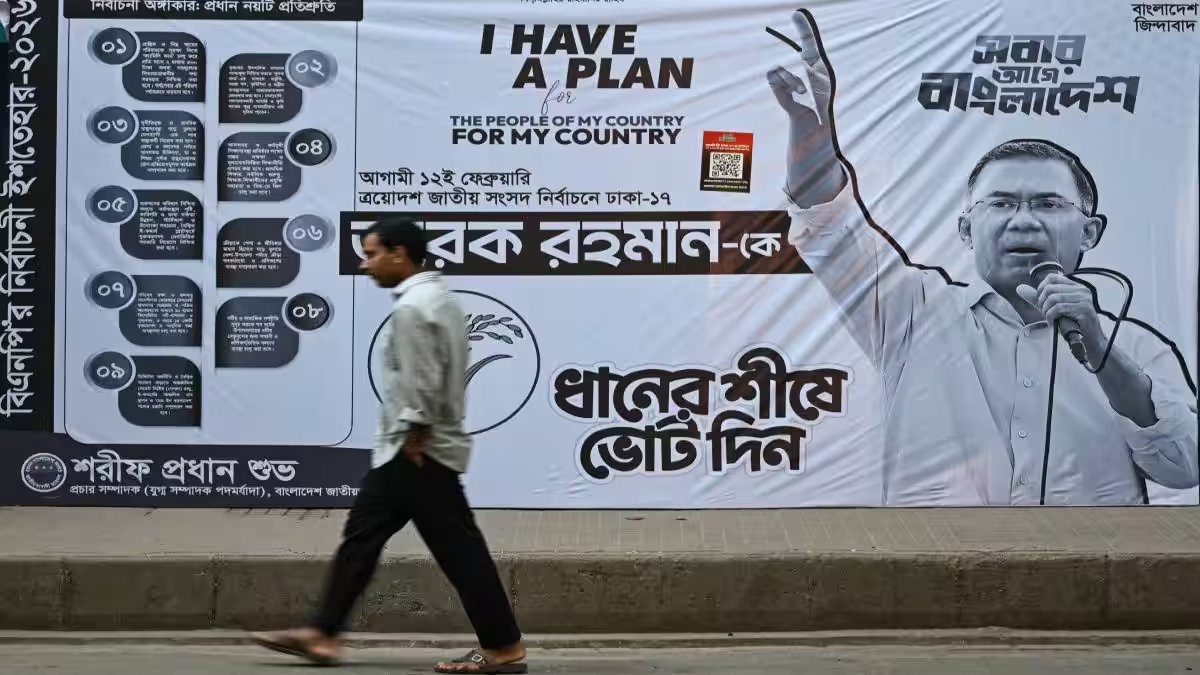
As the Bangladesh election throws a bipolar political outcome with Jamaat-e-Islami seemingly gaining the role of a powerful Opposition block to keep a resurgent Bangladesh Nationalist Party (BNP), Bangladesh sits on the cusp of a historical change. Though, the Bangladeshi voters had few good options to choose from with the Awami League taken away from the contest.
This also means that India faces a test to adjust its Dhaka strategy. The fact that Bangladesh chose the BNP over the Jamaat works in India’s favour.
However, India’s policy recalibration may not be an easy task. While Jamaat is a Pakistani proxy and a front for jihadists, BNP too has had a chequered history and ties to Pakistan and fundamentalists.
Follow latest Bangladesh election updates
here
Even as the BNP has now pitched itself not just as an alternative to Jamaat but as its antithesis, there are contradictions that show it has not yet shed its past.
For one, last year, Standing Committee member Iqbal Hasan Mahmud Tuku said the BNP was a secular party and described its previous alliance with Jamaat as “just the way political coalitions take place in democracies like India” and said “that is now in the past”. But the party’s central leadership soon rejected the statement and said Tuku was speaking in his personal capacity and not for the party.
The episode highlighted two aspects of the BNP that have not been discussed enough since Sheikh Hasina’s ouster.
One, the BNP has long been an enabler of Islamist and jihadist activities of Jamaat. Between 2001 and 2006, the BNP ran the government with the support of Jamaat — and the two remained formal coalition partners between 1999 and 2022. Two, the recent BNP-Jamaat divide could be more pragmatic than ideological.
BNP & Jamaat are not as different as you might think
The BNP-Jamaat fallout in recent years could be more tactical and short-term, according to Abhinav Pandya, a scholar of fundamentalism and terrorism in South Asia.
Pandya flagged that both the Jamaat and BNP have Islamist roots and have had ties with Pakistan and the difference has sometimes been just of the scale.
“While Jamaat is entirely a Pakistani proxy to spread its state-backed Islamist and jihadist agenda across South Asia, the BNP has shown some tactical pragmatism but never abandoned its Islamist roots outright. In fact, in Bangladesh, the Islamisation is such that even ‘secular’ institutions like the Awami League operate within the framework of Islamism,” said Pandya, the head of the think tank Usanas Foundation.
The BNP’s public rejection of Tuku’s simple statement — even if intended as a bland confidence-building measure as part of an ongoing outreach to India — lays bare that the party has neither abandoned its Islamist roots nor ties to Pakistan.
ALSO READ:
Bangladesh votes for next govt but real battle is for the state — and Jamaat may be winning it
Despite such similarities, the two parties are not the same — and that makes the situation much more complex for India.
The BNP has definitely been pro-Pakistan in the past, but it is not necessarily as Islamist as Jamaat or as close to Pakistan as Jamaat, according to Deep Halder, the author of ‘Being Hindu in Bangladesh: The Untold Story’ and ‘Inshallah Bangladesh: The Story of an Unfinished Revolution’.
“While the BNP has been supportive of Pakistan in the past, Jamaat has always been a Pakistani party contesting an election in Bangladesh. It has always been a proxy in the truest sense. In addition to this difference, currently, the BNP does not want to play the second fiddle to Jamaat. This means that the two parties are neither politically not ideologically aligned entirely in the post-Hasina era,” said Halder.
That means that despite fundamental flaws, the BNP might still be the best bet for India as a tactical partner in Bangladesh. And trends suggest that the
BNP is headed to a landslide victory in the election. BNP chief Tarique Rahman has already reached out to India and a stable relationship with his party and government would mean a breather for short term while India could reconsider the long-term approach to Bangladesh.
Bangladesh General Election 2026
Seats Declared: 293 / 300 | Majority Mark: 151
| Alliance/Party | Seats | % of Declared Seats (293) |
|---|---|---|
| BNP+ | 213 | 72.7% |
| JIB+ | 68 | 23.2% |
| JPE+ | 0 | 0.0% |
| OTH | 12 | 4.1% |
| Total Declared | 293 | 100% |
The choice for India in Dhaka
In Bangladesh, the choice for a partner boils down to picking the bad or the worse player.
While the Jamaat is fundamentally and overtly opposed to India, the BNP can at least be a short-term and tactical partner, according to Pandya.
But Pandya warns that any tactical alliance with the BNP would have an expiration date as the party would not be a long-term partner.
“For a year or two, India could definitely get along with the BNP, but that’s not expected to last 5-10 years. With Hasina gone, there is no secular-adjacent force in Bangladesh. There are just Islamists of various levels of extremism and Islamists can only be tactical partner for so long. None of them believe in multiculturism. Even the likes of the BNP are unlikely to stop radicalisation in the country that has accelerated in the post-Hasina era,” said Pandya.
ALSO READ:
Hasina gone, Bangladesh’s extremists dismantle 1971 foundation to become ‘East Pakistan’ again
There are also doubts how long the BNP would be able to hold Bangladesh together because the country is now so radicalised and Islamised that even being nationalist, Islamist, or pro-Pakistan is not enough to be acceptable to powers that have ruled Bangladesh’s streets since July 2024.
Halder said that a party or leader in Bangladesh needs to be both Islamist and pro-Pakistan to be acceptable to the street powers and also needs to be aligned with them 100 per cent.
“There were attacks on media houses and journalists that were critical of India and supportive of the July protests. Cultural centres were also attacked. These attacks tell you that Bangladesh has entered an era where Islamists aiming to be string-pullers don’t want just your compliance but total submission. They are not content with anti-India or pro-Pakistan positions but want everything to revolve around Islamism. And the friction is not exactly new,” said Halder.
For decades, there has been a contest between forces of 1947 and 1971 in Bangladesh, according to Halder.
“There were always two ideas of Bangladesh. One was the idea that led to the foundation of Bangladesh in 1971. It envisioned the nation as a sociocultural entity centred around language and culture. Under this idea, people would rise above religion. The second idea was that of East Pakistan that imagined the nation strictly in religious —Islamic— terms. This second idea now appears to be getting stronger by the day,” Halder told Firstpost.
So, what are India’s options in Bangladesh?
Pandya said there are only hard and uneasy options as the opportunity for good solutions ended with Hasina’s ouster.
“Both India and Sheikh Mujib failed to curb Pakistan’s influence in Bangladesh. And that has come to haunt them now. For a long-term solution, India needs to work towards the grassroot revival of the Awami League even if it sounds politically incorrect. And, secondly, India needs to be very firm in display of force to deter jihadists and be ready for Myanmar-like cross-border strikes if Pakistan’s jihadists try to use Bangladesh as a hub and launchpad,” said Pandya.
Rahman returned to Bangladesh on the eve of the parliamentary election and a referendum on the July Charter. India reached out to Rahman, the son of the former Prime Minister Khaleda Zia, who passed away recently, as he emerged as the leader of Bangladesh’s largest democratic party after the Muhammad Yunus regime barred ousted Hasina’s Awami League from the election. Rahman has spoken in conciliatory tone, in contrast to Jamaat’s anti-India pitch, about improving ties with its largest neighbour India.
End of Article


