
While the headline number is slightly higher than what the old series would have indicated, economists say it is not a major surprise and does not change the near-term policy outlook.
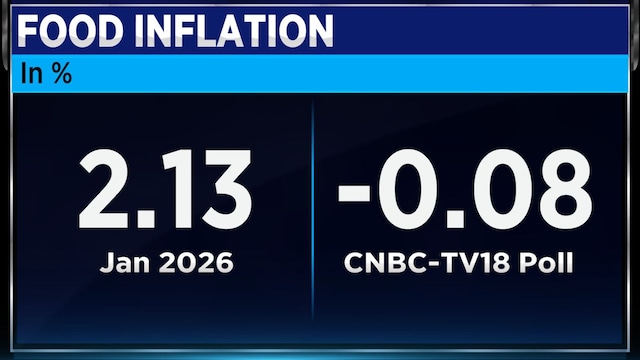
Food inflation stood at 2.13%, clothing and footwear at 2.98%, and restaurant and accommodation services at 2.87%.
Sakshi Gupta, Senior Economist at HDFC Bank, said the print was broadly in line with expectations. “At least it’s not a shockingly high number or shockingly low number,” she said, noting that while the headline is manageable, food inflation at 2.13% was higher than anticipated.
Items such as tomato, coconut and edible oils appear to have pushed up food prices under the revised weight structure.
Sameer Narang, Head – Economics Research Group at ICICI Bank pointed out that the internals of the data are more interesting than the headline. For months, India had been witnessing food deflation and sticky core inflation.
Now the trend seems to have shifted. “The biggest surprise is that food suddenly has turned positive,” he observed. At the same time, core inflation appears lower under the new series, especially when gold and silver are excluded.
Garima Kapoor, Chief Economist at Elara Capital said markets had expected food inflation to continue surprising on the downside. The new series, with revised weights, may lead to somewhat higher food readings going forward. However, she highlighted that core inflation has softened, which is positive from a policy perspective.
From a market perspective, bond yields reacted calmly. Lakshmi Iyer, Group President of Investments at Bajaj Alternate Investment Management, indicated that liquidity conditions remain comfortable, with overnight rates trending below the repo rate. As a result, the bond market absorbed the data without significant stress, and yields eased slightly after the release.
Following the release, the 10-year benchmark yield declined from 6.69% to 6.67% towards the end of the day,
On the policy front, there was broad agreement that the RBI is unlikely to change rates in the near term. Most economists expect the central bank to remain focused on liquidity management and ensuring effective transmission of earlier measures. With growth indicators holding up and GDP estimates remaining healthy, there appears to be little urgency for policy action.
However, some caution that risks to inflation may build over the medium term. Rising commodity prices and possible pass-through to core components could push inflation expectations higher in FY27. For now, though, the January print reinforces the view that inflation remains under control, even as the new series reshapes its composition.
For the entire discussion, watch the accompanying video