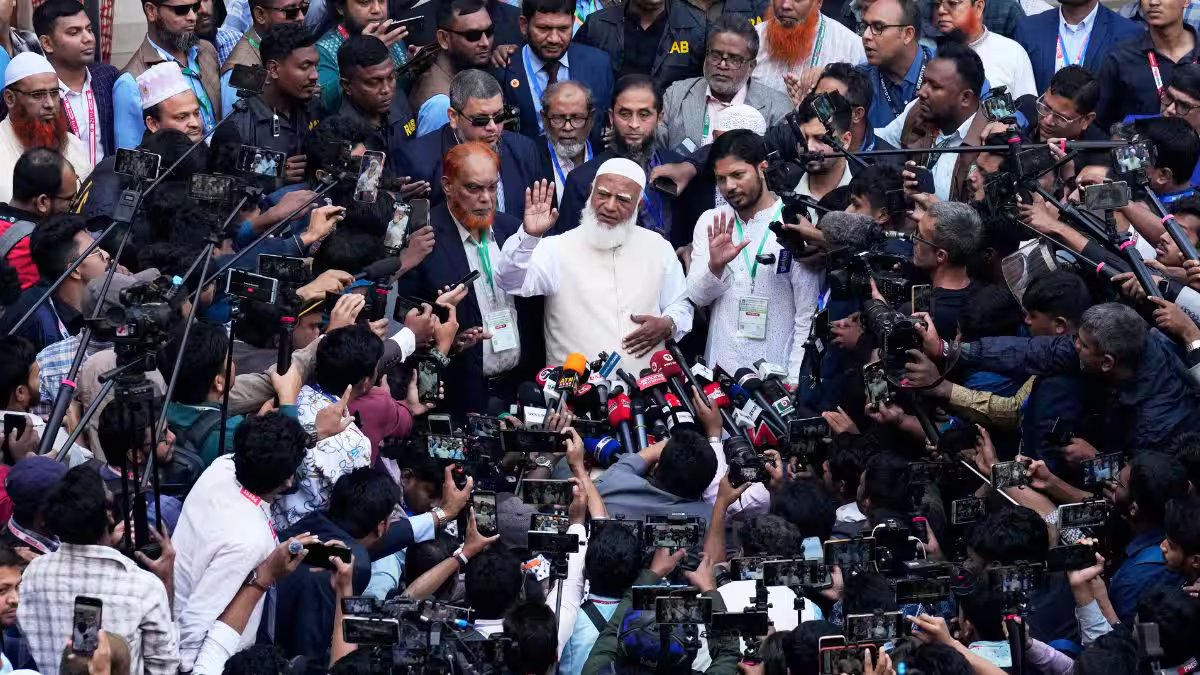
Analysts have warned that Jamaat-e-Islami has become so entrenched in Bangladeshi polity under Muhammad Yunus that it has essentially turned into the country’s deep state. As a result, the Islamist group aims to pull the strings of power irrespective of the election outcome.
Even as Bangladesh’s voters cast their ballots on Thursday, the country’s radical political formations dictated by Islamists appear to be emerging as the string-puller irrespective of the result of the nation’s first election after the ouster of Sheikh Hasina about 18 months ago.
Within weeks of assuming office, Bangladeshi interim leader Muhammad Yunus lifted the ban on Jamaat-e-Islami, making way for the Islamist organisation to fill the political void created by the ban on Awami League, pursue its ultraconservative agenda, and entrench itself into the country’s polity.
Since Yunus rehabilitated Jamaat after Sheikh Hasina’s ouster, Jamaat has operated with impunity and its cadres and leaders have entrenched themselves at all the levels of the government to essentially become a deep state of sorts, according to Deep Halder, the author of ‘Being Hindu in Bangladesh: The Untold Story’ and ‘Inshallah Bangladesh: The Story of an Unfinished Revolution’.
“Jamaat has sought to become the de facto state. While every party has had its people in the state apparatus, Jamaat has infested state institutions rapidly under Yunus because of the purge of the Awami League and promotion of Jamaat. That means Jamaat is aiming to be the real power. Even if someone else, such as the BNP, would form the elected government, Jamaat would assert itself as the real power with the state apparatus in the grips,” Halder told Firstpost.
But Jamaat might not even need to challenge the elected government from within as it is going toe to toe in the polls. It appears to have a chance at winning the election and forming the government.
| Survey | BNP+ | Jamaat+ | Others |
|---|---|---|---|
| EASD | 208 (66.3%) | 46 (11.9%) | 17 – Independent; 3 – Jatiya |
| IILD | 44.1% | 43.9% | — |
| NRC | 220 | 57 | 21 |
Conventional understanding would say that Awami League’s voters would prefer the Bangladesh Nationalist Party (BNP) in the absence of Awami League, but many could also vote for Jamaat because fundamentalism has been quite mainstream in the country as radicalisation has been unchecked since Hasina’s ouster.
As per a survey by Communication and Research Foundation, 48.2 per cent of Awami League voters would vote for the BNP and 29.9 per cent for Jamaat.
“Unlike popular perception, Islamic fundamentalism in Bangladesh is not just a problem of the lower classes. Plenty of educated people are members and leaders of Jamaat. And they openly call for the implementation of sharia. Yunus’ administration has quietly empowered these groups,” said Halder.
Pakistan’s jihadists ambitions in Bangladesh through Jamaat
Even though Jamaat is now contesting an election, it is not a political party like the BNP or outlawed Awami League. It is a transnational Islamist movement that is committed to establishing a state run by sharia.
Jamaat was founded in 1941 in Lahore in present-day Pakistan by Abul Aʾla Maududi. After Independence, Jamaat formed separate organisations in India, Pakistan, and East Pakistan (present-day Bangladesh). But these organisations are separate only in name.
In reality, Jamaat is a Pakistan-controlled transnational Islamist organisation that’s modelled on the line of Muslim Brotherhood and works towards the formation of sharia-based societies and provide a front for terrorist activities, says Abhinav Pandya, a scholar of fundamentalism and terrorism in South Asia.
Maududi as well Jamaat’s constitution reject nationalism, secularism, and democracy and call for laws and social contract to be based on sharia, the Islamic law. In Bangladesh, Jamaat has been working to Islamisise the society and law. There have been noticeable changes since Hasina’s ouster.
For example, there have been reports of girls being stopped from playing sports, singing being restricted, and calls for mandatory hijab for women. And, of course, the country has been in the grips of cyclic violence against minorities such as Hindus that has involved lynchings of minority community members and attacks on their houses and places of worship. These attacks began during anti-Hasina agitation in July-August 2024 and have continued unabated.
“At its core, Jamaat is not a political party. It is a transnational Islamist movement based in Pakistan works both as an enabler of jihadists and acts as a front for jihadist groups. It rejects secularism and multiculturism and wants an ultraconservative society not unlike the Taliban-run Afghanistan where women and minorities essentially do not have any rights,” Pandya, who heads the think tank Usanas Foundation, told Firstpost.
India has a template for what a Jamaat-run Bangladesh could like.
During 2001 and 2006, Jamaat was a coalition partner of BNP when late Khaleda Zia was the prime minister.
“When the BNP and Jamaat ran the country, Bangladesh was not just Pakistani jihadists’ gateway for India but also a camp where terrorists trained and smuggled arms into India. It was only after Hasina took over that there was a crackdown on these terrorists and camps,” said Pandya.
End of Article