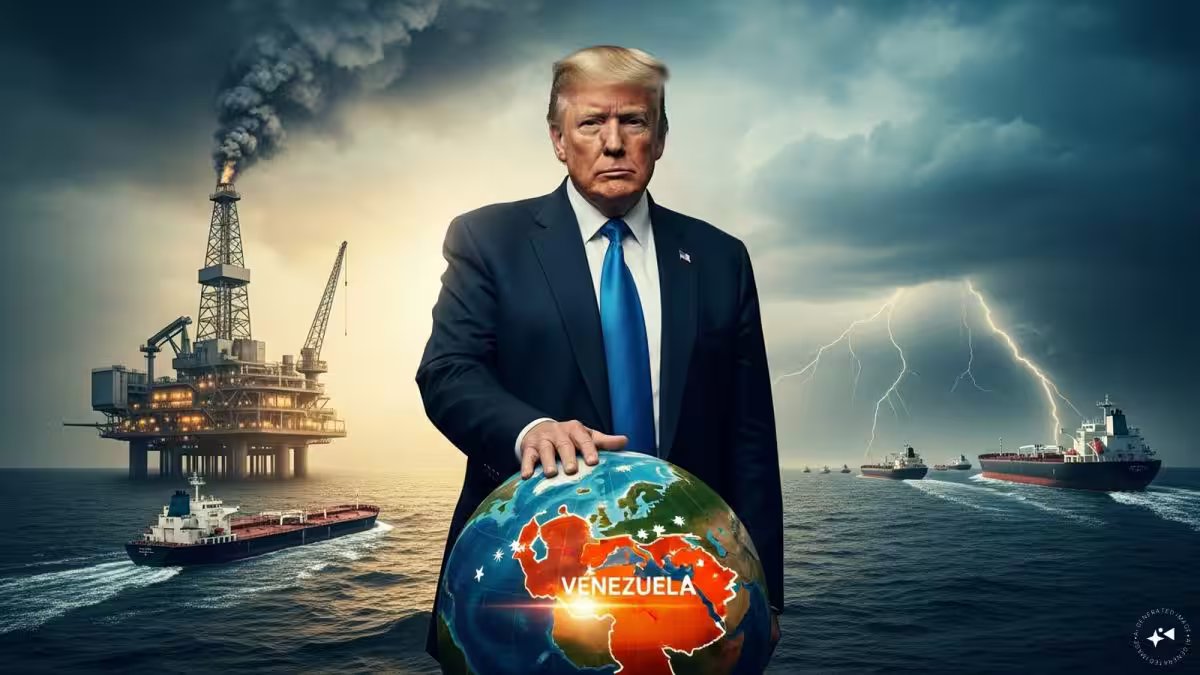
US actions in Venezuela are altering oil market dynamics, strengthening Washington’s ability to cap prices while Gulf producers continue to anchor market stability
A month after Venezuelan President Nicolas Maduro was abducted by the Trump administration, the outline of a new oil framework involving the United States and Venezuela is beginning to crystallise. The shift is prompting questions about where the global energy balance is heading, as tanker seizures and redirected crude flows signal a rapidly changing landscape.
US authorities have intensified pressure on Venezuelan exports by seizing at least seven “shadow fleet” oil tankers carrying sanctioned crude. The campaign gathered momentum in the lead-up to Operation Absolute Resolve and continues to target illicit shipments.
President Donald Trump has stated that approximately 50 million barrels of Venezuelan crude have been transported to the
United States for processing and sale. According to Trump, the revenue from these sales has been collected and redistributed by the administration.
Alongside these measures, Trump has urged private investors, particularly US
oil companies, to commit as much as $100bn towards overhauling Venezuela’s oil industry, with an ambitious timeline of 18 months.
Despite the scale of the proposals, significant hurdles remain. Private capital has been slow to respond, reflecting continued caution over the pace of sanctions removal and unresolved political and legal uncertainties. As a result, Venezuela’s oil sector remains largely in a holding pattern, with companies and investors adopting a wait-and-see approach.
Questions over Washington’s broader objective
Beyond the immediate developments, Washington’s actions in
Venezuela have raised wider questions about their strategic purpose. With the United States already holding the position of the world’s largest oil producer, analysts are examining what additional leverage Venezuela provides and how this could affect global oil markets, particularly producers in West Asia.
At first glance, the reassertion of US influence across a Western Hemisphere-centred oil system could appear unsettling for Arab Gulf producers. Washington now exercises direct or indirect influence over oil output from Canada through to Guyana and Venezuela, representing close to 20 per cent of global supply on a gross basis. Such reach suggests a potential shift in the centre of gravity of energy markets towards the west.
Implications for Gulf producers remain complex
Whether this expansion undermines the Gulf’s ability to manage supply, influence prices or maintain strategic leverage remains a nuanced issue. What the United States has secured through its actions in Venezuela is not centralised control over global oil flows, but greater insulation from price volatility and geopolitical disruptions at a time of heightened global competition and persistent market uncertainty.
US influence in oil markets remains fragmented and largely commercial. Production decisions are spread across hundreds of private firms operating under capital discipline, regulatory frameworks, shareholder expectations and electoral pressures. Even in Venezuela, Washington’s role is exercised through licensing regimes, regulatory mechanisms, financial channels and access for private oil companies, rather than through direct production mandates.
This approach differs fundamentally from the coordinated supply discipline that characterises the Opec+ alliance, a distinction that continues to shape global energy dynamics.
Limits of US power during market stress
The United States still lacks a critical tool during periods of oil market strain: coordinated and deployable spare capacity. While US shale output responds to price movements, it cannot be rapidly expanded, deliberately curtailed for strategic reasons or sustained at a loss to serve geopolitical aims. These capabilities remain concentrated in the Arab Gulf, most notably in Saudi Arabia and, to a lesser extent, the United Arab Emirates.
As a result, the evolving oil landscape is better understood not as a zero-sum contest between Washington and Gulf producers, but as a system with divided influence.
The United States is increasingly positioned to influence the upper limits of oil prices. Domestic production strength, combined with expanding hemispheric reach, allows Washington to counter sharp price increases that carry political and inflationary risks, particularly between election cycles. Control over Venezuelan exports strengthens this position, not through direct manipulation of output, but by signalling the availability of additional supply from Venezuela and, over time, from neighbouring Guyana as capacity expands.
Historically, this role formed part of an informal understanding between Washington and Riyadh, often aimed at containing inflation or softening global economic slowdowns. The United States also gains access to what is reportedly among the world’s largest crude reserves, at a time when demand forecasts suggest hydrocarbons will remain in use for at least another two decades.
End of Article