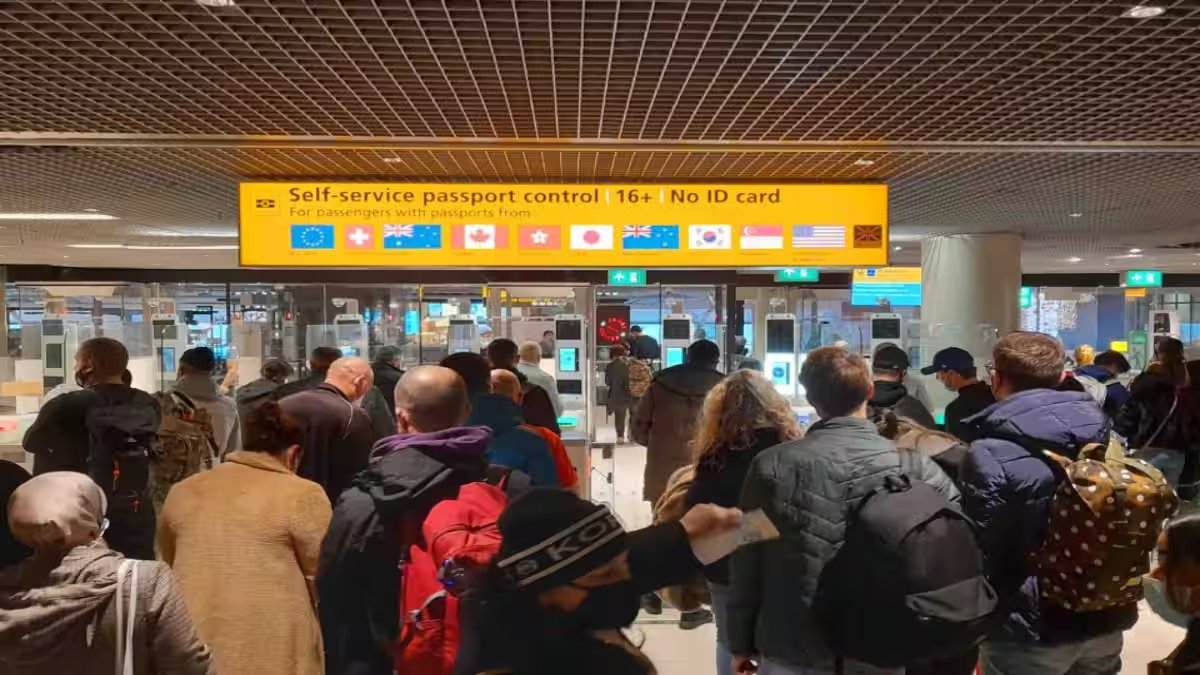
The EU’s newly introduced Entry-Exit System (EES) has become a pain for travellers, especially the non-EU nationals who are now facing three-hour delays at major European airports.
The European Union’s newly introduced Entry-Exit System (EES) has become a pain for travellers, especially the non-EU nationals who are now facing three-hour delays at major European airports. Authorities argue that the digital border check system, rolled out in recent months across the Schengen Area, requires fingerprints and facial scans that are taking much longer to process during peak travel times.
Due to the tedious process, airports across Europe are facing long lines as the EES rolls out at the external borders of the Schengen Area. It is pertient to note that the digital border system started to be implemented in a phased manner in October. The system drastically changes how non-EU travellers are processed when entering and leaving the bloc.
As per the new system, travellers from countries such as the United States and the United Kingdom, or any other European nation, must register fingerprints and a facial image the first time they cross the border. This biometric data would then replace the traditional passport stamping and would be stored in a shared database used by border authorities across participating countries.
However, the airport operators argue that these extra steps are already slowing passport control at busy international hubs. Airports Council International (ACI) Europe said that border checks are taking up to 70 per cent longer in some locations, leading to waits of as long as three hours during peak travel times.
The group noted that the impact is being felt most at airports that handle large volumes of long-haul flights.
Airport operators raise concerns
In light of the current delays, airport operators warned that the rollout is already causing disruption and could worsen as more travellers are added to the system. The ACI has called for an urgent review of the rollout timeline, citing operational and staffing challenges at major airports.
“Significant discomfort is already being inflicted upon travellers, and airport operations are being impacted, with the current threshold for registering third-country nationals set at only 10 per cent,” said Olivier Jankovec, director general of ACI Europe.
He went on to warn that the increasing share of travellers required to register without resolving existing problems could lead to more serious disruption. “Unless all the operational issues we are raising today are fully resolved within the coming weeks, increasing this registration threshold to 35 per cent as of January 9 will inevitably result in much more severe congestion and systemic disruption for airports and airlines,” Jankovec said.
He added that this “will possibly involve serious safety hazards.” The ACI Europe stated that airports in France, Germany, Italy, Spain, Portugal, Greece, and Iceland have been among the hardest hit so far.
What are the factors behind the delay?
The airport authorities mentioned several factors behind the delay. They insist that many travellers must first use self-service kiosks to submit biometric data before reaching a border officer. When kiosks are unavailable, unfamiliar, or out of service, queues can quickly form.
ACI Europe said some of the airports are also facing system outages and technical configuration problems. The group also pointed to the concerns about staff shortages, saying that there are not always enough trained border guards available to manage the added workload, especially during peak travel periods.
Another issue is the lack of a widely available pre-registration option. Without the ability to complete biometric registration in advance, travellers would still have to stand in line at the airport, causing more headaches.
EU remains adamant
Amid all the criticisms, the European Commission has rejected claims that the ESS is broadly responsible for the long queues at airports. A Commission spokesperson said that the system was launched successfully across member states using a progressive approach.
The spokesperson noted that the member states have already exceeded early registration targets and that processing times have improved as border guards gain experience with the system. The Commission said that it has not received reports confirming widespread three-hour waits caused directly by the new checks.
According to the Commission, queues are often linked to other factors such as flight schedules, staffing levels, or peak holiday travel. Officials also said that countries have the option to partially or fully suspend the system in exceptional circumstances to manage congestion.
End of Article