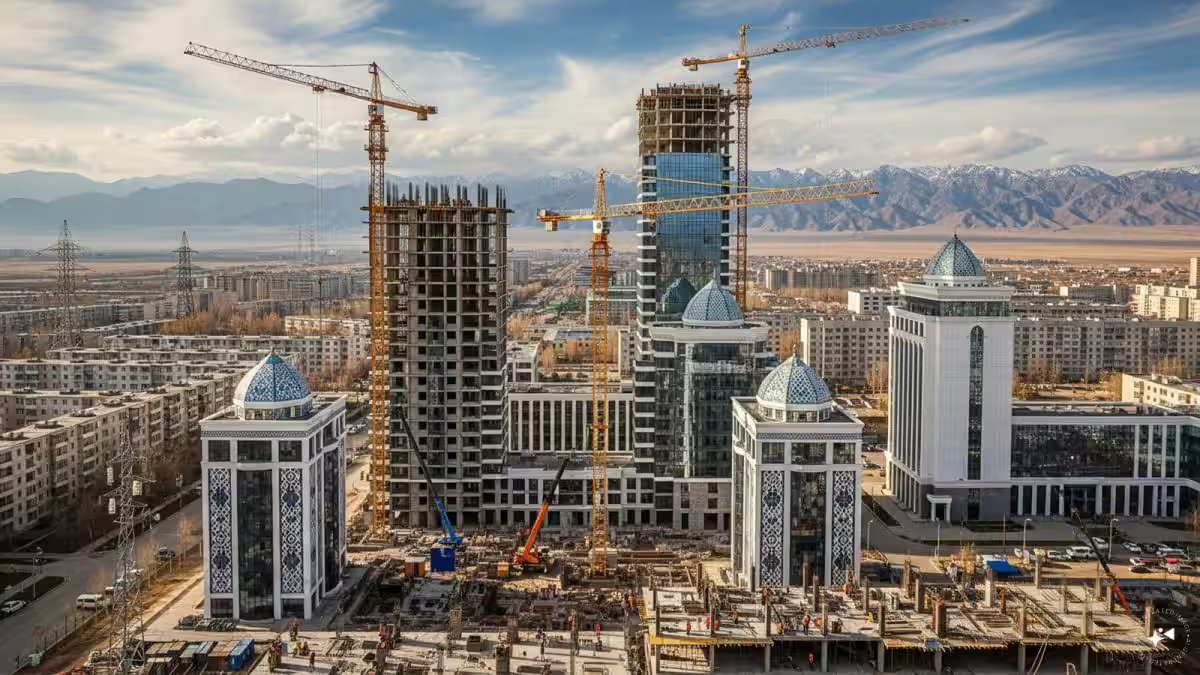
Central Asian governments are pushing ahead with ambitious new city projects as ageing Soviet-era infrastructure, rapid population growth, and the need for foreign investment converge across the region.
Over the past several months, Kyrgyzstan, Kazakhstan, Uzbekistan, and Turkmenistan have taken concrete steps to advance the construction of new modern cities, according to regional media reports published in December 2025. While planning has been under way for several years, recent moves signal renewed momentum.
Each country has identified a major project designed for hundreds of thousands of residents. Kyrgyzstan is building Asman, Kazakhstan is developing Alatau, Uzbekistan is constructing New Tashkent, and Turkmenistan is expanding Arkadag. All four cities are planned for initial populations of approximately 250,000.
The projects are intended to replace outdated Soviet-era infrastructure and attract international investment by offering modern facilities and services for foreign companies. The push also reflects demographic trends, as the United Nations projects Central Asia’s population will rise from about 84 million today to more than 114 million by 2050.
Asman positioned as Kyrgyzstan’s modernisation drive
Kyrgyzstan has presented Asman as a key symbol of its modernisation ambitions. In 2023, President Sadyr Japarov laid the groundwork for the project, stating that foreign direct investment would fully cover the costs. Discussion of Asman began in 2021, with plans to build the city on the north-western shore of Lake Issyk-Kul for up to 700,000 inhabitants at an estimated cost of $20 billion.
The proposed design resembles the komuz, a traditional Kyrgyz musical instrument. Japarov said it would be cheaper and easier to build a new city than to upgrade existing ones. However, the project was suspended in 2023 after international partners proposed changes to turn Asman into a “green city”, requiring additional time to revise the concept.
In November 2025, Bishkek resumed the project and held a construction start ceremony. Ravshan Sabirov, director of Kyrgyzstan’s National Investment Agency, said Asman would be built in stages. He said, “One company was allocated 100 hectares (247 acres) of land; the other, 80 (198 acres). We invite all companies to participate in the project; the conditions are the same for everyone”.
Earlier reporting said Kyrgyzstan-based Elite House received 247 acres for development, while an unnamed company from the People’s Republic of China was named as the general partner and allocated 50 hectares [123 acres].
Reliance on foreign capital
Like other large infrastructure projects in Kyrgyzstan, including the Kumtor gold mine and the China–Kyrgyzstan–Uzbekistan railway, Asman depends heavily on foreign direct investment. Japarov has said no government funds will be used, noting that “there are foreign investors who are interested in participating in the implementation of such a large project”.
Asman is planned as a “smart city” featuring alternative energy sources, resource-efficient consumption and green municipal transport. Investors include companies from Türkiye, the People’s Republic of China, India, the United Arab Emirates and Qatar, specialising in future city projects, technology and tourism development. Construction is expected to take seven to ten years and will be divided into commercial, entertainment and sports zones.
Corruption concerns and continued outreach
Efforts to secure foreign investment have been complicated by corruption issues. The director of construction for Asman has changed several times. Timur Faziev, founder of Elite House and appointed director of construction, was implicated in a criminal corruption case involving land purchases and illegal construction in Bishkek. He was removed from the project four months after his appointment.
Despite these challenges, construction is continuing as the Kyrgyz leadership maintains its search for investment. At the first summit of the “Central Asia plus Japan” dialogue in December 2025, Japarov’s press service said, “On January 15, representatives of the National Investment Agency under the President of the Kyrgyz Republic paid a working visit to the People’s Republic of China, where they made similar presentations to potential investors in Shanghai and Nanjing.”
Kazakhstan holds an advantage over its neighbours due to its experience in constructing most of its capital, Astana, between 1994 and 1998. Astana was built on the site of the former Akmola settlement in the northern Kazakh steppe, 604 miles north of Almaty.
The government is now developing a new city, Alatau, with an initial population target of 247,000. The city is located 31 miles north of Almaty, which remains Kazakhstan’s largest and most prominent city. Officials hope Alatau will serve as a Central Asian “Singapore” and grow to 2 million residents by 2050.
Alatau’s phased expansion plan
Supporters of Alatau say it will help address Almaty’s overpopulation and ecological challenges. In January 2024, President Kassym-Jomart Tokayev signed a decree establishing the settlement, stating, “We intend to build a completely new metropolis in the style of Singapore, which will become a leading international business hub that meets world standards”.
The first phase of Alatau, designed for 247,000–401,000 residents, is scheduled to be completed by 2030. Population projections range from 1.02–2 million by the end of the third phase in 2050. The city will be divided into four large districts, each including residential areas, a business centre, educational and medical facilities, a tourist cluster, and a trade and logistics zone.
The Kazakhstan government has expressed confidence in the project’s prospects. In late 2025, the Ministry of National Economy of Kazakhstan said:
End of Article