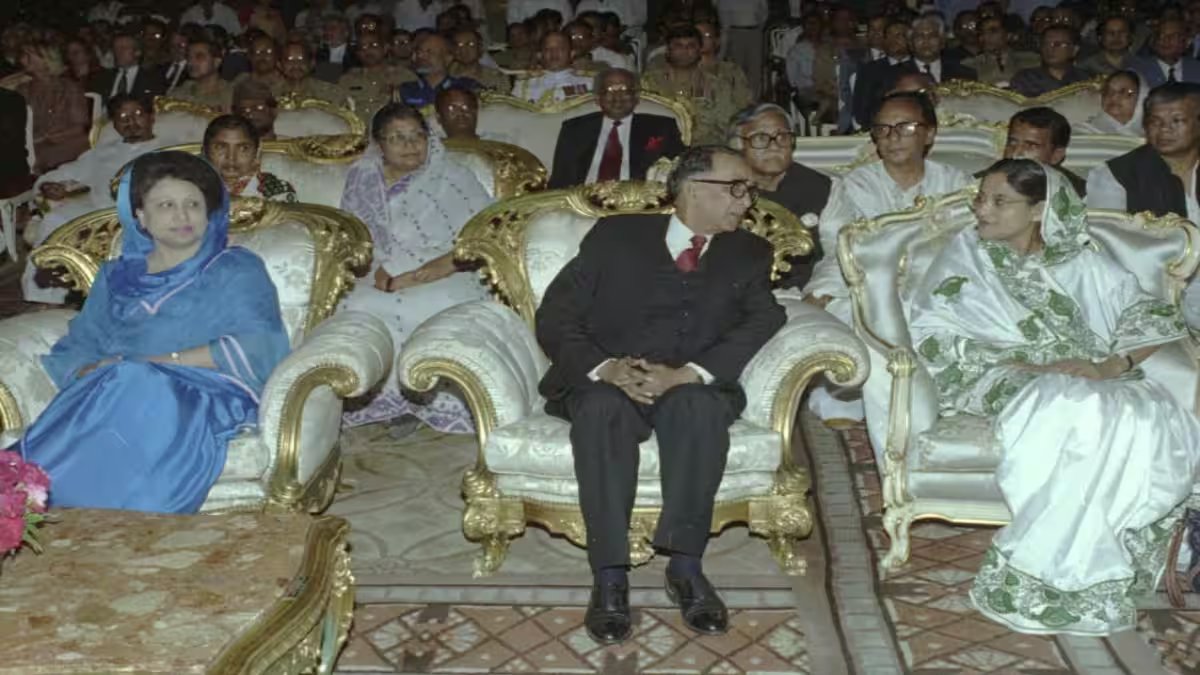
For decades,
Bangladesh was led by two powerful women, one after another, from prominent political families: Awami League’s
Sheikh Hasina and Bangladesh Nationalist Party’s
Khaleda Zia. The former prime ministers left such a legacy that for the longest time, Bangladesh was known for the women who ruled.
However, things changed drastically in the span of just
one and a half years, with Hasina’s ousting and Zia’s passing, Bangladesh has been struggling with the lack of women in power. The situation is worse, as per the data emerging ahead of the highly anticipated Bangladesh general elections.
Only 78 women will be contesting in this year’s parliamentary elections in Bangladesh. While the number is less, it is still seen in Dhaka as a new record. Moreover, nearly a third of them are not independent political actors, but relatives of influential men – wives, daughters or family members of party leaders and power brokers.
Looking at the latest numbers, experts argued that this only underscores “how far the country still lags in ensuring gender parity in politics.” It is pertinent to note that the candidacies are spread across 67 constituencies in Bangladesh, leaving more than two-thirds of seats with no scope for directly elected female representation.
What the numbers say
Women make up half the population of Bangladesh. In fact, the male-to-female ratio of Bangladesh (96-97 males to 100 females) is better than that of India (106-107 males to 100 females. Despite this, only 3.93 per cent of the 1,981 candidates contesting these elections are women.
The figures are so low that experts in Bangladesh are calling the female participation in the polls “tokenistic and largely dynastic”. According to the latest data, out of the 78 women candidates, 61 have been nominated by 30 political parties, while 17 are independents.
The
Bangladeshi Election Commission data shows that women with family or marital ties to prominent political figures consistently fare better than those without such connections. “The electoral process in Bangladesh remains deeply male-dominated,” said Jesmin Tuli, former additional secretary of the Election Commission and a member of the Electoral Reform Commission.
“In Bangladesh, most women leaders or members of parliament have risen through family influence. The number of women who have struggled up from the grassroots is very small. Very few female leaders have gradually built themselves up from university life through fieldwork,” she told Bangladeshi news outlet The Daily Star. “Our social and family structures are also responsible. Parents in middle-class families generally do not want their daughters to enter politics. Politics has not yet become safe for women; in fact, it remains unsafe,” she added.
It is pertinent to note that the Representation of the People Order (RPO), 1972, requires political parties to reserve at least 33 per cent of committee posts for women, including at the central level. However, almost all the parties failed to meet this obligation. In light of this, in 2021, the Election Commission extended the deadline to 2030.
At least 30 parties with no women candidates
According to The Daily Star, at least 30 parties, including Jamaat-e-Islami, Islami Andolan Bangladesh, Bangladesh Khelafat Majlis, Khelafat Majlis, Bangladesh Islami Front, Liberal Democratic Party (LDP), Jonotar Dal, Bangladesh Sangskritik Mukti Jote, Bangladesh Congress, Jatiya Party (JP), Bangladesh Khelafat Andolan, Bangladesh Nationalist Front and Bangladesh Jasad, have fielded only male candidates.
When asked why Jamaat did not nominate any women, Jamaat Assistant Secretary General Ahsanul Mahboob Zubair said the party follows a grassroots-based selection process. He noted that while men are guided by the party’s instructions, women are given the freedom to decide whether to contest.
“We haven’t fielded [women candidates] this time; Inshallah, we’ll do it the next time,” he said, adding that some of the other parties in the Jamaat-led alliance have nominated women. The women of the party went ahead in defending the move, insisting that Jamaat operates on “Islamic principles”.
“According to the Quran, men are directors of women, which is considered a command and obligation in Islam,” Jamaat-e-Islami Women’s Wing Secretary Nurunnisa Siddika said earlier this week. Siddika described it as an “internal organisational decision.”
Nepotism
All 10 BNP women candidates contesting in this year’s election have direct or marital links with senior party figures. In fact, most of the female candidates contesting in the polls belong to one influential family or another.
This was the same story for both Hasina and Zia. The Awami League supremo, Sheikh Hasina, is the daughter of Bangabandhu
Mujibur Rahman. Meanwhile, Zia was the wife of the former President of Bangladesh,
Ziaur Rahman.
Bangladesh has a rocky history regarding women’s representation. According to the Election Commission records, no women were elected in the first two parliamentary polls in 1973 and 1979. Only five were elected in 1986 and four in 1988.
In 1991, a record 40 women contested in the polls and only four emerged as winners. In June 1996, 30 women ran, and five were elected. In 2001, 38 contested and six won. In 2008, 59 women ran, and 19 were elected. In 2014, 29 contested and 18 won. In 2018, 69 women contested and 22 won. In 2024, 99 women ran, and 20 were elected, according to The Daily Star.
The figures clearly indicate that across the decades, the patterns remain unchanged. Women in Bangladesh rarely enter politics, and those who do are from one political dynasty or the other.
End of Article



Tank base repair plays a huge role in safety—nice explanation.