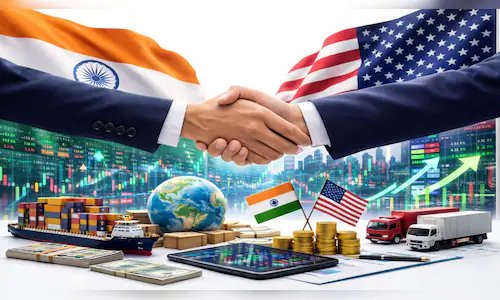
Former Indian envoy to the US Meera Shankar and Mukesh Aghi, President and CEO of the US-India Strategic Partnership Forum (USISPF), told CNBC-TV18 that while the tariff rollback is a meaningful breakthrough after a prolonged stalemate, India will need to move quickly on domestic bottlenecks to convert the headline number into sustained export gains.
“This means we are getting a lower tariff rate than most of our Asian peers,” Shankar said, referring to the new 18% levy, while noting that it does not automatically translate into a competitive advantage.
Tariff rollback brings relief after months of strain
The reduction in tariffs marks a sharp de-escalation from the earlier reciprocal tariff rate of 50%, which had become a major source of anxiety for exporters and raised concerns over whether trade tensions could spill over into the wider strategic partnership between the two countries.
Shankar called the development “a good step” towards easing friction after months of stalemate, even as she cautioned that the move will come into effect only once the official notice is published in the US Federal Register.
Mukesh Aghi said the last nine months had been “agonising”, with industry and stakeholders pushing both sides to arrive at a workable understanding.
Labour-intensive exports likely to benefit
Aghi underlined that the earlier tariff regime had a “dramatic impact” on India’s lower-end export categories, including garments and gems and jewellery, triggering job losses and affecting livelihoods linked to export-driven manufacturing.
“Earlier tariffs has had a dramatic impact on low-end exports from India—garments, gems and jewellery—and a lot of people have basically become unemployed because of that,” Aghi said.
With the tariff cut now in place, exporters in these segments could see a meaningful improvement in market access and pricing power in the US, which remains India’s largest export market for both goods and services.
Aghi also pointed out that the rupee’s depreciation in recent months could further improve India’s competitiveness, helping exporters regain lost ground.
India now sits better than most emerging peers on US tariffs
The 18% tariff level puts India in a more favourable position compared to several emerging economies. China continues to face significantly higher tariffs, while other Asian and emerging market exporters remain close to India’s new rate.
Shankar noted that India’s revised rate is lower than most Asian peers, even though major US partners still enjoy better terms.
“The UK has 10%, and the EU, Japan and South Korea have 15%. We have 18%,” Shankar said, adding that most other Asian countries fall in the 19–20% range, while China remains at 34%.
The shift gives India a relative edge in competing for incremental US demand—particularly in price-sensitive categories—at a time when global supply chains are still adjusting and buyers are diversifying away from China.
Competitive advantage isn’t automatic: India must fix domestic constraints
Despite the improved tariff positioning, Shankar warned that India cannot assume exports will surge on their own. She argued that domestic hurdles—ranging from costs and logistics to broader competitiveness issues—could blunt the benefits of lower tariffs unless addressed urgently.
“Now, it doesn’t automatically give us a competitive advantage because we have other factors that slow us down. Therefore, I think it’s important we use this opportunity to do whatever needs to be done domestically to take advantage of this reduction,” she said.
The message is clear: the tariff rollback creates an opening, but India’s ability to scale exports will depend on how effectively it can reduce friction at home and improve ease of doing business for export-facing industries.
A reset moment for trade—and a test of execution
The tariff cut to 18% may mark the first step towards rebuilding confidence in the India-US trade relationship after months of uncertainty, while offering tangible relief to sectors hit hardest by the earlier spike.
However, as Shankar and Aghi emphasised, the true payoff will hinge on whether India can translate the improved tariff environment into real gains in export volumes, job creation, and long-term competitiveness in the US market.
Also Read | India-US Trade Deal: Industry leaders welcome Modi-Trump trade agreement
Below is the excerpt of the interview.
Q: It’s been nine months of agonising waiting, a lot of back and forth. There were questions on whether this was going to lead to irreparable damage between India and the US. What would become of the strategic partnership? Finally, President Trump, doing what he does best, has surprised everyone with shock and awe.
Mukesh Aghi: We were, I would say, taken aback by surprise. The last nine months have been agonising, trying to push, cajole and pull both sides to come to an understanding, because this has had a dramatic impact on low-end exports from India — garments, gems and jewellery — and a lot of people have basically become unemployed because of that.
So I think this is very good news for India vis-à-vis China which has a 34% trade tariff, while India has 18%. Also, if you look at the rupee depreciation of 6% to 7%, India becomes much more competitive from that perspective.
This is the largest market for Indian exports, both from a goods perspective and a services perspective. But more importantly, this is not just a trade deal — it does have an impact on a larger geopolitical partnership between the two countries.
It also has an impact on people-to-people ties. You have around 5 million-plus Indian Americans who are very much focused on building a strong relationship with India. So overall, it’s good news — positive news for both countries.
Q: Well, yes, as you point out, this is going to be a significant development for the Indian diaspora in the US as well. But Mukesh, I want to come back again now to what the deal entails. We are still waiting for the contours. We’re still waiting for the fine print. But let’s look at President Trump’s claims. President Trump says zero tariffs — that India has agreed to zero tariffs for US goods. And I want to highlight to our viewers that this trade framework is only about goods; services are not involved. Mukesh, in your understanding, were any guarantees or commitments made on zero tariffs, at least on certain products, by India?
Mukesh Aghi: I think you have to understand that while there’s an 18% tariff on Indian goods exports to the US, India has lowered and in certain cases it is lower than 18%. But in no case is it 0%.
We have to look into much more detail as the fine print comes out. But overall, I would say the deal structure is fair. It helps India export into the US market, and it also helps US companies gain access to the Indian market.
More importantly, it is about the energy partnership. India’s import of oil is substantial, and by partnering with the US both in crude and LNG, it is going to bring the trade surplus India has with the US closer to equilibrium, which is what the US President wants.
Q: Yes, that is certainly what he wants, and he’s explicitly said so in his post on Truth Social. But coming back to President Trump’s claim that India has agreed to stop altogether the purchase of Russian crude — Lindsey Graham also tweeted congratulating President Trump, saying other countries will follow. India has always maintained that its crude purchase is a matter of strategic autonomy. Do you believe there might be conditionalities attached — where the Trump administration has said that by a certain period you need to wind down to zero, and perhaps not immediately?
Mukesh Aghi: Well, if you look at past history, India brought its import of Iranian oil down to zero. Once it was 30%. It did the same with Venezuela. Today, Russian oil imports are around 50%, and it’s coming down.
Obviously, there’s an offer to provide Venezuelan oil to India. So I think there will be some understanding and timelines, but it’s not an immediate overnight stop. It will take some time.
Q: Ambassador Shankar, it’s been a long night looking at what President Trump has been saying, and reactions from India have been calibrated. On balance, after nine months of stalemate, is this a big breakthrough and the first step towards mending the partnership?
Meera Shankar: I think, yes, it’s a good step that the reciprocal tariffs, which were the highest on India, have come down from 50% to 18%. Of course, the notice is still not out in the Federal Register, and it comes into effect only when that happens.
This means we are getting a lower tariff rate than most of our Asian peers, though the UK, Europe, Japan and South Korea have lower tariffs. The UK has 10%, and the EU, Japan and South Korea have 15%. We have 18%. Most other Asian countries have 19% or 20%, and China has 34%.
Other than Japan and South Korea, we have the lowest reciprocal tariff rates in Asia. Now, it doesn’t automatically give us a competitive advantage because we have other factors that slow us down. Therefore, I think it’s important we use this opportunity to do whatever needs to be done domestically to take advantage of this reduction.
We don’t know the details of what the deal entails from our side. President Trump tweeted that we will buy energy, possibly from Venezuela, agricultural products and technology. From the Indian side, we are hearing there could be a limited amount of agricultural products, possibly for biofuels, and there could also be quantitative quotas.
We also have to wait and see this claim that we will buy $500 billion worth of goods from the US. We buy about $45 billion today, so $500 billion is a stretch. That figure may refer to the target for two-way trade by 2030.
As for zero duties, my sense is that this is an expression of intention that eventually, if the two countries negotiate a full free trade agreement, tariffs may come down further. But I doubt we are looking at zero tariffs right now.
We should also remember that this is still an increase compared to the overall US status under the WTO a year ago. Tariffs have been unilaterally increased, and the US has used its leverage to pressurise countries into these trade deals. It emphasises the asymmetry of power between the US and its trade partners.
Watch accompanying video for entire conversation.



Wow amazing blog layout How long have you been blogging for you made blogging look easy The overall look of your web site is magnificent as well as the content