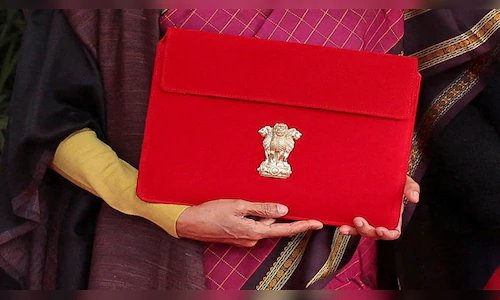
Capital expenditure has emerged as the centrepiece of Union Budget 2026, with Finance Minister Nirmala Sitharaman describing the outlay as the highest in a decade, as the government seeks to sustain growth momentum amid global uncertainty.
The Budget has pegged capital expenditure at ₹12.2 lakh crore for FY 2026–27, up from the revised estimate of ₹10.9 lakh crore in FY 2025–26, marking a 9% increase over the previous year’s budgeted outlay. Capex as a share of GDP remains steady at around 3.1%, underscoring continuity in fiscal strategy.
Effective capital expenditure — which includes grants-in-aid for the creation of capital assets — is projected to rise sharply by 22.1% to ₹17.14 lakh crore in FY27, compared with ₹14.04 lakh crore in FY26 (RE). This lifts effective capex to 4.4% of GDP.
At the post-Budget press conference, Sitharaman said the government wants to upgrade legacy industrial clusters to make them more efficient and cost-competitive, adding that the advantage gained by stepping up capex post-Covid continues to support growth.
Calling this the first Budget of the “second quarter of the century”, she said reforms are being pursued to improve productivity and employment outcomes.
According to Sakshi Gupta, Principal Economist at HDFC Bank, the Budget lays out a medium-term roadmap for boosting domestic growth and productivity amid rising global uncertainties. She noted that unlike last year’s focus on consumption, this Budget shifts attention towards manufacturing and services, while maintaining conservative and credible fiscal assumptions.
Industry and economists broadly welcomed the approach. Shekhar Bhandari, President – SME, Kotak Mahindra Bank, said the Budget charts a growth-oriented path while staying anchored in fiscal discipline. He highlighted the revival of 2,000 industry clusters and the ₹10,000 crore MSME Growth Fund as reaffirming the central role of SMEs and manufacturing in long-term growth.
Jairam Sridharan, MD & CEO, Piramal Finance, said the two defining themes of recent Union Budgets — fiscal consolidation and infrastructure investment — have continued this year. He noted that the fiscal deficit has steadily declined from pandemic-era highs, while capex has risen from about ₹5.5 lakh crore during Covid to over ₹12 lakh crore in the latest Budget.
Sanjay Agarwal, Founder, MD & CEO, AU Small Finance Bank, said the Budget sends a strong signal of consistency and confidence. He added that capex-led fiscal consolidation, with the fiscal deficit anchored at 4.3% of GDP in FY27, provides stability even as the government pushes for growth.
Manoj Shetty, Managing Partner – Capital Markets, Aikyam Capital Group, said sustained capital expenditure of ₹12.2 lakh crore, alongside a declining debt-to-GDP ratio, strengthens the macro framework and provides comfort to long-term investors.