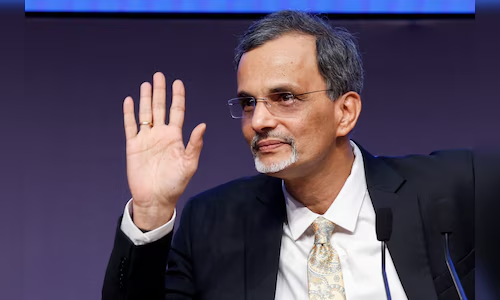
Speaking after Finance Minister Nirmala Sitharaman tabled the Economic Survey in Parliament, Nageswaran said that while taxation remains an important part of the investment climate, policy continuity across both tax and non-tax areas is what ultimately strengthens investor confidence.
“We need to do whatever is within our capability, which is to offer predictability, continuity, and stability of policies, whether it is tax or non-tax,” he said, adding that outcomes are not always fully in policymakers’ control because global factors also shape investor behaviour.
The Economic Survey, released just three days ahead of the Budget, projected real GDP growth of 6.8% to 7.2% for the next financial year (FY27), a slight moderation from the current year’s estimate of 7.4%. It noted that steady growth amid global uncertainty calls for caution, but not pessimism.
On inflation, the Survey pointed out that both the Reserve Bank of India and the International Monetary Fund expect headline inflation to remain around the 4% range, while warning that FY27 inflation may edge higher than FY26.
Nageswaran also downplayed the view that tax policy is the primary barrier to stronger foreign portfolio investment inflows. He said net flows have been influenced more by overseas investments by Indian companies and repatriation from earlier investments, rather than only domestic tax concerns.
“I’m not sure that tax policies themselves are one of the major hindrances,” he said, while acknowledging that unresolved issues such as safe harbour rules, transfer pricing, and definitions around permanent establishment still need attention.
He stressed that geopolitical uncertainty and tariff-related risks, particularly involving the United States, have become the more immediate marginal factors affecting foreign investment sentiment.
The Survey was tabled on a day when the rupee fell to fresh record lows against the dollar. It observed that the currency has been “punching below its weight” in 2025, but added that an undervalued rupee may not necessarily be harmful, as it can help offset the impact of higher American tariffs on Indian exports.
Beyond capital flows, the Survey also made a broader call for India’s next phase of industrial growth to move from “swadeshi” to strategic resilience. It argued that India must raise competitiveness and embed itself deeper into global value chains so that the world shifts from merely thinking about buying Indian to buying Indian without hesitation.
Nageswaran said that for India to strengthen its strategic resilience, both the state and private sector must focus on deregulation, innovation, R&D and quality-driven competitiveness rather than seeking protection from global competition.
As the Budget approaches, the Chief Economic Adviser’s message was clear: attracting sustained capital inflows will require steady reforms, predictable policymaking, and a stronger integration with global markets, not isolated fiscal adjustments alone.
Also Read | Economic Survey 2026 pegs India’s FY27 growth at 6.8-7.2%, outlook remains positive
Below is the verbatim transcript of the interview.
Q: Let me start by talking to you about the sum and substance, as I pointed out — the Economic Survey seems to focus on unleashing the entrepreneurial state but also unleashing the competitiveness of India Inc. If I were to ask you in that context, what do you believe is the single biggest imperative that both the state as well as India Inc. need to focus on today? What would those be?
Nageswaran: The state has to continue with outcome-based policymaking, as we have mentioned. Deregulation is one of them. So, moving from process to outcome orientation, and also the way we look at policy failures ex post, rather than sort of seeing them as wilful negligence, etc. So, there is also some work to be done with respect to how some of the ex post accountability mechanisms operate. These are the two things with respect to the state functioning.
Also, regulatory agencies — not just with respect to the financial market regulator — we are talking more about non-financial regulators, for example in higher education, or for that matter in school education, where a bulk of the regulations focus on inputs rather than the education quality outcome — the size of the library, the number of books you need to have, the size of the playground, etc. But ultimately, the important thing is to ensure physical fitness and high-quality education outcomes. This is just an example.
On the private sector side, there has to be a focus on innovation, R&D, and quality consciousness, which is why I invoked the Prime Minister’s remarks at Independence Day — Daam Kam and Dum Zyada. I think that is exactly what captures the essence of export competitiveness. I think we need to be prepared to compete with the world and not seek refuge under shelter. That is how we are going to establish our strategic resilience and indispensability.
Q: Let me address the paradox in your words of what is happening as far as the currency is concerned. Let’s talk about the fact that, as you point out in the survey, the fundamentals of the economy continue to be strong, yet we have seen a significant depreciation of the rupee. You still believe that the rupee is not an outlier if you look at a longer-term horizon. But in your words, when we talk about investor reluctance and you call for an examination of that, is there anything specific — any friction point — that we can address today to ensure that we start to see capital flows? FPI, for instance. Will it make sense to address tax-related issues at this point in time? Would you believe that that won’t really move the needle much?
Nageswaran: No, whether it will move the needle or not is not exactly in our control. But I would agree with the first part of your statement: we need to do whatever is within our capability, which is to offer predictability, continuity, and stability of policies, whether it is tax or non-tax.
And also, in terms of improving our geographical market access — if you’re located in India, where all you can sell — I think we are expanding our geographical footprints by concluding free trade agreements. So, whatever you mentioned with respect to policies, tax or non-tax, offering predictability and continuity is desirable in and of itself.
Now, whether that will guarantee an outcome is not in our hands, and that has never been the case, because a lot of other considerations influence investor behaviour. But if we keep doing whatever is in our remit, I’m sure investors will take note of that, and in comparison to other nations, we will come out looking better, and naturally, money flows will follow.
Q: Do you believe that at this point in time there is a need to look at taxation specifically to draw FPI flows back in?
Nageswaran: I’m not sure that tax policies themselves are one of the major hindrances, because gross inflows are still doing better than before. It has mainly been the fact that Indian ODI has also picked up, and there has been repatriation from past investments also.
To the extent that there are still some unresolved issues, we need to continue to resolve them, whether it is safe harbour, transfer pricing, advance pricing agreements, definitions of what constitutes permanent establishment for cloud computing and equipment leasing. In many of these areas, I’m sure in the next few days we will get a few answers.
But I think these are all issues that have been there. In spite of that, we have been seeing an improvement in FDI flows over the last several years. Therefore, we cannot attribute the net FDI figures being on the lower side to these factors, because they are stock issues. These variables have been there — they are not incremental variables.
The incremental variable is the geopolitical uncertainty and the tariff situation with the United States, etc. That is the near-term catalyst at the margin for the way net FDI has become weaker.
Continuing to address these issues is desirable in and of itself. But marginal phenomena have to be explained with marginal developments, not stock developments.
Q: One final question as far as the currency is concerned before I move to other issues. You point out in the survey that at this point in time, the depreciation is helping because it offsets some of the negative impact of the US tariffs for instance. Today, almost at 92, we’ve also got Brent now at $70 a barrel. When does it start to become uncomfortable? At what point do you feel that it could start to cause an elevated risk for us?
Nageswaran: This question has been posed by many of you. It needs an empirical answer. I don’t want to be flippant and give you an offhand number, because these things depend on the kind of sensitivity analysis we need to do.
This requires assumptions on the elasticity of our imports and exports, etc. Some of them are essential imports and will be inelastic, and some are elastic, so there will be compensations even within the import basket.
So, it is very difficult to give you an off-the-cuff answer to that question.
Q: Let me then address the issue of competitiveness. You talk about the need for manufacturing competitiveness as well. I heard you speak in your press conference where you brought up how the state was entrepreneurial when we came to software exports. Do you believe that there is a need for an STPI-like approach? We have the PLI schemes already in place, and many other measures have been taken, but are further measures needed to accelerate competitiveness of manufacturing?
Nageswaran: We have to maybe look at some conditionalities related to investment in R&D, innovations, quality, and investments in productive capacity. Also, in terms of keeping domestic prices on par — basically export parity prices — these are the kinds of conditions we should be able to demand in return for any incentives or protection we offer, with the goal of indigenisation.
Q: We brought in the PLI schemes. The objective was to create national champions, global champions. How far have we gone down that journey? What is the data telling you? Have we been able to achieve that aspiration?
Nageswaran: We have succeeded in a few areas, but not in all areas. Some of the conditions with respect to the PLI were oriented towards production against some benchmark reference point.
I think, taking into account the geopolitical context, the kind of performance we demand of our private sector has to have multifaceted criteria — not merely production, but productivity, innovation, R&D, and export parity prices within some pre-specified time frames, rather than being open-ended.
Q: This pivot that you talk about, moving from Swadeshi — where we should not necessarily only focus on import substitution — you have given us a three-tier framework on how this pivot is going to take place to strategic indispensability. Where do you believe India could enjoy that strategic advantage? What could be India’s answer to rare earths?
Nageswaran: Some of these things do not happen overnight. Whether it is rare earths or magnets, it’s about creating the capacity for mining and processing them, and some technologies could be available from other countries. They may be expensive, but that is why, if you look at Chapter 16 in Part One, there are some areas where we have to indigenise even if it is high cost, absorb those costs, and wait for time to make us more competitive and normalise the cost over time.
There are some areas we can postpone, and some we can leave to market forces. So, there is a question of feasibility, desirability, and essentiality. All three have to be looked at together. We need a priority list of areas where we need to achieve resilience first before we can move on to become indispensable in other areas. Then we will have an important role to play in global value chains.
Q: I want to go back to the geopolitical environment, because you do use that to preface the context the Indian economy is faced with today. You talk about the fact that you hope there will be an India-US trade deal this year. But given the tariff turmoil and the possibility of some impacts coming with a lag, what could be the downside risk to some of the projections you’ve made?
Nageswaran: The downside, as I mentioned in my remarks, will definitely come from global conditions and the various risk scenarios that I pointed out in my presentation.
To quantify them is an empirical exercise. It’s difficult to tell you that Scenario A will result in 40 to 50 basis points, or 60 to 80 basis points, etc.
But definitely, whatever happens in the global financial markets or geopolitical disturbances impacting the supply of oil, copper, memory chips, etc., will affect the projections. These are factors beyond our control.
Q: I’m going to take one last question, and this has to do with states, because you gave states an A-plus on deregulation. On the issue of fiscal discipline, you have raised some concerns. How worried are you about fiscal slippages? And if I were to ask you about one more priority area that both the Centre and the states need to go after, what would that be?
Nageswaran: First, on the fiscal side, I’m concerned, but not worried, because growth is taking care of much of the deficit impact right now. But definitely, it’s a concern I want to flag, which is what I did in the survey.
As far as deregulation is concerned, if you want me to point to one area, I would point to education, where states can do a lot more, moving from input-based to output-based regulation.
Q: How long did it take you to put the survey together?
Nageswaran: It normally takes about a couple of months, and this time it has been more intense. It’s about the number of hours rather than the number of days. This time, it has been a very intense exercise.