India and the European Union have concluded a landmark free trade agreement, ending nearly two decades of negotiations marked by repeated breakdowns, shifting political priorities and tough trade-offs on tariffs, market access and regulation. Once implemented, the pact will be the largest trade deal ever signed by both sides, covering a market of nearly 2 billion consumers and close to a quarter of global GDP.
The agreement is expected to reshape trade flows between the world’s fourth-largest economy and its ninth-largest trading partner, while serving as a strategic hedge for both amid rising geopolitical tensions and global supply-chain disruptions.
Nearly 20 years in the making
Negotiations for an India–EU FTA were first launched in 2007, at a time when India was rapidly opening its economy and the EU was aggressively expanding its network of trade pacts across Asia. Early ambitions were high: the deal was billed as a comprehensive agreement covering goods, services, investment, government procurement and intellectual property.
However, progress soon ran into structural disagreements.
By 2010-11, fault lines had emerged over automobile tariffs, wines and spirits, pharmaceutical patents, data protection rules and market access for services. The EU pushed for steep cuts in India’s import duties on cars and alcohol, while India resisted, citing the need to protect domestic manufacturing and farmers.
The talks formally collapsed in 2013, after 16 rounds of negotiations, as both sides hardened their positions. India objected to EU demands on intellectual property protections that it feared could raise medicine prices, while Brussels was unhappy with India’s reluctance to open up public procurement and lower industrial tariffs.
For nearly a decade thereafter, the FTA remained frozen.
Why talks stayed stalled for years
Between 2014 and 2021, India adopted a more cautious trade posture. New Delhi walked away from the Regional Comprehensive Economic Partnership (RCEP) in 2019 and became increasingly sceptical of large, multi-sector trade deals, arguing that earlier agreements had led to import surges without commensurate export gains.
At the same time, the EU was preoccupied with Brexit, internal economic strains and negotiating trade deals with partners such as Japan, Canada and Vietnam. India slipped down Brussels’ list of immediate priorities.
The political climate also shifted. India grew wary of what it saw as the EU’s growing emphasis on environmental standards, labour rules and sustainability clauses, viewing them as potential non-tariff barriers.
A reset after 2022
The stalemate broke in 2022, when India and the EU formally agreed to relaunch negotiations amid a changing global landscape. The Covid-19 pandemic, supply-chain disruptions and the Russia-Ukraine war pushed both sides to diversify trade partners and reduce strategic dependencies.
Crucially, the scope of talks was restructured. Instead of a single mega-agreement, negotiations were split into three parallel tracks: a Free Trade Agreement, an Investment Protection Agreement, and a Geographical Indications (GI) pact.
This modular approach helped negotiators make progress without letting disagreements in one area derail the entire process.
Between 2022 and 2025, negotiators held 14 formal rounds, supported by frequent technical and political-level discussions. Progress remained uneven, particularly on automobiles, services and sustainability commitments, but momentum steadily built as both sides showed greater flexibility.
The final push
The last formal negotiating round took place in October 2025, after which talks entered a political phase. Compromises were struck on some of the most sensitive issues, notably through quota-based tariff reductions on cars, long transition periods for industrial goods and calibrated market access in services.
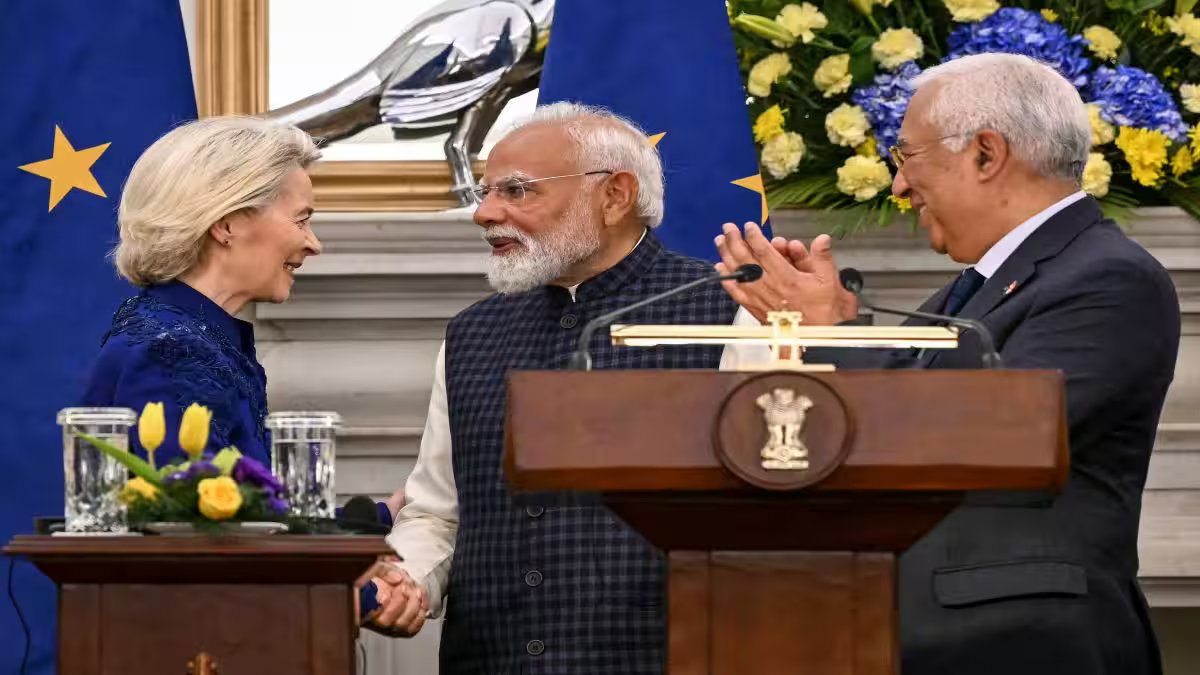
By January 2026, both sides declared negotiations concluded, closing one of the longest-running and most complex trade talks India has ever undertaken.
What the agreement delivers
Under
the FTA, India will cut or eliminate tariffs on 96.6 per cent of EU goods exports, saving European companies up to €4 billion (around $4.8 billion) a year in import duties, according to the European Commission. EU goods exports to India are expected to double by 2032 once the agreement is fully implemented.
One of the most closely watched concessions is in automobiles. India will gradually reduce car import tariffs from 110 per cent to 10 per cent, subject to an annual quota of 250,000 vehicles, while duties on auto components will be scrapped over five to ten years. Beyond the quota, India has made clear it expects European carmakers to invest and manufacture locally.
Tariffs on machinery, chemicals, pharmaceuticals, iron and steel, aircraft and medical equipment will also be phased out over transition periods of up to 10 years. In agri-food, India has agreed to cut steep duties on products such as wines and
olive oil, while continuing to protect sensitive sectors like dairy, rice and sugar.
Beyond goods, the pact grants EU firms India’s deepest-ever commitments in services, including financial services and maritime transport, and strengthens intellectual property protections, addressing long-standing concerns of European businesses.
Why it matters strategically
The EU and India currently trade over €180 billion (around $216 billion) worth of goods and services annually, with EU exports to India alone standing at €75 billion (around $90 billion) in 2024. Trade with India supports around 800,000 jobs in the EU, while European investment stocks in India total over €140 billion (around $168 billion).
For India, the deal signals a calibrated shift towards deeper trade integration without abandoning its ‘Make in India’ strategy. For the EU, it offers a foothold in one of the world’s fastest-growing major economies at a time when Europe is seeking to reduce dependence on a narrow set of global suppliers.
Political and economic hurdles ahead
Despite its conclusion, the agreement still faces important hurdles. On the EU side, the legal text must undergo scrutiny, translation into all official languages and approval by the European Council and the European Parliament. In India, the pact will require cabinet approval and ratification.
Domestically, India must manage concerns from sectors wary of increased competition, particularly in automobiles and agri-food. European policymakers, meanwhile, will face scrutiny over labour standards, environmental commitments and safeguards for sensitive farming sectors.
Once ratified, the agreement is expected to enter into force in phases starting next year, with tariff cuts rolled out gradually over several years. The pace and effectiveness of implementation will determine whether the FTA delivers its promised gains, cheaper imports for consumers, expanded export opportunities for businesses and deeper strategic ties between New Delhi and Brussels.
End of Article