The euro breaches $1.20, and the yen strengthens on intervention chatter; focus shifts to Powell’s message
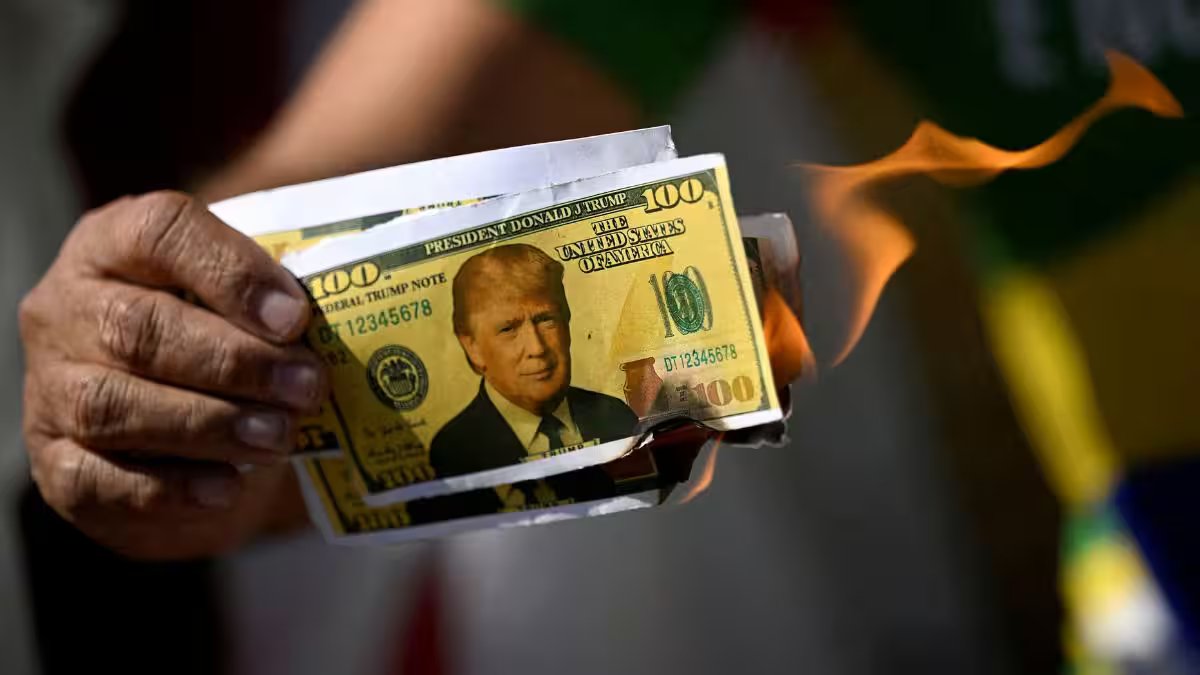
The US dollar remained under pressure near a four-year low on Wednesday after President Donald Trump played down the currency’s recent weakness, prompting fresh selling of the greenback and lifting major rivals such as the euro, yen, and sterling ahead of the Federal Reserve’s policy decision.
Currency markets were still absorbing heavy dollar selling from the previous session, which pushed the euro past the $1.20 mark for the first time since 2021. The single currency was last trading 0.36 per cent lower at $1.1994, after briefly surging above the psychological milestone.
Sterling eased 0.33 per cent to $1.3796, having jumped 1.2 per cent on Tuesday to hit its strongest level since 2021. The dollar index, which tracks the greenback against six major currencies, was marginally higher at 96.114, after sliding more than 1 per cent in the previous session to a four-year low of 95.566.
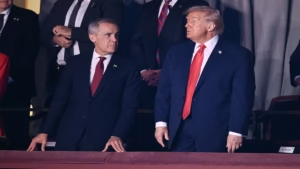
Trump said on Tuesday that the dollar was “great” when asked whether it had fallen too much in value. Markets interpreted the remarks as a signal that the administration was comfortable with a weaker currency, accelerating dollar selling.
While Trump’s stance on the dollar is not new, the comments came at a time when the greenback is already under pressure amid fears over Federal Reserve independence, erratic US trade and foreign policy, and speculation about coordinated currency intervention by US and Japanese authorities to stabilise the yen.
“It shows there’s a crisis of confidence in the US dollar,” said Kyle Rodda, senior market analyst at Capital.com. “As long as the Trump administration sticks with its unpredictable trade, foreign, and economic policy, this weakness could persist.”
The dollar fell more than 9 per cent in 2025 and has continued to weaken in early 2026, already down around 2.3 per cent in January. Investors have grown wary amid concerns about rising public spending, political pressure on the Fed, and uncertainty over future monetary policy leadership.
Attention is now firmly on the Federal Reserve’s policy decision later on Wednesday, where the central bank is widely expected to keep interest rates unchanged. Markets believe the pause could extend beyond Fed Chair Jerome Powell’s final meetings in March and April.
Uncertainty surrounding the possible nomination of Powell’s successor in May, efforts to remove Fed Governor Lisa Cook, and a criminal investigation involving the Fed chief have added to the political overhang on the central bank.
The Japanese yen received a further boost from dollar weakness, surging more than 1 per cent on Tuesday to a three-month high of 152.10 per dollar before easing slightly to 152.79 on Wednesday.
The yen’s recent strength has been driven by talk of US–Japan rate checks, often seen as a precursor to direct currency intervention. Japanese Finance Minister Satsuki Katayama said the government would take appropriate action in foreign exchange markets if needed but declined to comment on the yen’s sharp moves.
Investors, however, remain skeptical about the lasting impact of any intervention, particularly with Japan heading into a snap election on February 8, where Prime Minister Sanae Takaichi’s campaign is centred on expanded fiscal stimulus.
Elsewhere, the Australian dollar touched $0.70225, its highest level since February 2023, supported by broad dollar weakness and data showing consumer price inflation rose at a faster pace in the December quarter, raising expectations of a near-term rate hike by the Reserve Bank of Australia.
The Aussie later eased to $0.6987, while the New Zealand dollar fell 0.5 per cent to $0.6015. Markets now await guidance from the Federal Reserve for cues on the future path of US monetary policy and the dollar’s direction.
End of Article