Exports worth Rs 6.4 lakh crore are expected to gain a major boost under the India–EU Free Trade Agreement, as Indian goods secure access to all 27 European Union markets through a single trade framework, Union commerce and industry minister Piyush Goyal said.
Exports valued at Rs 6.4 lakh crore are set to benefit from the India–EU Free Trade Agreement, with Indian goods gaining access to all 27 European Union markets under a single trade framework, Union commerce and industry minister Piyush Goyal said in a post on X.
Several states are expected to emerge as major beneficiaries, including Gujarat, Maharashtra, Tamil Nadu, Karnataka, Uttar Pradesh, Rajasthan, Punjab, Telangana, Andhra Pradesh, West Bengal, Assam and Kerala, driven by their strengths in manufacturing, agriculture and export-oriented industries.
It is a statement on the depth of the India-EU partnership.#IndiaEUTradeDeal pic.twitter.com/rM2hqH86gL
— Piyush Goyal (@PiyushGoyal) January 27, 2026
India–EU FTA marks historic milestone
India and the European Union on Tuesday concluded the long-awaited FTA, marking a historic milestone in bilateral economic relations and reinforcing both sides’ commitment to diversified, rules-based trade amid rising global uncertainty.
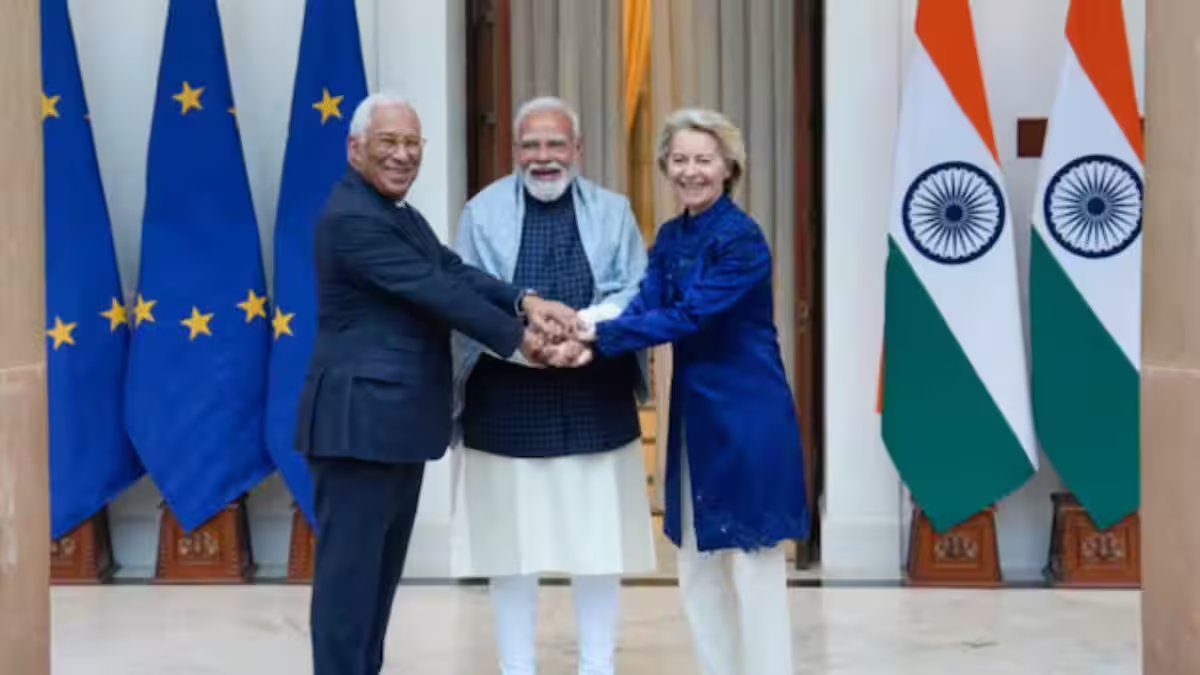
The agreement, finalised after more than two decades of negotiations and revived talks since 2022, was announced at the 16th India–EU Summit by Prime Minister Narendra Modi and European Commission President Ursula von der Leyen.
Timing crucial amid global trade uncertainty
The deal comes at a time of significant global trade disruption, driven by tariff pressures, fragile supply chains and the prolonged Russia-Ukraine war. Together, India and the EU are the fourth- and second-largest economies globally, accounting for around 25 percent of global GDP and nearly one-third of world trade.
Major boost for labour-intensive sectors
The FTA is expected to significantly improve market access for Indian exports across labour-intensive sectors such as textiles and apparel, engineering goods, pharmaceuticals, medical devices, electronics, chemicals, plastics and rubber, marine products, leather and footwear, gems and jewellery, handicrafts, tea, spices and agricultural products.
Once the agreement comes into force, tariffs of up to 10 percent on nearly USD 33 billion worth of labour-intensive exports will be eliminated.
Sector-wise tariff benefits
Under the agreement, 100 percent of tariff lines for textiles and apparel will attract immediate zero duty, opening access to the EU’s USD 263 billion textile market and strengthening India’s global competitiveness.
Tariffs on leather and footwear will be reduced from up to 17 percent to zero, enabling Indian exporters to tap the EU’s USD 100 billion market and revitalise key manufacturing clusters such as Agra, Kanpur, Kolhapur and Ranipet.
The gems and jewellery sector will gain full duty-free access to a USD 79 billion premium market, benefiting major hubs in Gujarat, Rajasthan, Maharashtra and West Bengal.
Engineering and manufacturing exports will receive preferential access to the EU’s USD 2 trillion industrial market, supporting India’s target of reaching USD 300 billion in engineering exports by 2030, with MSMEs across Maharashtra, Karnataka, Gujarat, Andhra Pradesh and Tamil Nadu set to benefit.
‘Balanced and win-win agreement’: Goyal
Addressing a joint press conference in New Delhi, Goyal described the India–EU FTA as a “balanced, fair and win-win” agreement for businesses on both sides.
He said momentum for the deal gathered after the visit of European Union trade commissioners led by Ursula von der Leyen in February 2025, calling it a collective effort by both governments.
Implementation timeline
Goyal said the agreement would now undergo fast-track legal scrubbing and translation into 24 languages, expressing hope that it would enter into force within the 2026 calendar year.
“The India–EU FTA opens up a plethora of opportunities for investments on both sides,” he said.
End of Article