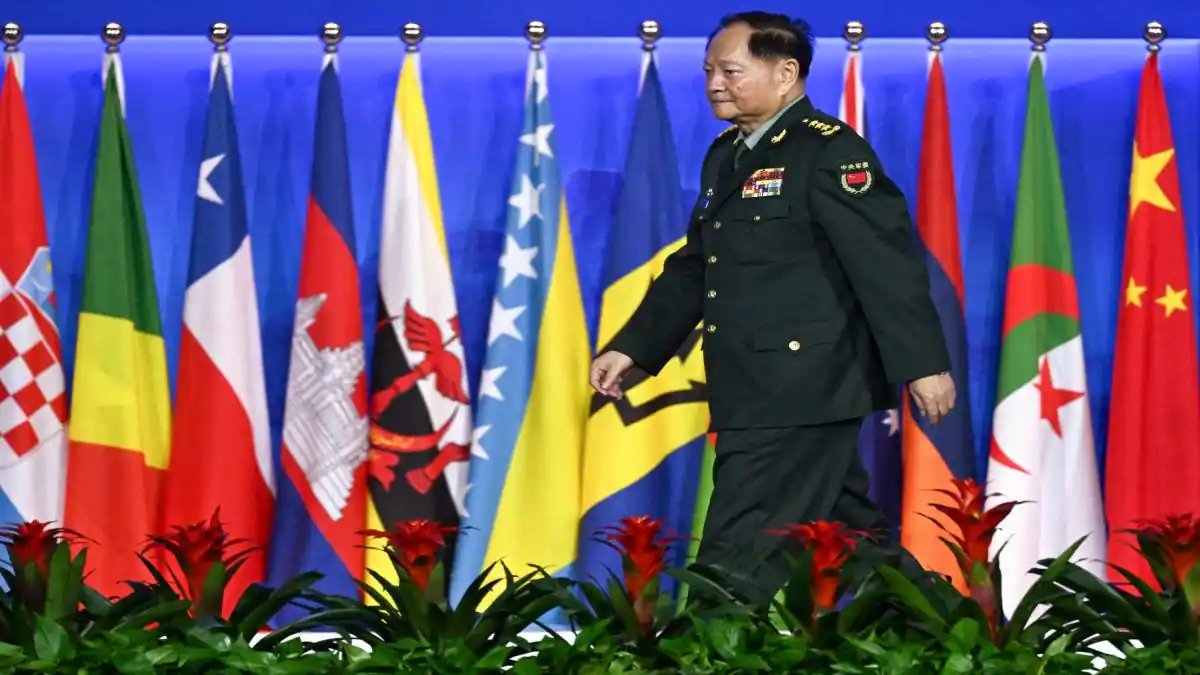
Over the weekend, the Chinese military plunged into chaos when its most senior general, who is also a close ally of Xi Jinping, was placed under investigation for “suspected serious violations of discipline and law”.
China’s defence ministry announced on Saturday (January 24) that
Zhang Youxia and Liu Zhenli, another Central Military Commission (CMC) member, were under investigation for “suspected serious violations of discipline and law”, which means corruption.
This is no ordinary moment in China. As Neil Thomas, a fellow on Chinese politics at the Asia Society thinktank, told The Guardian: “This is easily the most significant People’s Liberation Army (PLA) purge in the post-Mao era. It’s hard to overstate how rare this is … it would be like arresting the chair of the US joint chiefs of staff for corruption.”
But who exactly is Zhang and why has he been placed under investigation?
Who is China’s Zhang Youxia?
Before we deep dive into the many theories surrounding the investigation into Zhang, let’s understand who he is.
Before this episode, 75-year-old Zhang was the senior of the two vice chairs of the powerful Central Military Commission. Zhang is a child of former senior officers — his father was a general who served alongside Xi’s father, Xi Zhongxun, in northwest China.
Zhang began his military career in 1968 and set himself apart for being a stellar frontline officer, especially during the border war with Vietnam in 1979. According to those who served with Zhang, he was an audacious and wily unit leader, who urged soldiers to use more artillery during a series of battles for Longshan, a disputed area on the border.
Consequently, he began rising up the military ladder and he was tapped by Xi to help in the overhaul of the PLA, culminating in a major reorganisation from 2015. “Zhang was a key enabler of Xi’s military reform agenda prior to late-2015 — before Xi became powerful enough to impose himself on the PLA,” James Char, an assistant professor at Nanyang Technological University in Singapore who studies the Chinese military, was quoted as telling New York Times.
The American daily further reports that in 2012, General Zhang joined a delegation of senior Chinese military officers to visit the US. Drew Thompson, then a Pentagon official helping to organise the visit, said the general was strikingly confident and inquisitive.
As the years passed, he became a close ally of Xi Jinping; he was initially expected to retire in 2022, but the Chinese leader reinstated him for a third term on the CMC, underscoring their closeness. Moreover, General Zhang also sat on the Politburo, the Chinese Communist Party’s top political decision-making body, until now.
Reasons behind General Zhang’s fall from grace
On Saturday, China’s Defence Ministry announced in a statement that Gen Zhang Youxia, vice chairman of the Central Military Commission which controls the armed forces, was under investigation and accused of serious “violations of discipline and law.”
Liu Zhenli, another People’s Liberation Army general and a lower member of the commission who was in charge of the Joint Staff Department, was also put under investigation, the ministry said.
The statement gave no details about the allegations against them or the charges they were facing. However, an editorial on Sunday in the Liberation Army Daily newspaper, the mouthpiece of the country’s armed forces, suggested that Zhang was accused of corruption and possibly disloyalty to Xi.
The editorial levelled serious accusations against Zhang, portraying their alleged misconduct as a fundamental threat to the party’s control of the military. The editorial noted that the two men had “gravely betrayed the trust and expectations” of the party leadership, accusing them of “seriously fostering and exacerbating political and corruption-related problems” that weaken the Communist Party’s absolute leadership over the armed forces and endanger the party’s governing foundations.
Adding to this, the Wall Street Journal reported that the top Chinese general had been placed under investigation for reportedly leaking information about the country’s nuclear-weapons programme to the US and accepting bribes for official acts, including the promotion of an officer to defence minister.
The daily noted that Zhang was allegedly forming political cliques, to build networks of influence that undermine party unity, and abuse his authority within the Central Military Commission.
As per the Wall Street Journal, Zhang was also being investigated for allegedly accepting huge sums of money in exchange for promotions in procurement of military hardware. But the most damning allegation against Zhang was that he had leaked core technical data on China’s nuclear weapons to the US.
The Wall Street Journal reported that some of the evidence against Zhang came from Gu Jun, the former general manager of the China National Nuclear Corp, a state-owned company that oversees all aspects of China’s civilian and military nuclear programmes
Others, however, note that the investigation into General Zhang is more about power than corruption. Dennis Wilder, a senior fellow at Georgetown University and a former senior CIA analyst, told The Guardian that a power struggle was a more likely explanation than corruption. The purge “isn’t about corruption, it isn’t about leaking secrets, it is about a general that became too powerful”, he said.
Neil Thomas, a fellow on Chinese politics at the Asia Society thinktank, also concurred on this view. “For Xi, there’s nothing more important than strengthening party discipline and ensuring it does not go the same way as the Soviet Communist party, which in his view was rendered ineffective by corruption,” said Thomas. “No one is safe in Beijing because Xi puts the party above any individual.”
Others also note that Xi’s move against Zhang may be the Chinese leader’s efforts to quash rival factions within the military. The PLA Daily’s editorial suggested that Zhang was becoming too powerful for Xi’s liking, observed Thomas.
As the Indian Express reported, Zhang Youxia and Zhang Shengmin are both seen as part of the “Shaanxi gang”, having worked in the northwestern province (as has Xi Jinping). Until recent events, this clique was seen as being dominant within the CMC. Perhaps, the removal was aimed at checking their influence.
What next for China
Regardless of the reason for Xi’s move against Zhang, it leaves the Chinese leader virtually alone at the top of its military hierarchy. The CMC had six uniformed members until now; however, it now has only one of these members standing —
Zhang Shengmin.
CMC Vice Chairman Zhang Youxia and CMC member Liu Zhenli officially purged.
The CMC has become more ridiculous from 1 chairman 1 vice chairman 2 members to 1 chairman 1 member 😂😂😂 pic.twitter.com/4Cw8n2glz1
— Taepodong (@stoa1984) January 24, 2026
Many
China watchers note that move against Zhang concentrates even more power in the president’s hands, makes the already secretive command of China’s military more opaque, and suggests that a near-term attack on Taiwan is less likely.
James Char, a scholar at the S Rajaratnam School of International Studies in Singapore, told ABC News that by announcing the probe, “Xi has also responded to criticisms that his PLA anti-corruption campaign has been a selective process — that his fellow princeling gets a free pass.”
But it also raises serious questions for China’s military. A depleted leadership raises questions as to how the world’s largest military will be run. There’s also questions on China’s ambitions when it comes to
Taiwan. Some argue that the purges make an attack on Taiwan less likely, at least in the short term, because the army does not have the high level decision-making capacity to launch a sophisticated operation.
But Associate Professor Chong Ja Ian from the National University of Singapore told the BBC, “The purge does not affect the Xi’s ambitions to control Taiwan. That comes down to the CCP as a whole and Xi specifically.”
With inputs from agencies
End of Article