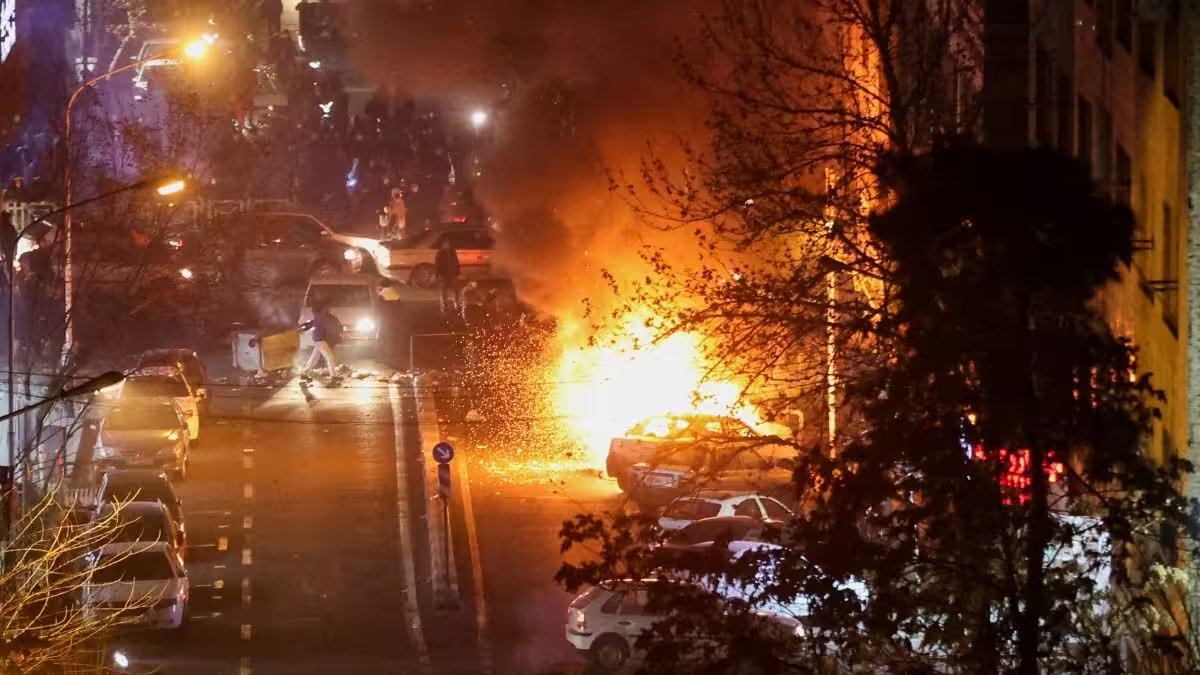
As Iranians have begun receiving brief windows of internet connectivity, the true extent of the crackdown has begun to emerge as testimonies, videos, and confirmation of killings and arrests have begun to trickle out of the country.
As Iranians have begun receiving brief windows of internet connectivity, the true extent of the crackdown has begun to emerge as testimonies, videos, and confirmation of killings and detentions have begun to trickle out of the country.
In the past 10 days, the Washington DC-based Human Rights Activists News Agency (HRANA) has raised its estimated death toll by more than double to 5,848.
In its latest report, the HRANA on Sunday said that another 17,091 deaths are under investigation.
The surge in verification of deaths and detentions has been credited to the unexplained sporadic availability of internet amid Iran’s ongoing communication shutdown. The New York Times has reported that these windows of connectivity have allowed Iranians to send more extensive messages and videos abroad and give journalists and rights groups a better understanding of the extent of the crackdown and its toll.
In this video, which is related to the recent protests, repressive forces can be seen damaging citizens’ parked vehicles. The agents are also shooting at residential buildings. The date when this video was recorded is unknown.#BrutalCrackdown pic.twitter.com/1zoH5VIJty
— HRANA English (@HRANA_English) January 25, 2026
Before recent windows of connectivity, the only connectivity in Iran was through clandestine internet satellite terminals —such as that of Starlink— that the Iranian regime has tried to kill with a full-fledged cyber-offensive.
“Every time I connect, it takes a year off my life. I prefer to turn a blind eye and remain in the dark and in this state of uncertainty and despair,” Mahsa, a 39-year-old resident of Tehran, told The Times in a message when she found connectivity.
With internet, the extent of crackdown emerges
Around the middle of the month, the HRANA estimated that the Iranian regime’s crackdown had killed 2,615 people.
In the latest report that comes after days sporadic internet access, the HRANA said that at least 5,848 people had been killed, including 77 children. It said that at least 41,283 people have been arrested since protests began late last month.
These reports have coincided with a surge of videos of protests and crackdown that the organisation has shared on its social media accounts.
| Category | Figure |
|---|---|
| Recorded gatherings / protests | 645 |
| Cities involved (no duplicates) | 197 |
| Provinces involved (no duplicates) | 31 |
| Confirmed deaths (total) | 5,848 |
| ↳ Protesters | 5,520 |
| ↳ Children (under 18) | 77 |
| ↳ Government-affiliated forces | 209 |
| ↳ Non-protesters / civilians | 42 |
| Deaths under investigation | 17,091 |
| Severely injured | 7,804 |
| Total arrests | 41,283 |
| Broadcasts of forced confessions | 240 cases |
| Summonses to security institutions | 11,023 cases |
While the regime has curtailed internet access, it has used traditional medium has a psychological tool in the crackdown, the report said.
The release of videos or reports featuring forced confessions reflects an escalation of security measures in the media and psychological sphere, which is aimed at instilling public fear, undermining the credibility of protesters, and controlling the narrative of the protests within the country, according to the report.
Is Iranian govt’s internet tactic backfiring?
While officials have not said anything about resuming internet connectivity, observers have said these windows of internet could be an unintended consequence of the Iranian regime trying to create a ‘whitelist’ of internet users.
Amir Rashidi, a cybersecurity expert with Miaan, a digital rights group focused on Iran, told The Times that these windows of internet access may be the result of people trying to access the internet as the regime experiments with methods to “whitelist” users.
Whitelisting refers to the Iranian regime’s efforts to essentially offer different levels of connectivity across the country based on people’s political loyalties or ability to pay for access or their need for the internet, such as for businesses or academic institutions, according to The Times.
“At times, for a few minutes, parts of the network appear to be unfiltered, but this quickly reverts back to a full internet shutdown. All of this points to an effort to aggressively expand whitelisting, ultimately moving toward a form of tiered or class-based internet access,” said Rashidi.
The more the regime experiments with whitelisting, “the more gaps and unintended pathways for connectivity will emerge”, according to Rashidi.
End of Article