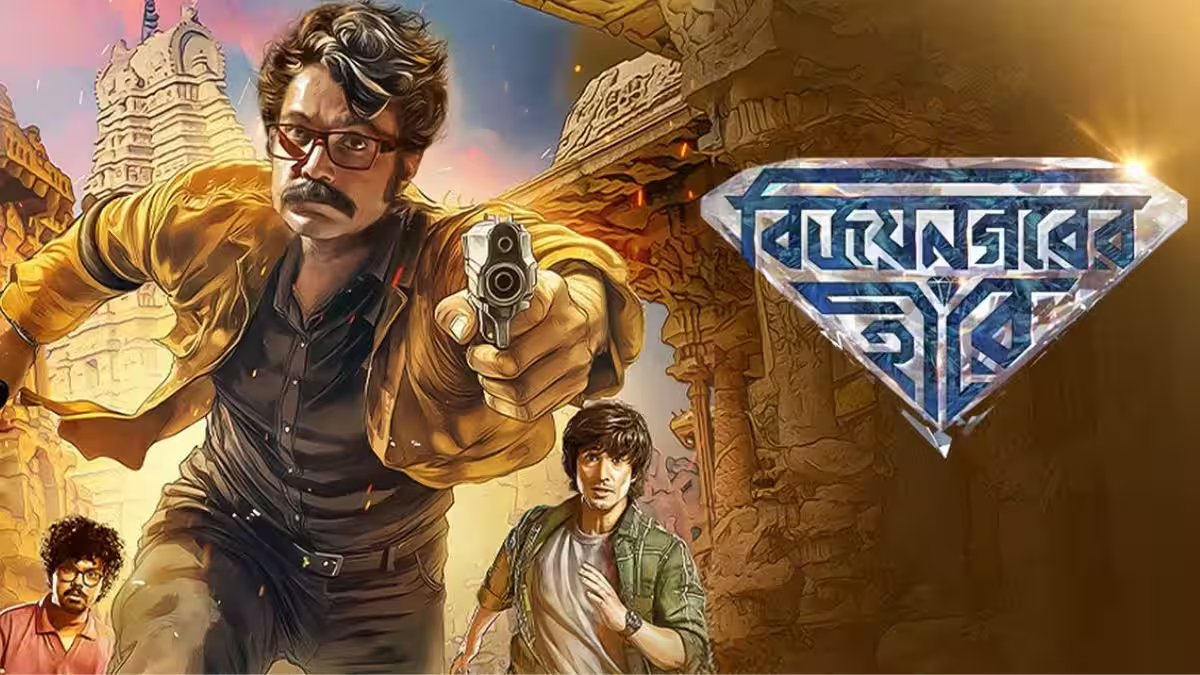
Director: Chandrasish Ray
Language: Bengali
Cast: Prosenjit Chatterjee, Aryann Bhowmik, Chiranjeet Chakraborty, Pushan Dasgupta, Satyam Bhattacharya, Sreya Bhattacharya and Rajnandini Paul.
After three globe-spanning adventures, Kakababu finally turns inward, both geographically and thematically. Vijaynagar’er Hirey (The Diamond of Vijaynagar), adapted from Sunil Gangopadhyay’s beloved Kakababu novel of the same name, marks a significant moment for the franchise.
Not only does it shift the narrative focus to India’s own historical and cultural legacy, it also signals a generational transition behind the camera, with creator-director Srijit Mukherji passing the baton to Chandrasish Ray.
The film opens with a tightly choreographed prologue in
Kolkata that immediately establishes tone and temperament. Raja Roychowdhury aka Kakababu played with assured gravitas by Prosenjit Chatterjee, single-handedly foils an attempted museum heist.
As he overpowers one of the goons, he declares: “This is Raja Roychowdhury’s Kolkata. Invaluable artefacts cannot be smuggled from here on a whim.” The line functions as both a warning and a thesis statement, this is a story deeply invested in the ethics of history, ownership, and preservation.
Disguised as a holiday,
Kakababu sets off for Hampi with his nephew Shontu (Aryann Bhowmick) and young Jojo (Pushan Dasgupta). They check into a heritage hotel run by a royal family, accompanied by Kakababu’s friend Rinku (played by Sreya Bhattacharya) and her husband Ranjan (Satyam Bhattacharya).
But the pretence quickly unravels. Kakababu has been summoned by his former mentor, Professor Bhagwati Prasad Sharma, ailing, enigmatic, and burdened with unfinished business.
Professor Sharma urges Kakababu to resume the quest for the legendary “Hen’s Egg,” a priceless diamond believed, according to myth, to be the lost jewel of the Vijayanagar dynasty.
Through their shared past, the film offers one of its most poignant moments: a glimpse into Kakababu’s younger days and the tragic incident in Afghanistan that cost him one of his legs. Veteran actor Chiranjeet Chakraborty’s Professor Sharma is understated yet deeply effective, much like salt in a well-cooked dish, elevating every scene he inhabits.
Immaculate in its visual design, Vijayanagar’er Hirey strikes a careful balance between information and immersion. The camera moves through the ruins of Hampi and along the banks of the Tungabhadra with reverence and restraint, allowing the landscape to speak without turning it into a visual lecture.
History is folded gently into the storytelling, present and evocative, yet never overwhelming, so that the film flows organically, letting the weight of the past enhance the narrative rather than interrupt it.
The visuals never reduce the location to postcard imagery; instead, they allow the weight of history to seep into the narrative. The Vijayanagar Empire, once one of the richest and most powerful kingdoms in the world, becomes a silent yet commanding presence.
The plot unfolds through riddles, coded clues, and layers of myth tied to the Kavach clan, a secretive lineage sworn to protect the diamond for centuries. Their unwavering devotion is sharply contrasted with the moral corrosion of a few guardians who have strayed from their duty.
While some antagonists are predictable, the film’s focus remains firmly on ideas rather than individuals. This is less a whodunit and more a meditation on cultural inheritance, greed, and guardianship. The run up to the climax keeps on the edge and leaves you awestruck.
Music composer Indraadip Dasgupta, a constant in the Kakababu universe, once again elevates the film. His score blends seamlessly with the narrative, featuring vocals by Rupam Islam, Durnibar,
Shaan, and others. The music underscores both the thrill of discovery and the quiet melancholy of lost civilisations.
Director Chandrasish Ray steps into big shoes but does so with confidence. While Srijit Mukherji laid the foundation of the cinematic Kakababu, blending intelligence, adventure, and moral clarity, Ray brings a slightly more stylised approach.
The pacing remains tight, the narrative focused. Every character, from seasoned performers to supporting roles, is firmly in control. Nothing feels exaggerated or indulgent.
Prosenjit’s Kakababu attains a distinctly larger-than-life stature in this instalment. Stylised action sequences, special effects, and a few overtly heroic dialogues, elements that were sparingly used in earlier films are more pronounced here. Yet rather than diminishing the character, these choices heighten the sense of myth and spectacle.
Shontu’s evolution is particularly noteworthy. No longer just Kakababu’s young shadow, he emerges as an able partner who is seen participating actively in action and investigation. Aryann Bhowmick brings a maturity to the role that reflects the character’s natural growth over the series.
Ultimately, Vijayanagarer Hirey stands out as more than just an adventure film. Rooted in Sunil Gangopadhyay’s literary vision, it uses popular cinema to reintroduce audiences to a forgotten chapter of Indian history. In choosing Hampi and the Vijayanagar legacy as its narrative core, the film reminds us that history is not inert, it lives on through those willing to protect it.
For the Kakababu franchise, this inward journey feels not just timely, but necessary.
Rating: 3.5 out of 5
WATCH the trailer of ‘Vijaynagar’er Hirey’ here:
End of Article