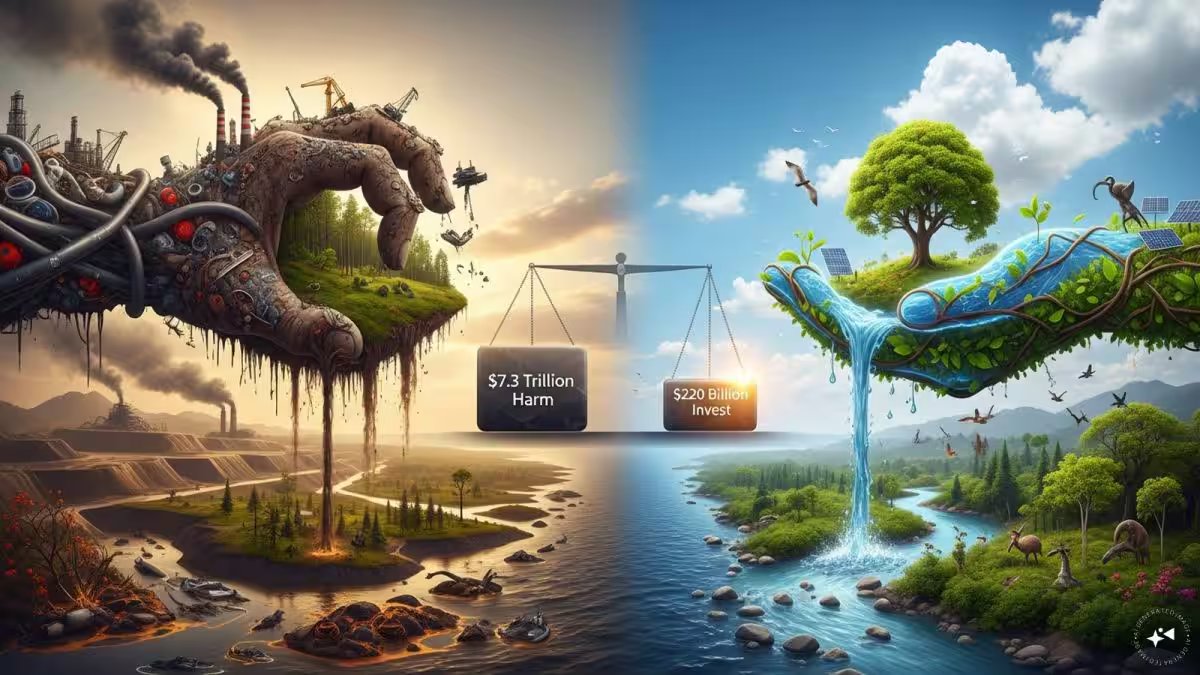
The UN Environment Programme (UNEP), in its report State of Finance for Nature 2026, estimates that activities directly harmful to nature accounted for $7.3 trillion in global finance, while investment in nature-based solutions (NbS) stood at just $220 billion
The world spends around $30 damaging nature for every $1 invested in protecting it, according to a Down to Earth report, citing new United Nations study that highlights a stark imbalance in global environmental finance.
The UN Environment Programme (UNEP), in its report State of Finance for Nature 2026, estimates that activities directly harmful to nature accounted for $7.3 trillion in global finance, while investment in nature-based solutions (NbS) stood at just $220 billion.
UNEP warns that the resulting ratio — more than 30:1 in favour of nature-negative activities — is exacerbating the “triple planetary crisis” of climate change, biodiversity loss and pollution, and underscores the urgent need to redirect financial flows toward protecting and restoring ecosystems.
Global spending on activities that harm nature reached $7.4 trillion in 2023, with private investment and environmentally harmful subsidies continuing to dominate financial flows, according to the UN Environment Programme (UNEP).
Around $5 trillion of the total came from private investment concentrated in high-impact sectors such as utilities, industrials, energy and basic materials. A further $2.4 trillion was channelled through environmentally harmful subsidies, largely supporting fossil fuels, agriculture and water use, the report said.
UNEP warned that investment in nature-based solutions (NbS) must increase at least 2.5 times to reach $571 billion a year by 2030 if countries are to meet climate and environmental commitments. As of 2024, NbS spending accounted for just 0.5 per cent of global gross domestic product.
The report combines financial assessment and technical analysis to guide policymakers, businesses, financiers and civil society on scaling up NbS investment while reducing nature-negative capital flows.
Harmful subsidies outweigh nature finance
Public spending on NbS linked to sustainable agriculture, forestry and fisheries fell by about four per cent between 2021 and 2023, from $69 billion to $66 billion.
Finance through environmental policy and wastewater management also declined, by $980 million and $620 million respectively.
Private philanthropy contributed about $271 million to NbS in 2023, a 60 per cent drop from its 2021 peak. Voluntary carbon markets also contracted, with the value of nature-based carbon offsets falling 57 per cent amid concerns over project integrity.
Mixed signals for nature-based solutions
Despite the imbalance, UNEP identified areas of progress. Private investment in the most nature-damaging sectors, including oil and gas, fell 48 per cent between 2020 and 2023, from $990 billion to $519 billion.
Total public and private finance for NbS reached about $220 billion in 2023, up five per cent year on year. “Finance flows for NbS have increased steadily, reflecting increased uptake based on their ability to address climate change, biodiversity loss and land degradation,” UNEP noted.
Public domestic expenditure remained the largest source, totalling $190 billion in 2023. Spending on biodiversity and landscape protection rose 11 per cent, though support for agriculture, forestry and fishing declined. “Despite its size, public domestic spending remains modest when compared with environmentally harmful subsidies, which continue to exceed $2 trillion annually,” the report said.
Uneven regional trends
Official Development Finance (ODF) for NbS rose to $6.8 billion in 2023, up 22 per cent from 2022. Private finance mobilised by ODF surged to $878 million, a 160 per cent increase, though UNEP warned that geopolitical pressures could constrain future flows. “However, ODF budgets are under heavy pressure in 2024 and 2025 due to the geopolitical situation, which will likely constrain future flows,” it said.
Asia led government NbS spending at $93 billion in 2023, followed by North America at $59 billion and Europe at $34 billion. North America recorded the fastest growth, while spending fell sharply in Africa, the Middle East and Oceania.
Narrowing window for reform
Environmentally harmful subsidies fell 18 per cent in 2023 to an estimated $2.4 trillion, largely due to reduced fossil fuel support after the energy crisis. Fossil fuels still accounted for 47 per cent of such subsidies.
While acknowledging recent progress, UNEP warned that business as usual would continue to degrade ecosystems. To meet commitments under the Rio Conventions, it said, investment in nature-based solutions must rise to at least $571 billion a year by 2030, while finance that harms nature must be phased out or repurposed.
With inputs from agencies
End of Article