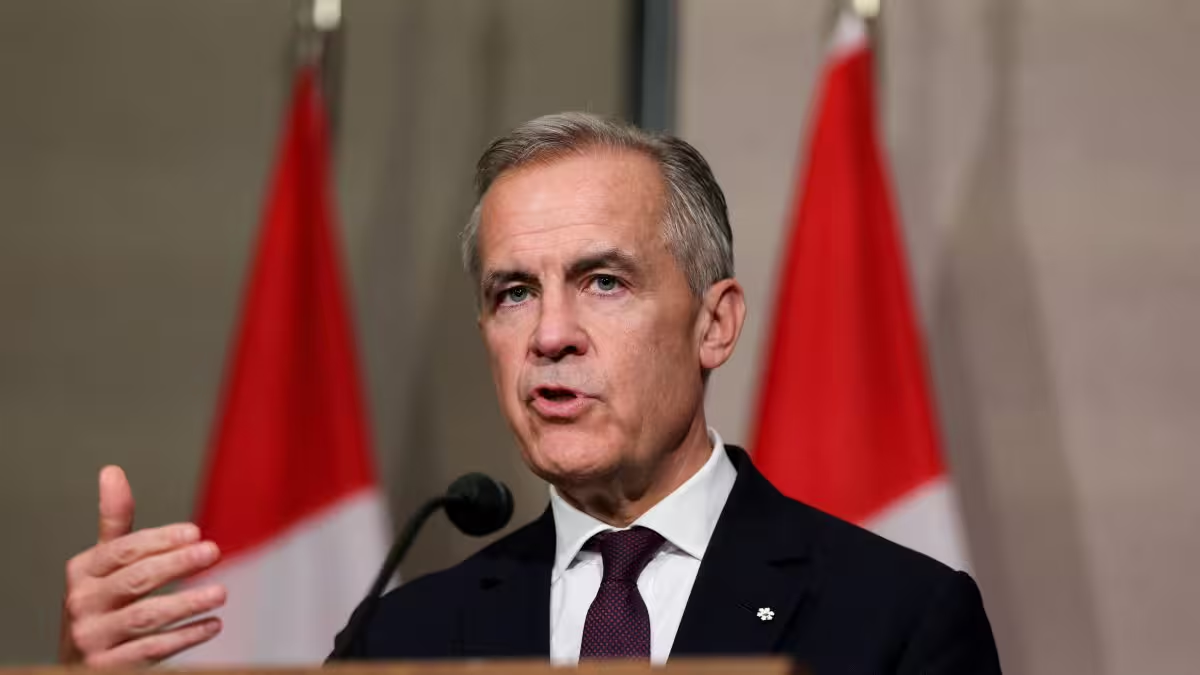
Carney has hit back at President Donald Trump after the US leader claimed that Canada “lives because of the United States” and accused Ottawa of enjoying American “freebies,” saying Canada thrives on its own strength and identity.
Canadian Prime Minister Mark Carney on Thursday sharply rebutted President Donald Trump’s controversial claim at the World Economic Forum that “Canada lives because of the United States.” In a national address, Carney said, “Canada and the United States have built a remarkable partnership,” adding, “Canada doesn’t live because of the United States. Canada thrives because we are Canadian.”
Trump criticises Carney for ‘ingratitude’
Trump responded by slamming Carney for what he described as a lack of gratitude for US military protection. The US president was referring to Carney’s speech in Davos, where the Canadian leader encouraged mid-sized nations to unite against aggressive superpowers.
“Canada gets a lot of freebies from us, by the way. They should be grateful also, but they’re not. I watched your prime minister yesterday. He wasn’t so grateful,” Trump said. “Canada lives because of the United States. Remember that, Mark, the next time you make your statements,” he added.
Carney warns of coercion in global economic order
Carney’s speech at the World Economic Forum on Tuesday drew widespread attention. He declared the international rules-based order “essentially defunct” and warned that the world has entered an era “where the most powerful pursue their interests using economic integration as coercion.”
The remarks stood out given Canada’s longstanding economic dependence on and military partnership with the US. However, Carney, a former central banker, has pledged to reduce that reliance since taking office last year.
Canada diversifies trade and defence
Under Carney, Canada has signed a limited trade agreement with China and begun implementing billions of dollars in new defence spending. The country is also reportedly evaluating investments in Trump’s proposed Golden Dome missile shield—a system the US president has estimated at $175 billion, though Bloomberg analysts suggest costs could reach $1.1 trillion. The shield, relying on untested space-based technology, is intended to defend North America against threats including ballistic missiles, hypersonics, and advanced cruise missiles.
Existing North American defence collaboration
Canada already works with the US through the North American Aerospace Defense Command (Norad). In 2022, Canada announced a C$38.6 billion ($28 billion) plan to modernise the system, including a new radar network developed in Australia to detect incoming missiles—unveiled by Carney in March.
End of Article