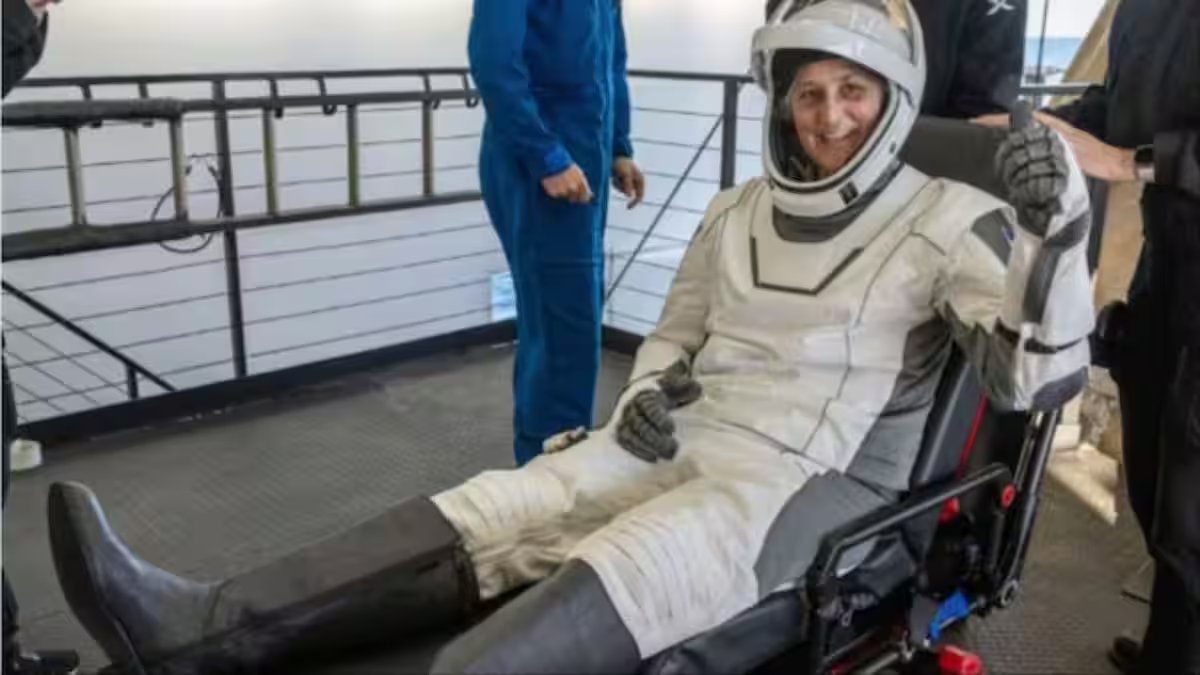
“I hope the US and India will work together in space…I would love to go to the moon, but pass this onto the new generation. So many opportunities for young people in space…they should explore more and participate more,” said Williams in an exclusive interview to News18
NASA astronaut Sunita Williams hopes for closer US-India collaboration in space and expressed her wish to go to the moon, while saying she would leave that opportunity for the next generation.
In an exclusive interview to News18, Williams, who is currently visiting India, said, “I hope the US and India will work together in space…I would love to go to the moon, but pass this onto the new generation. So many opportunities for young people in space…they should explore more and participate more.”
The 60-year-old said she was happy to be back in India and had plans for a vacation after returning to Earth from space.
“It’s good to be back in India. We went through a longer routine to get back in form after we returned to Earth. We needed a mental break as we knew we would be longer in space than anticipated; we loved being in space and had plans when we returned to India…to go on a vacation. We were relieved when we were returning to Earth. My whole family was very supportive,” she was quoted as saying.
Williams described her experience in space as unique and fulfilling, sharing a personal touch of culture with the food she took aboard her spacecraft.
“I took food to the spacecraft, which represented my culture. It was great to be a NASA astronaut,” she added.
During her career, Williams faced unexpected challenges, including an extended stay on the International Space Station when an eight-day mission turned into a nine-month ordeal due to issues with the Boeing spacecraft.
Over her 27-year career, she completed three missions aboard the ISS and set multiple human spaceflight records.
“After 27 years of service, NASA astronaut Suni Williams retired from the agency, effective Dec. 27, 2025. Williams completed three missions aboard the International Space Station, setting numerous human spaceflight records throughout her career,” NASA said in a statement issued on January 20.
Sunita Williams’ stellar career
NASA astronaut Sunita “Suni” Williams, born on September 19, 1965, in Euclid, Ohio, to a Gujarati father, Deepak Pandya, from Mehsana district, and a Slovenian mother, Ursuline Bonnie Pandya, has left an indelible mark on space exploration.
“Suni Williams has been a trailblazer in human spaceflight, shaping the future of exploration through her leadership aboard the space station and paving the way for commercial missions to low Earth orbit,” News18 quoted NASA administrator Jared Isaacman as saying.
“Her work advancing science and technology has laid the foundation for Artemis missions to the Moon and advancing toward Mars, and her extraordinary achievements will continue to inspire generations to dream big and push the boundaries of what’s possible. Congratulations on your well-deserved retirement, and thank you for your service to NASA and our nation.”
Williams logged 608 days in space, ranking second among NASA astronauts for cumulative time in orbit. She shares the sixth spot for longest single spaceflight by an American, with 286 days alongside NASA astronaut Butch Wilmore during NASA’s Boeing Starliner and SpaceX Crew-9 missions.
She completed nine spacewalks totaling 62 hours and six minutes — the most by a woman and fourth-most overall. Williams also became the first person to run a marathon in space.
A retired US Navy captain from Needham, Massachusetts, Williams holds a bachelor’s degree in physical science from the United States Naval Academy and a master’s in engineering management from Florida Institute of Technology. She is an accomplished pilot with over 4,000 flight hours in 40 different aircraft.
Williams first launched aboard space shuttle Discovery with STS-116 in December 2006 and returned on Atlantis with the STS-117 crew. She served as flight engineer for Expeditions 14/15, completing a then-record four spacewalks during the mission.
With inputs from agencies
End of Article