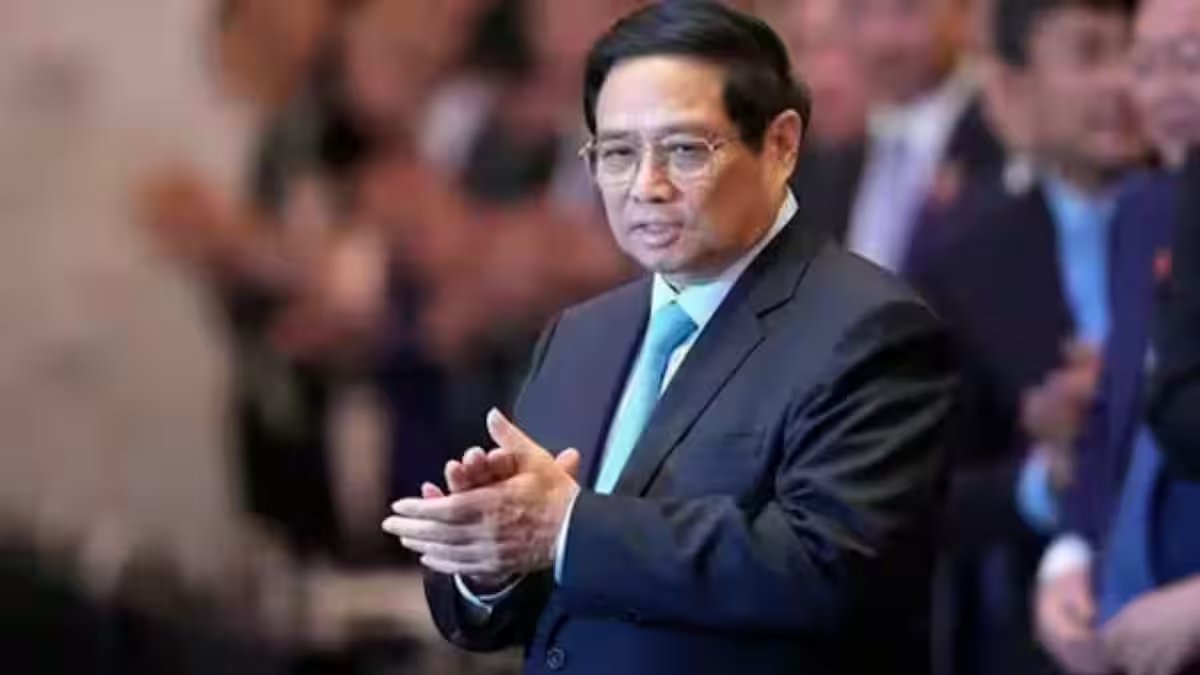
Vietnam’s Communist Party has unveiled a new Central Committee that excludes the sitting prime minister and president, fuelling speculation of a power shift in Hanoi as party authority tightens ahead of key leadership decisions.
The iron-clad tradition of Vietnam’s “four pillars” leadership model is facing its most significant tremor in decades. As the 14th National Congress of the Communist Party of Vietnam (CPV) unfolds this week, the unveiling of the new 200-member Central Committee has sent shockwaves through diplomatic and policy circles. Missing from the list of high-profile delegates are two of the country’s most senior figures Prime Minister Pham Minh Chinh and President Luong Cuong, stoking speculation that their influence is waning in favour of a more centralised power structure.
The Central Committee is one of the most powerful institutions in Vietnam’s one-party system. It sets the country’s broad policy direction and will soon elect the party’s top leader and the roughly 19-member Politburo, whose membership typically determines the nation’s most influential political positions. The absence of Chinh and Luong from the committee is therefore being read as more than a routine personnel shuffle, suggesting a potential re-ordering of political authority in Hanoi.
Central Committee overhaul signals leadership recalibration
In Vietnam’s political hierarchy, formal state titles do not always correlate with real influence. While the prime minister oversees government administration and the president serves as head of state, it is the Communist Party and especially its Politburo that ultimately drives policy and strategic direction. Traditionally, inclusion on the Central Committee has been a prerequisite for elevation to the Politburo. Omissions from the list can therefore sharply narrow an official’s future prospects within the system.
Party insiders see the reshuffle as a sign that internal consensus is shifting. The timing matters: Vietnam has been undergoing a sustained period of elite recalibration, propelled in part by an aggressive anti-corruption campaign that has removed several senior officials over recent years. Those actions have reshaped the party’s internal balance, reduced the autonomy of the government bureaucracy, and elevated figures with strong loyalty to key party leaders.
Observers note that the current National Congress, presided over by General Secretary To Lam, appears to be steering the nation toward a more centralised model of leadership. To Lam, a former security chief, has rapidly consolidated authority since assuming the top post in August 2024. The exclusion of key names from the Central Committee, the body that ultimately influences the Politburo and top offices suggests a meticulously planned reshaping of the political elite.
Analysts view this as part of a broader effort to sideline rivals and reinforce a governance style that prioritises internal cohesion over consensus-based decision-making. The sweeping anti-corruption drive, previously seen as targeting economic malfeasance and bureaucratic inefficiency, now appears to be doubling as a tool for internal restructuring. By promoting loyalists and excluding perceived independent power centres, the leadership seems intent on consolidating authority within a tighter circle.
Party dominance intensifies as governance tightens
The reshaping of the Central Committee comes at a critical moment for Vietnam’s economy and geopolitical positioning. The country faces slowing global demand, pressure on exports, and challenges to sustaining its rapid growth model amid heightened competition from neighbouring economies. Some observers argue that sidelining the prime minister and president reflects unease within the party over the growing prominence of government figures during recent economic pushes such as energy security, infrastructure expansion and foreign investment initiatives.
The party’s latest moves thus reinforce the primacy of ideological loyalty and internal alignment over technocratic leadership. Vietnam’s leadership has long sought to balance market-friendly reforms with strict political control. A streamlined party structure, dominated by figures closely aligned with the current leadership core, could be aimed at ensuring that economic pragmatism does not spill over into political experimentation.
The forthcoming selection of the Politburo will provide the clearest indication yet of where power is coalescing. If figures associated with the current party leadership dominate that body, it would further confirm a shift away from the collective leadership norms that have defined recent decades, toward a more vertically organised system.
Implications for policy, stability and international alignment
For investors and diplomatic partners, the reshuffle raises immediate questions about policy continuity. On paper, the exclusion of the prime minister and president from the party’s central organ does not automatically remove them from office. In practice, however, it weakens their leverage and could constrain their ability to advance reforms or large-scale projects without strong party backing and alignment with the new leadership core.
The reduced visibility of the presidency within the party hierarchy may also diminish the symbolic weight of that office, reinforcing the notion that real authority flows increasingly from party structures rather than state institutions. In the short term, Vietnam is unlikely to experience abrupt policy disruptions; the Communist Party has traditionally managed political transitions with care and has avoided overt factional conflict.
Over the medium term, however, the evolving power balance could shape how boldly Hanoi pursues economic liberalisation, manages corruption enforcement, and navigates an increasingly complex global environment. The internal consolidation comes at a critical juncture: Vietnam is aggressively pursuing a 10% annual GDP growth target for the 2026-2030 period, part of its long-term goal to transition into a high-income developed nation by 2045.
Supporters of the leadership’s more centralised model argue that decisive action and streamlined authority are necessary to cut through bureaucratic “red tape” and accelerate development. Critics warn, however, that concentrating power can stifle internal debate and weaken institutional resilience, particularly as Vietnam seeks to balance relations between major powers such as the United States and China.
In that context, the new party list is less about who is in or out today and more about what kind of political system Vietnam is edging toward one in which the government executes policy, but the party increasingly streamlined and assertive decides its direction.
End of Article