United States President Donald Trump has formally launched a new international initiative aimed at reshaping Gaza’s political future following more than two years of devastating war.
The centrepiece of this effort is a proposed governing body called the “Board of Peace,” which is intended to oversee Gaza’s post-war administration, economic recovery, and long-term stability.
India is among several countries that have been invited to participate in this US-led framework, as Washington seeks broad international backing for its 20-point “Comprehensive Plan” to end the conflict and manage Gaza’s transition away from Hamas rule.
The
White House says the initiative will “play an essential role in fulfilling all 20 points of the President’s plan, providing strategic oversight, mobilising international resources, and ensuring accountability as Gaza transitions from conflict to peace and development.”
What is Trump’s Gaza ‘Board of Peace’?
The concept of the Board of Peace forms a core element of Trump’s wider ceasefire proposal for Gaza.
The 20-point “Comprehensive Plan” was first announced in September last year and, according to Trump, has since received backing from leaders across the Arab world, Israel, and Europe.
The United Nations Security Council formally endorsed the framework through Resolution 2803 in November.
In a letter shared by
US Ambassador to India Sergio Gor on Sunday, Trump described the initiative as the moment when earlier diplomatic ambitions would finally be put into action.
“Now it is time to turn all of these Dreams into reality. At the heart of the Plan is The Board of Peace, the most impressive and consequential Board ever assembled, which will be established as a new International Organization and Transitional Governing Administration,” the letter as seen by Firstpost, read.
Trump said the new body would function both as an international organisation and as a transitional governing authority for Gaza.
The Board of Peace is expected to focus on rebuilding civil institutions, restoring governance capacity, mobilising investment, and guiding Gaza’s economic recovery after widespread destruction.
According to the White House, the board will serve as the central strategic authority overseeing Gaza’s transition. Trump himself will chair the body and retain veto power over its decisions, giving the US president significant influence over its direction.
The initiative is also tied to the second phase of the US-brokered ceasefire process.
US envoy
Steve Witkoff recently launched “phase two” of the plan, which deals with complex issues such as Gaza’s reconstruction, the future disarmament of Hamas, and the deployment of an international security force.
While Washington presents the Board of Peace as a roadmap toward stability and prosperity, many have pointed out that Palestinians have not been included in the top decision-making tier.
How will the three-tier governance structure work?
The White House has outlined a three-level system to manage Gaza’s transition. At the top sits the US-led Board of Peace, also referred to as the Founding Executive Council. This group controls funding, sets strategic priorities, and has final authority over major decisions.
The council is chaired by Trump and
includes several figures closely aligned with his administration or known for their pro-Israel positions. Confirmed members are:
-
US Secretary of State Marco Rubio
-
US Special Envoy Steve Witkoff
-
Jared Kushner, Trump’s son-in-law
-
Billionaire financier Marc Rowan
-
World Bank President Ajay Banga
-
Former UK Prime Minister Tony Blair
-
Robert Gabriel Jr, US Deputy National Security Adviser
Rubio has been one of the Trump administration’s strongest supporters of Israel and has previously stated that critics of Israel would not be granted US visas.
He has also described the recognition of Palestinian statehood by Western countries as a “reckless decision” that “only serves Hamas propaganda.”
Witkoff, a New York-based real estate developer, has been responsible for ceasefire negotiations in Gaza.
He was accused last year of abandoning talks after blaming Hamas for blocking an agreement, a claim disputed by Hamas official Basem Naim, who said Witkoff was “serving the Israeli position.”
Kushner has previously argued that Palestinians are incapable of self-governance and once referred to Gaza as having “very valuable waterfront property.” He was also a key architect of the Abraham Accords, which normalised relations between Israel and several Arab states.
Marc Rowan, co-founder of Apollo Global Management, has funded pro-Israel advocacy organisations and supported the Israeli-American Council.
Ajay Banga, nominated to the World Bank presidency by Trump, previously held senior roles at General Atlantic and Mastercard.
Tony Blair, who supported the US-led invasion of Iraq in 2003, remains a controversial figure in West Asia.
In addition to these figures, two “strategic advisers” have been appointed:
-
Aryeh Lightstone, associated with the Abraham Accords and the Gaza Humanitarian Foundation (GHF), an aid organisation accused of serious mismanagement that
allegedly contributed to the deaths of Palestinians seeking food. -
Josh Gruenbaum, linked to previous proposals to turn Gaza into a “Middle East Riviera,” prioritising real estate development over refugee rights.
Below the Founding Executive Council sits the Gaza Executive Board.
This body is responsible for coordinating governance and reconstruction efforts on the ground and includes representatives from regional powers and international organisations. Its members are:
-
Steve Witkoff
-
Jared Kushner
-
Turkey’s Foreign Minister Hakan Fidan
-
Qatari diplomat Ali Al-Thawadi
-
Egyptian intelligence chief General Hassan Rashad
-
Tony Blair
-
Marc Rowan
-
UAE Minister Reem Al-Hashimy
-
Nickolay Mladenov
-
Israeli-Cypriot billionaire Yakir Gabay
-
UN humanitarian coordinator Sigrid Kaag
The White House said this board will help “support effective governance” and ensure the delivery of essential services in Gaza.
At the bottom of the hierarchy is the only Palestinian-led body: the National Committee for the Administration of Gaza (NCAG).
This 12-member technocratic team is led by Ali Sha’ath, a former Palestinian Authority deputy minister, and is tasked with managing key civilian sectors.
The NCAG includes specialists responsible for:
-
Economy & Trade: Engineer Aed Abu Ramadan
-
Agriculture: Abdel Karim Ashour
-
Health: Dr Aed Yaghi
-
Housing & Lands: Engineer Osama al-Saadawi
-
Justice: Adnan Abu Warda
-
Interior & Internal Security: Major General Sami Nasman
-
Municipalities & Water: Ali Barhoum
-
Finance: Bashir Al-Rayyes
-
Social Affairs: Hana Tarazi
-
Education: Jabr Al-Daour
-
Telecommunications: Engineer Omar Al-Shamali
The appointment of Major General Nasman to oversee internal security places a veteran figure in charge of policing.
However, questions remain about how much authority the NCAG will actually wield, given the parallel presence of US-led forces and the dominance of the Board of Peace at the top.
Alongside the civilian governance structure, a military component has also been established. US General Jasper Jeffers has been appointed commander of the “International Stabilisation Force,” with a mandate that includes “permanent disarmament.”
Which other countries have been invited?
Apart from India, other countries that have received invitations include Argentina, Canada, Egypt, Turkey, Albania, Cyprus, and Pakistan.
Pakistan’s foreign office spokesperson Tahir Andrabi said that
the prime minister had received the invitation and added that Islamabad would continue supporting international efforts for peace and security in Gaza.
Several world leaders have publicly acknowledged being invited to join the initiative. These include:
-
Albanian Prime Minister Edi Rama
-
Argentine President Javier Milei
-
Brazilian President Luiz Inacio Lula da Silva
-
Canadian Prime Minister Mark Carney
-
Italian Prime Minister Giorgia Meloni
-
Turkish President Recep Tayyip Erdogan
-
Jordan’s King Abdullah II
-
Egyptian President Abdel Fattah al-Sisi
-
Hungarian Prime Minister Viktor Orban
-
Romanian President Nicusor Dan
-
Cypriot President Nikos Christodoulides
Trump has also invited the leaders of Egypt, Turkey, and Jordan to help oversee Gaza’s post-war transition, however, it remains unclear which of these leaders have formally accepted their invitations.
Neither Erdogan nor Sisi has confirmed their participation, and there has been no official word on the status of several other invitees.
Bloomberg has reported that the Trump administration is
asking countries to contribute at least $1 billion to become permanent members of the Board of Peace. Nations that opt for non-permanent membership would not be required to pay this fee.
A draft charter reportedly gives Trump authority over membership decisions, renewals, and final approvals.
Why is Israel objecting to Trump’s picks?
Despite the US-led nature of the initiative, Israel has raised concerns about the composition of the new governing bodies, particularly the inclusion of Turkey and Qatar in the Gaza Executive Board.
Prime Minister Benjamin Netanyahu’s office said that the formation of the executive committee “was not coordinated with Israel.” Netanyahu also instructed Israel’s foreign minister to contact US Secretary of State Marco Rubio regarding the issue.
Israeli media reported that National Security Minister Itamar Ben-Gvir called for a return to “full war” and “voluntary migration” instead of handing Gaza’s future to a board that includes Turkey.
Former National Security Adviser Yaakov Amidror expressed similar concerns, warning that allowing “Turkiye – led by a government sympathetic to the Muslim Brotherhood – into Gaza is a strategic error that would strengthen Hamas”.
Israel has also objected more broadly to the White House’s choice of world leaders involved in the initiative, saying some appointments were “contrary to its policy,” though it did not specify which figures it opposed.
What next for Gaza?
While diplomatic manoeuvring continues, conditions inside Gaza remain dire.
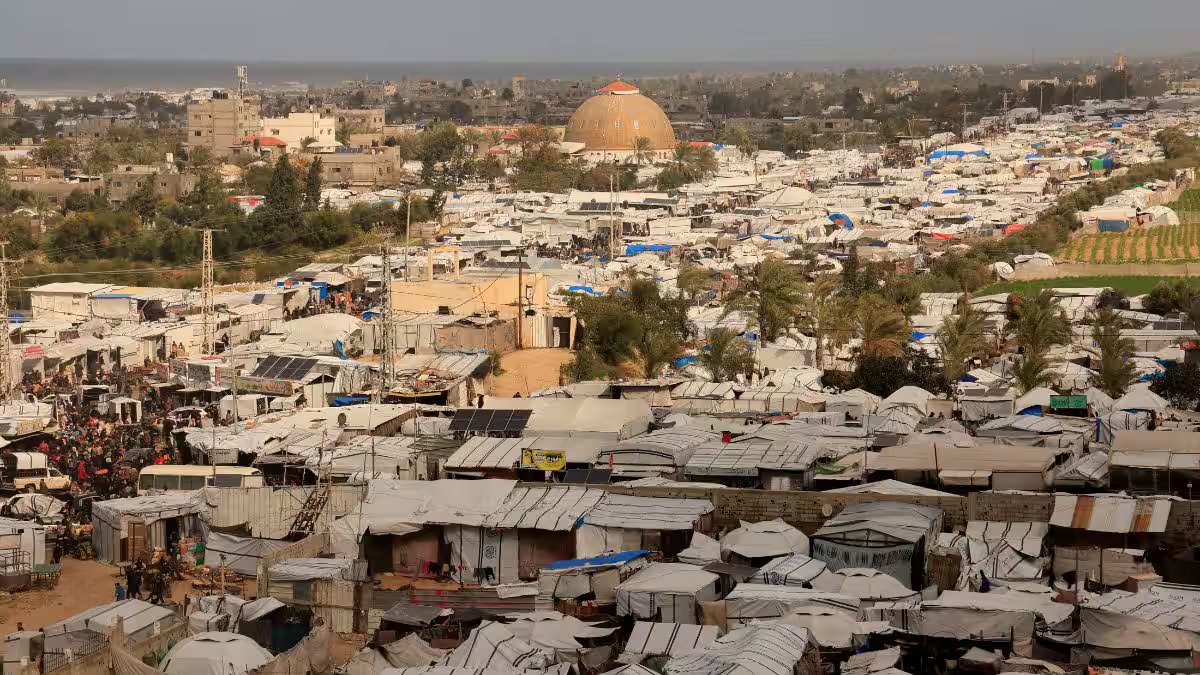
Most of Gaza’s population is living in damaged buildings or makeshift tents
that offer little protection from winter weather. During recent cold spells, some Palestinians reportedly died from hypothermia.
The war, which has lasted more than two years, has left much of Gaza’s infrastructure in ruins. Israeli airstrikes and ground operations have destroyed large parts of the territory, and bulldozers have flattened entire neighbourhoods.
More than 71,000 Palestinians have been killed during the conflict.
The US-drafted ceasefire plan has now entered its second phase, which includes several unresolved and sensitive issues. These include:
Hamas
has not yet agreed to disarm, and the composition of the international security force remains unclear.
While the White House frames the initiative as a path toward “reconstruction and prosperity,” many observers note that Palestinians have little influence over the strategic decisions shaping their future.
Trump’s Board of Peace represents one of the most ambitious international interventions in Gaza’s governance in decades.
The inclusion of wealthy financiers, former Western leaders, and pro-Israel officials at the top has fuelled debate about whose interests the plan ultimately serves.
With inputs from agencies
End of Article