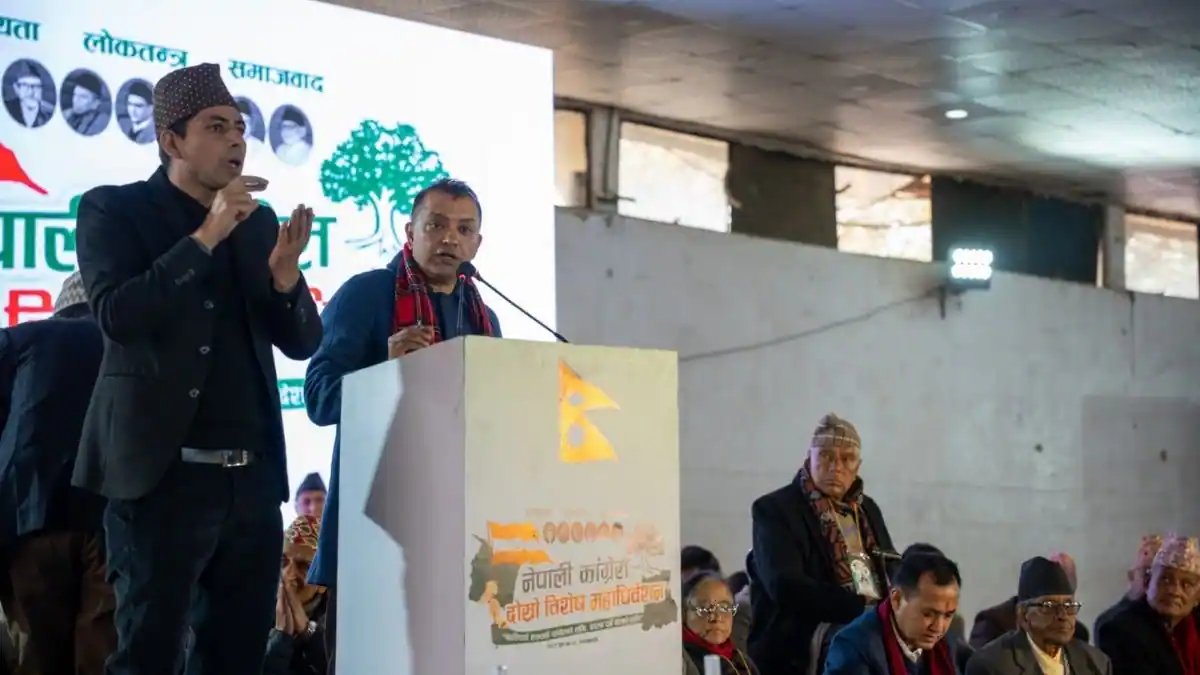
Weeks ahead of the elections, the Nepali Congress has split into two parties, with both factions claiming to be the ‘real’ party. The matter is now before the Election Commission (EC) and is likely to end up in the Supreme Court as the EC’s decision is almost certain to be challenged.
Weeks ahead of the parliamentary elections, the Nepali Congress (NC) on Wednesday split into two factions.
The split happened as negotiations between the Gagan Thapa-Bishwo Prakash Sharma and Sher Bahadur Deuba factions failed to reach an agreement.
Following the failure of the talks, the Thapa-Sharma faction claimed that 60 per cent of NC’s national delegates attended a convention and elected Thapa as President, Sharma and Guru Ghimire as General Secretaries, and Farmullah Mansoor as Vice Chairman, according to The Indian Express.
Thapa and Sharma have claimed their faction as the ‘real’ party.
As both the factions are laying claim to be the real party, the matter is now before the Election Commission (EC) and is likely to end up in the Supreme Court as the EC’s decision is almost certain to be challenged.
Nepal is scheduled to hold elections to the parliament’s lower house, the House of Representatives, on March 5. The house was dissolved last year after the youth-led protests topped the government of then-Prime Minister KP Sharma Oli.
On its part, the Deuba faction has called a meeting of NC’s central working committee and decided to take disciplinary action against Thapa and Sharma, which included stripping them of their party membership, according to The Kathmandu Post.
In their arguments before the EC, The Post reported that Thapa-Sharma faction has argued that their convention had dissolved Deuba’s central working committee so any decision by the committee was invalid. On its part, the Deuba faction has argued that any decision by Thapa and Sharma was not valid because they had been expelled from the party.
The Express reported that dissent against Deuba’s leadership had been brewing for months within the NC that was fuelled after he unilaterally decided to join the coalition of then-PM Oli of Communist Party of Nepal-Union Marxist Leninist (CPN-UML).
The government was eventually overthrown in the youth-led movement in September 2025.
End of Article