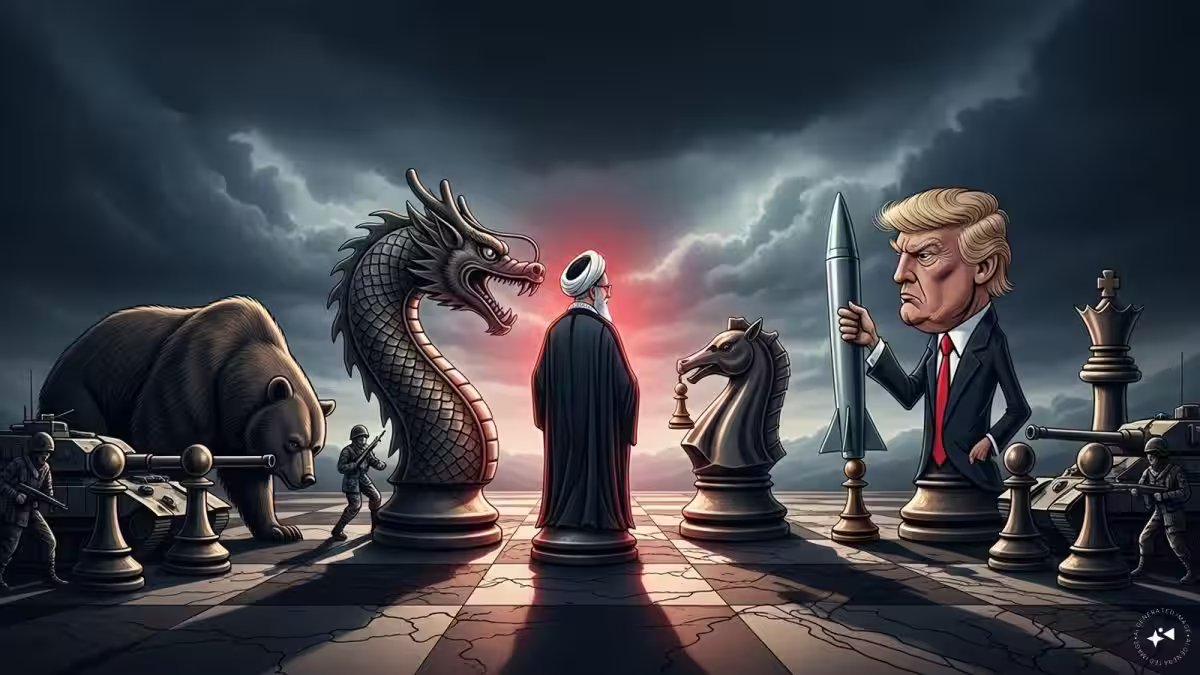
As mass protests sweep Iran, the country appears geopolitically weakened, with its traditional partners offering little assurance of decisive support. While
US President Donald Trump weighs military options, neither Russia nor China seems willing to fully step in, raising questions about how far Tehran’s allies are prepared to go to protect the Islamic Republic.
Iran is facing one of the most powerful protest waves in its history, with demonstrators storming government buildings and spreading across entire cities. Despite hundreds of reported fatalities during a state crackdown, the protests show no sign of abating. For the first time,
demonstrators are rallying under relatively unified slogans demanding the restoration of the monarchy.
The
protests, which erupted at the end of last year, quickly turned violent. Protesters threw stones at police, attacked government buildings, set fire to security vehicles and hurled Molotov cocktails at law enforcement officers.
Human rights activists say more than 500 people have been killed and over 10,000 detained. Since January 8, Iran has imposed a near-total internet blackout in an effort to disrupt mobilisation.
Although protesters have articulated a clear political demand, they continue to suffer from poor coordination and a lack of recognised leadership.
Trump weighs options as stakes rise
The possibility that the unrest could escalate further has been shaped by repeated warnings from US President Donald Trump. He has threatened strikes if Iran continues suppressing protests, saying on Monday that “we’re looking at some very strong options”.
Recent US military action in Venezuela has lent credibility to those threats. The United States and Israel have already considered further strikes on Iran to dismantle its nuclear programme. Such action could fuel hopes of regime change among protesters, though it could also prompt the authorities to rally public support against an external threat.
Russia’s limited backing
Russia, one of Iran’s closest allies in recent years, appears prepared to offer only limited assistance. According to Carnegie Politika, Tehran cannot expect Moscow to do much more than supply helicopters and provide a refuge for fleeing leaders if the situation worsens.
Several Il-76 military transport aircraft have reportedly arrived in Iran from Russia and Belarus, alongside the country’s first Mi-28 attack helicopters. In December, images emerged showing dozens of Russian Spartak armoured vehicles delivered to Iran.
Such equipment would be ineffective against US or Israeli air strikes and unnecessary for crowd control. It would, however, be relevant if unrest were to escalate into armed insurgency.
Even so, Moscow’s support should not be overstated. The Kremlin has previously abandoned allies when circumstances deteriorated, including in Venezuela earlier this year, in Syria after the collapse of Bashar al-Assad’s regime in 2024, and in Iran itself during the twelve-day war last summer. Direct deployment of Russian troops to defend the Iranian regime appears unlikely.
What Moscow is doing is closely studying Iran’s response to unrest. Russia is examining Tehran’s use of internet restrictions, particularly its “national internet” system, which keeps domestic services running while cutting off external access. Russia’s own internet “whitelists” closely mirror this approach, and millions of Russians have already experienced similar shutdowns.
China keeps its distance
China, meanwhile, has denounced “interference” in Iran’s internal affairs but is unlikely to mount any rescue effort. Observers point to Venezuela as a precedent, where Beijing avoided direct involvement despite its economic interests.
Just weeks after Iran’s Islamic Revolutionary Guard Corps led a “counterterrorism” drill with China, Russia and other Shanghai Cooperation Organisation members, the same force is now being deployed domestically against protesters it labels “terrorists”.
As deaths reportedly mount into the thousands, Iran’s ambassador to Beijing, Abdolreza Rahmani Fazli, said Tehran would protect Chinese businesses and nationals and hoped to receive help from China and other “friendly countries”, according to state-owned Phoenix TV.
‘No bullet to take’ for Tehran
Those appeals have been met with open scepticism in parts of China’s nationalist discourse. Zhanhao, one of China’s most widely read WeChat public accounts, argued that China should not “take the bullet” for Iran, contending that Tehran has failed to prove its value to Beijing.
While Zhanhao is a for-profit outlet, its reach and alignment with officially tolerated nationalist narratives have made its position notable. The commentary reflects a broader, increasingly transactional view of the Iran-China relationship, one shaped by risk aversion and concerns over secondary sanctions.
China continues to absorb most of Iran’s oil exports, but at steep discounts, while flooding the Iranian market with Chinese goods. Against this backdrop, Beijing’s reaction to Iran’s mass killings of protesters and sweeping internet blackout remains unstated.
End of Article