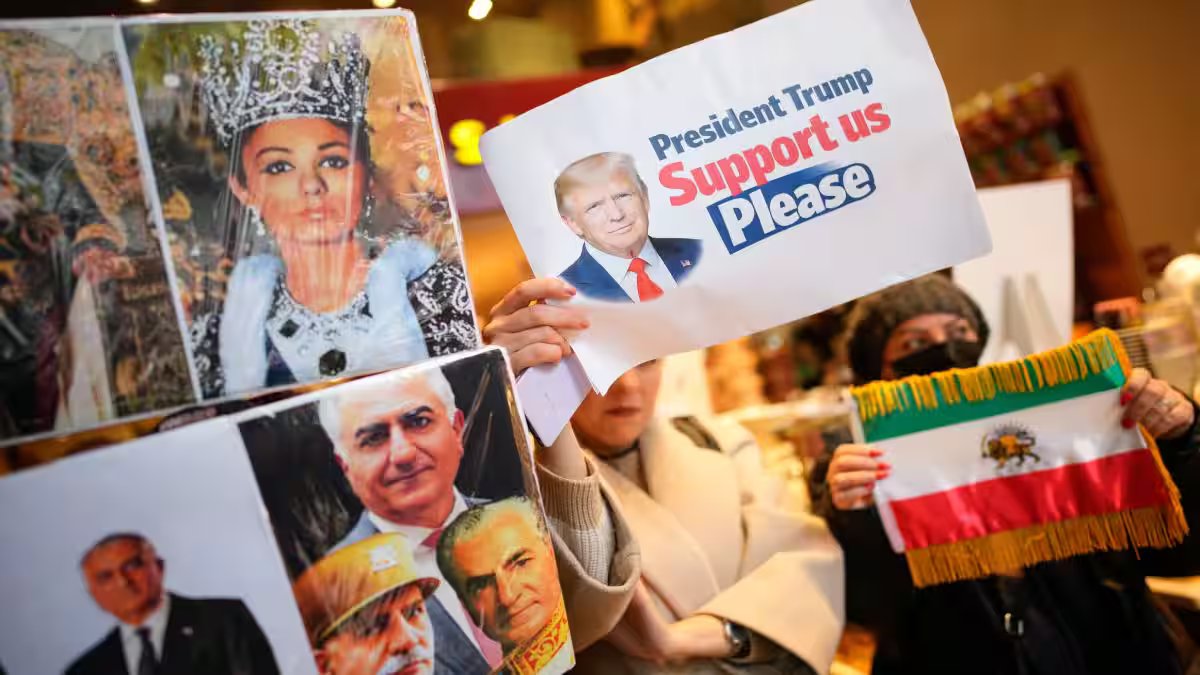
Six hundred and forty-six and counting. That’s the number of Iranians who have died so far as protests continue to roil the Islamic Republic. Amid this volatile situation, US President Donald Trump has ramped up the pressure on Tehran, announcing a 25 per cent tariff on “any country” doing business with Iran.
The US president posted on social media on Monday that the new duty would be “effective immediately,” without providing further details. The administration has yet to issue paperwork outlining the scope of the charges. “Effective immediately, any country doing business with the Islamic Republic of Iran will pay a tariff of 25 per cent on any and all business being done with the United States of America. This order is final and conclusive,” Trump wrote on his social media platform.
The tariff announcement by Trump comes as the US leader mulls possible military action against Iran over the protests. His White House Press Secretary, Karoline Leavitt, said earlier: “Air strikes would be one of the many, many options that are on the table.” However, she added that Iran had opened a diplomatic channel.
While it’s not clear what Trump’s orders are regarding the tariffs — what qualifies as “doing business” with Iran — this order is likely to impact several nations such as India, China, Brazil, Turkey and Russia.
Why is Trump targeting Iran’s partners with tariffs?
On Monday (January 12), without giving any additional details, Trump announced that countries which engage in trade with Iran will face a
25 per cent tariff on any business done with the US.
This announcement comes after Trump threatened to intervene militarily if Tehran killed protesters. Trump, on Sunday, said that Iranian officials had called him “to negotiate” — but added “we may have to act before a meeting”.
The Islamic Republic has been witnessing
mass rallies and demonstrations for the past three weeks, calling for an end to the clerical regime. In turn, Iran’s Supreme Leader,
Ayatollah Ali Khamenei, has taken a hard line against protesters, saying that demonstrators were “ruining their own streets to make the president of another country happy,” referring to the US president.
But despite Trump’s threats to Iran on its crackdown of protesters, human rights groups note that the death toll has neared 700, with US-based Human Rights Activists News Agency stating that 646 people have perished so far in the protests. Additionally, more than 10,700 people have also been detained. It’s important to note here that an internet blackout in Iran has restricted the flow of information, making it difficult to ascertain and gather information.
The grieving relatives of demonstrators killed by the regime’s bloody crackdown were seen on footage today trawling through body bags at a morgue on the outskirts of Iran’s capital.
Speaking on the tariffs, Michael Singh, former senior director for Middle East affairs at the National Security Council under President George W Bush, now the managing director at the Washington Institute for Near East Policy, told Politico: “For President Trump, this seems like a pretty mild response to a very significant situation in Iran and so this will probably disappoint many in the Iranian American community. “The problem is that we have sanctions in place against Iran that are quite tough, but they’re not being enforced — I mean Iran is selling lots of oil, and so I think the question will be what’s new here and is it going to be enforced, unlike the other sanctions that are already in place.”
Which are Iran’s major trading partners?
Trump’s 25 per cent tariff declaration puts a spotlight on Iran’s major trading partners. China is Iran’s largest oil and trading partner and may be most affected by Trump’s announcement. According to a CNN report, the new tariff could mean a minimum 45 per cent tariff rate on goods from China versus the current rate of 20 per cent. In the first 11 months of 2025, China exported $6.2 billion worth of goods to Iran and imported $2.85 billion, according to Chinese customs data.
And that’s not taking into account oil purchases. Analysts estimate that China has accounted for more than 90 per cent of Iran’s oil trade in recent years, imported through intermediaries.
Iran’s other trading partners include India, Russia, Turkey, and even the UAE. When it comes to Russia, Iran has close ties in the sectors of defence, energy and finance. A 25 per cent US tariff would add pressure to Russia’s already-sanctioned economy.
What about India-Iran trade?
India is among Iran’s five largest trading partners and is likely to be hit even further by Trump’s announcement.
According to the Indian Embassy in Tehran, India exported goods worth $1.24 billion to Iran in 2024-25, while it imported goods worth $0.44 billion, taking total trade to $1.68 billion. Before that in 2022-2023, trade between the two nations was $2.33 billion.
Major Indian exports to Iran include basmati rice, tea, sugar, fresh fruits, pharmaceuticals, soft drinks (excluding sharbat), kernels, HPS, boneless bovine meat, pulses, and other products. On the other hand, major Indian imports from Iran include saturated methanol, petroleum bitumen, apples, liquified propane, dry dates, inorganic/organic chemicals, almonds, etc.
There’s also the
Chabahar Port, which both countries signed an agreement on in 2015.
Notably, the US has already levied a whopping
50 per cent tariff on India, including a 25 per cent tariff for purchasing Russian oil. Additionally, as recent as the first week of 2026, the US president issued a new threat to India, saying the US could further raise these levies. Speaking to reporters, Trump then said: “They wanted to make me happy, basically. PM Modi is a very good man. He’s a good guy. He knew I was not happy. It was important to make me happy. They do trade, and we can raise tariffs on them very quickly, and it’ll be very bad for them,” Trump said, referring to New Delhi’s purchase of Russian crude.
Also, last week, the US president greenlit legislation that would impose
500 per cent tariffs on any country that buys oil from Russia.
These tariff threats could hinder India-US ties even as the two nations continue to finalise a deal that would provide long-sought tariff relief to New Delhi.
Since coming to power the second time, Trump has been using tariffs as leverage against other countries. But this has now been
challenged in the Supreme Court, with a verdict expected this month.
With inputs from agencies
End of Article