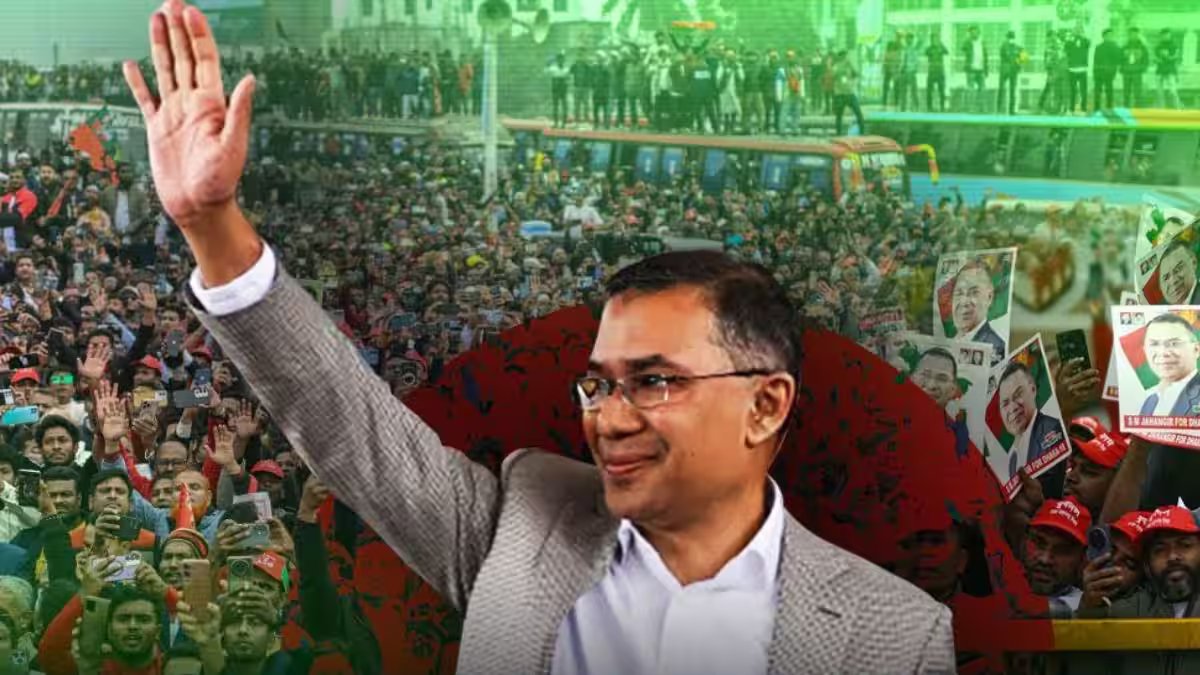
Newly appointed BNP chairman Tarique Rahman on Saturday said there is “no reason” for Bangladesh to return to the political conditions that existed before the toppling of Sheikh Hasina’s regime on August 5, 2024.
Newly appointed Bangladesh Nationalist Party (BNP) chairman Tarique Rahman on Saturday said there was “no reason” for the country to revert to the political environment that existed before the fall of Sheikh Hasina’s government on August 5, 2024.
Speaking weeks ahead of the February 12 general elections, Rahman also asserted that the BNP would steer Bangladesh “in the right direction” if it formed the next government. At 60, he has emerged as a frontrunner for the prime minister’s post.
Rahman’s elevation was approved by the BNP’s Standing Committee during a meeting held on Friday, days after the death of his mother, former prime minister and long-time party chief Khaleda Zia, who passed away on December 30 following a prolonged illness.
Addressing editors and senior journalists hours after his appointment, Rahman acknowledged lingering political challenges but rejected any return to the situation that prevailed before August 5. “We faced problems before and we continue to face them now. But there is no reason to go back to the period before August 5,” he said. Stressing dialogue, he added that differences within society should be resolved through discussion rather than confrontation.
Rahman said the continuation of democratic practices and accountability would be central to his leadership if the BNP won power. Drawing on key moments in Bangladesh’s history, he said the ideals of the 1971 Liberation War, the 1990 mass movement against the HM Ershad regime and the August 5 uprising should guide the nation’s future path.
“If we can keep these moments in mind, I strongly believe we can move Bangladesh forward in the right direction,” he said. He also outlined broad priorities for reform, pointing to healthcare and economic development as areas that would receive attention under BNP rule.
Reiterating his commitment to democracy, Rahman said meaningful change would be possible only through sustained democratic processes. “There may be many hurdles and it may be extremely difficult, but if accountability and democracy are maintained over time, change will follow,” he said.
However, Rahman did not spell out his party’s position on shifting geopolitical dynamics or elaborate on strategies for navigating the altered domestic political landscape ahead of next month’s polls.
Hasina, who was ousted after violent student-led protests over July and August that year, fled to India on August 5, 2024.
Three days later, Muhammad Yunus took over as head of the interim government, which disbanded Hasina’s Awami League party through an executive order. A special Bangladeshi tribunal subsequently sentenced Hasina to death penalty on charges of committing “crimes against humanity” through her “brutal” efforts to tame the student-led protests, termed the July Uprising.
With Hasina and her Awami League no longer in the fray, Rahman’s BNP is the forerunner with its once crucial ally Jamaat-e-Islami being the main rival.
Earlier late on Friday night, the BNP posted on X: “Following the passing of BNP Chairperson and former Prime Minister, national leader Begum Khaleda Zia, the position of party Chairman became vacant. In line with the BNP constitution, a meeting of the National Standing Committee was held.” “At the meeting, Mr Tarique Rahman was unanimously appointed to the vacant post and formally given responsibility as the Chairman of the BNP,” it added.
Rahman returned to Bangladesh on December 25 after 17 years of self-exile in London.
In 2002, Rahman was made BNP’s Senior Joint Secretary General and became Senior Vice Chairman in 2009. In 2018, when Zia was imprisoned, Rahman was appointed acting chairperson of the party.
“I have a plan,” he said in his first public address on the day he returned from UK, apparently referring to the African-American rights activist Martin Luther King’s famous quote, “I have a dream.” PTI AR/RD GSP NPK NPK
.
.
End of Article