
Aziz flagged an unprecedented divergence seen in 2025, where the US experienced a surge in capital expansion even as employment declined — a combination never witnessed in the past seven decades. “Never ever in the last 70 years has that been the case,” he said.
This matters because consumption accounts for nearly 70% of the US economy, and sustained job weakness could directly undermine spending.
JP Morgan’s 2% US growth forecast for 2026 assumes that employment growth eventually converges with capital expansion. “If that starts to weaken, I think we will have serious concerns about where this economy is going,” Aziz warned.
Beyond domestic economic risks, Aziz pointed to a profound shift in US foreign policy that could reshape the global order. He described the current approach as a clear departure from the internationalism and multilateralism that have defined US policy since World War II.
“This is a significant shift in US foreign policy… back to spheres of influence, back to the Monroe doctrine of the 1820s,” he said. While the change is structurally important, Aziz believes its practical impact will largely be confined to the US’s immediate region and is unlikely to trigger widespread unilateralism elsewhere.
In the near term, markets face several key catalysts that could influence sentiment and volatility. Aziz highlighted an upcoming Supreme Court judgment on tariffs and the Lisa Cook hearing, events he believes will shape how markets assess the independence of the US Federal Reserve. He also drew attention to a relatively underappreciated development: the European Union’s pilot programme to impose carbon adjustment taxes on imports such as steel and aluminium. “Let’s see how the US reacts to an implied 25–30% tariff because of the cross-border carbon tax,” he said, noting potential repercussions for US, Chinese and Indian exporters.
Also Read: India’s capital markets to rebound in 2026; M&A deals seen at $130–135 billion: Kotak Investment
Taken together, rising geopolitical uncertainty and questions around US institutions are likely to have implications for asset allocation. Aziz expects such uncertainty to remain supportive of gold prices, while the US dollar’s longer-term trajectory is likely to weaken, despite periods of strength, particularly with mid-term elections approaching.
Also Read: Budget flexibility hinges on nominal growth this year, economists caution
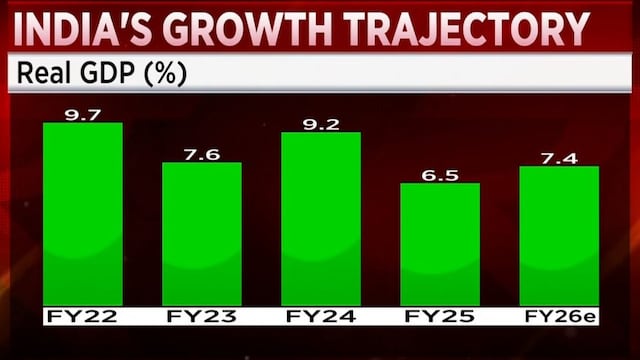
Turning to India, Aziz returned to what he described as a long-standing concern, calling himself a “broken record.” He argued that the core structural challenge facing the Indian economy is the persistent failure of the private corporate sector to raise investment levels. Despite reforms such as interest rate cuts and corporate tax rationalisation, private investment has remained stuck at around 12% of GDP for more than a decade. “After 12 years, we need to ask ourselves what the structural problems are that are stopping corporate India from actually expanding capacity and investing in India,” he said. Without a revival in private capital expenditure, Aziz warned, India’s growth will continue to rely on cyclical government-led stimulus rather than achieving a durable, higher growth path.
For the entire interview, watch the accompanying video


