The removal of Nicolas Maduro has exposed fragile power structure in Venezuela.
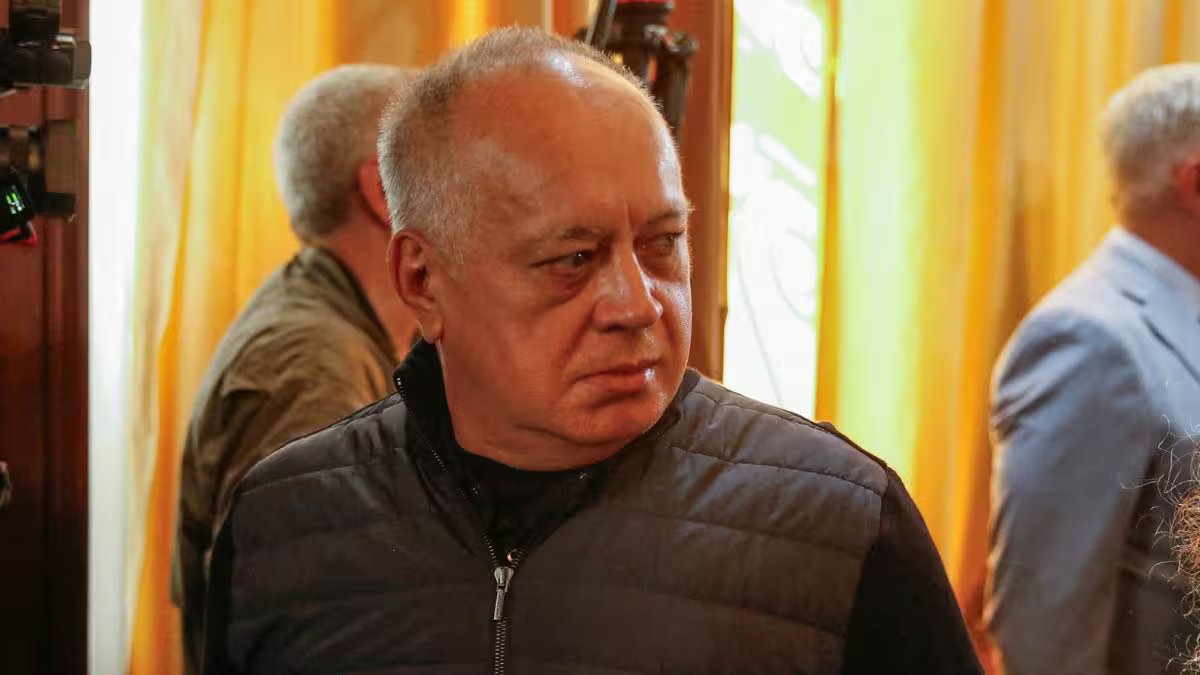
At the centre of this structure is Diosdado Cabello Rondón, Venezuela’s interior minister and one of the most powerful figures to emerge from the ruins of the Maduro presidency.
With Washington attempting to shape a post-Maduro transition without deploying ground troops, Cabello has become a figure of concern for US officials, reported Reuters in an exclusive.
Seen simultaneously as indispensable for maintaining order and as a potential destabiliser, he is being widely viewed as someone the United States ultimately wants out of power.
What we know about Diosdado Cabello
According to the US State Department website, Cabello was born on April 15, 1963, in El Furrial, Monagas state, rising through Venezuela’s political and military ranks over decades.
A trained military officer, he holds the rank of captain in the Venezuelan armed forces and has long been regarded as a bridge between the country’s civilian leadership and its security institutions.
Cabello’s political résumé is extensive. He has served as vice president and president of Venezuela, led the Constituent National Assembly, and occupied senior roles within the ruling socialist party.
His influence has not been confined to formal titles; instead, it has flowed from his control over key coercive institutions that underpin state power.
Following the disputed July 2024 presidential election — in which Nicolas Maduro declared victory despite international objections — Cabello was appointed minister of interior, justice, and peace.
That role placed Venezuela’s police forces and prison system under his authority. The United States, however, does not recognise Maduro as the legitimate winner of the election and therefore does not recognise Cabello as a lawful minister.
Allegations of crimes against humanity
Over time, Cabello came to be viewed inside and outside Venezuela as Maduro’s principal enforcer — the man tasked with keeping dissent in check and ensuring loyalty within the ranks of both civilian agencies and the military.
According to United Nations findings, both the civilian intelligence agency SEBIN and the military intelligence service DGCIM committed crimes against humanity as part of a coordinated state policy aimed at crushing political opposition.
These agencies carried out widespread domestic espionage, detentions, and abuses, forming the backbone of Maduro-era repression.
“Maduro brought him in to crack heads together in the aftermath of the stolen election,” Geoff Ramsey, non-resident senior fellow at the Atlantic Council think-tank, told Reuters.
Cabello’s reputation as a hardliner was reinforced by his visibility during periods of unrest, when security forces used lethal force against protesters.
For years, he was widely regarded as the second most powerful man in Venezuela, operating just below Maduro but above most civilian officials.
Narco-terrorism allegations and US indictments
Cabello also faces extensive criminal allegations in the United States.
US authorities accuse him of playing a central role in a narco-terrorism conspiracy involving senior Venezuelan officials and Colombia’s Revolutionary Armed Forces of Colombia (FARC), which Washington designates as a Foreign Terrorist Organisation.
According to US government filings, Cabello coordinated with the FARC to move large cocaine shipments, arranged armed protection for drug consignments, facilitated the resale of seized narcotics for millions of dollars, obstructed drug-trafficking investigations, and helped supply the FARC with military-grade weapons, including machine guns, rocket launchers, ammunition, and explosives equipment.
In March 2020, he was charged in a federal indictment in the Southern District of New York with conspiracy to commit narco-terrorism, conspiracy to import cocaine, and firearms-related offences under US federal law.
That same year, the US State Department announced a reward of up to $10 million for information leading to his arrest or conviction.
On January 10, 2025, the reward was raised to as much as $25 million, placing Cabello among the most sought-after figures linked to Venezuela’s ruling elite.
Alongside Maduro and Defence Minister Vladimir Padrino, Cabello is accused of being a leader of the Cartel de los Soles — a network of senior military officials alleged to have turned state institutions into conduits for international drug trafficking.
How Cabello emerged as a pivotal figure after Maduro’s capture
The capture of Maduro in a US operation on January 3, 2026, fundamentally altered Venezuela’s power equation.
With Maduro taken to New York to face prosecution on “narco-terrorism” charges, Washington moved swiftly to prevent a collapse of order inside the country.
According to people familiar with the Trump administration’s internal deliberations, US officials concluded that Venezuela’s opposition, led by Nobel Peace Prize winner Maria Corina Machado,
lacked the capacity to maintain stability during the immediate aftermath.
There was concern that unrest could disrupt access to Venezuela’s oil infrastructure or force the deployment of US ground troops — an option Washington wanted to avoid.
Instead, the administration embraced a classified CIA assessment that argued Maduro’s top aides were best positioned to govern on an interim basis.
That decision placed figures like Cabello at the heart of a temporary power arrangement — even as US officials privately viewed him as deeply problematic.
For now, Cabello is one of a handful of Maduro loyalists that US President Donald Trump has decided to rely on to keep the country functioning during a transition period.
How Washington warned Cabello
Despite his interim utility, US officials remain deeply suspicious of Cabello’s intentions.
Sources briefed on the administration’s thinking told Reuters there is concern that he could undermine Interim President Delcy Rodríguez, exploit instability, or provoke unrest to preserve his own power.
US intermediaries have reportedly communicated a blunt message to Cabello: defiance could result in consequences similar to Maduro’s.
He has been warned that he could face prosecution or see his life placed in danger if he attempts to obstruct the transition, according to people familiar with the matter.
However, US officials also acknowledge the risks of moving too aggressively. Cabello’s removal could galvanise armed pro-government groups known as colectivos — motorcycle-riding militias that have historically mobilised violently in defence of the regime.
Whether such groups would take to the streets may depend on whether other senior officials continue to shield them, adding another layer of uncertainty to Washington’s calculations.
“This remains a law enforcement operation, and we are not done yet,” said a US Justice Department official, speaking to Reuters on condition of anonymity.
The Rodríguez–Cabello–Padrino triangle
As Washington has placed its hopes in Delcy Rodríguez,
whom Trump has described as the country’s de facto leader.
Rodríguez, despite her public anti-US rhetoric, has privately assured Washington that she will comply with US demands, Trump said after Maduro’s capture.
Those demands include halting illegal migration, disrupting narcotics flows, revitalising oil infrastructure, and aligning Venezuela’s policies with US strategic interests.
Yet Rodríguez’s authority rests on uneasy foundations. When she recently delivered a speech condemning Maduro’s capture, she stood flanked by Cabello and Defence Minister Vladimir Padrino — the men who command Venezuela’s police and military.
“Those are the two guys who control Venezuela right now,” Brian Naranjo, a former senior US diplomat who served in Venezuela told The Wall Street Journal (WSJ). “These are the guys who command people with guns.”
While Cabello and Padrino have so far projected unity, both are widely seen as wild cards. US officials fear that either could move against Rodríguez if they believe their interests are threatened.
How Cabello differs from Padrino
Although often mentioned together, Cabello and Padrino represent different strands of power within Venezuela.
Cabello is seen as a more hardline nationalist, deeply embedded in domestic repression and political enforcement. He has historically acted as a conduit between civilian leaders and military intelligence, ensuring loyalty and discipline.
Padrino, a four-star general, has maintained control over the armed forces through a combination of patronage, ideological alignment, and expanded economic authority.
Under Maduro, Padrino oversaw the military’s involvement in social programmes, ports, fuel distribution, illegal gold mining, and cocaine trafficking — activities US officials say helped sustain the regime as the economy collapsed.
“He’s more ideological,” Martin Rodil, a Venezuelan who has assisted US officials in building criminal cases against regime figures, told WSJ.
“Russian intelligence has been supporting him in his job to control the Venezuelan armed forces, with technology, training and other activities.”
US officials view Padrino as potentially more pragmatic than Cabello, believing he may seek a negotiated exit to avoid prosecution. Nevertheless, both men face US indictments and multimillion-dollar rewards for their arrest.
Why Venezuela remains on edge
The Trump administration’s approach is to
maintain enough calm to reopen Venezuela’s oil sector to US companies while avoiding a security vacuum.
Washington has demanded that Venezuelan leaders demonstrate a willingness to open the oil industry on terms favourable to US firms, crack down on narcotics trafficking, expel Cuban security personnel, and end cooperation with Iran.
Progress toward these objectives is expected within weeks, according to people briefed on the strategy.
Beyond military pressure, the US has identified financial leverage points, including assets linked to Rodríguez that are reportedly sheltered in Qatar and could be seized.
At the same time, US authorities are attempting to co-opt other senior and mid-level officials to pave the way for a government willing to acquiesce to Washington’s interests.
Trump’s public vow to “run” Venezuela is seen by advisers as an aspiration to exert heavy external influence rather than assume formal control — a posture designed to limit domestic political backlash in the United States.
Despite Maduro’s removal, many Venezuelans have not celebrated. Cabello and Padrino remain in place,
armed groups still operate across the country, and leftist Colombian guerrillas have criticised the US operation.
For now, Cabello appears to be cooperating, at least publicly. His appearance at a pro-government march on January 6 marked his first such event since Maduro was taken out of the country, signalling continuity rather than rupture.
US officials believe that excluding him too early could trigger instability or even a coup.
At the same time, they remain determined to eventually push him out of power and into exile, according to sources familiar with the administration’s thinking.
With inputs from agencies
End of Article