
Speaking on CNBC-TV18, Teresa John, Deputy Head of Research & Economist at Nirmal Bang, said private capex is picking up, but the drivers have changed.
“We are seeing some revival in private capex. But when you compare to the previous cycle… the key difference is this is driven by a lot of new sectors,” she said.
According to her, metals accounted for nearly 28% of private capex announcements in the first half of FY26, followed by renewables, electronics under the PLI scheme, and chemicals. However, large infrastructure projects and PPP-led investments remain limited, which explains the absence of a sharp, broad-based recovery.
“This cycle is going to be very different from what the previous private capex cycles in India has been,” John added.
Providing a broader macro view, Sameer Narang, Head – Economics Research Group at ICICI Bank, said manufacturing is clearly driving the current upturn, while services-led capex remains weak.
“Manufacturing capex is showing signs of uptake and revival, though services capex is slightly on the lower side,” Narang said, adding that transportation services have seen a noticeable slowdown.
He pointed out that in manufacturing capex – metals, chemicals, electricity, renewables, semiconductors, and electronics are showing meaningful improvement. At the same time, private sector capex as a share of GDP remains below levels seen in earlier cycles.
With private infrastructure investment still muted, economists expect government spending to continue anchoring the capex cycle.
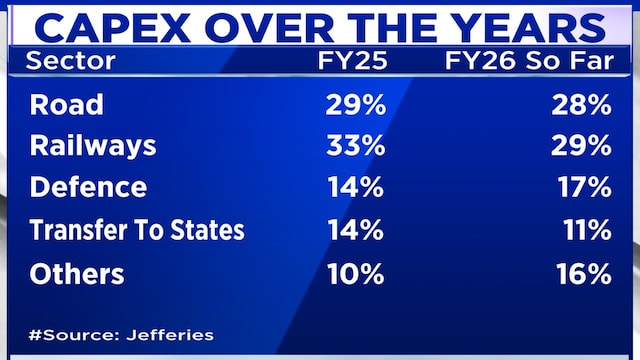
“The key filler then becomes the government,” Narang said. He noted that central government capex has already risen to about 3% of GDP from 1.5% earlier and is likely to grow in line with nominal GDP going forward.
Looking ahead to FY27, John said new-age sectors such as data centres, semiconductors and electronics will continue to attract investments. She also expects metals to remain dominant, driven by global under-investment, EV demand and AI-related usage.
On the government side, Narang expects railways and defence to see stronger allocations. “Railways and defence will be two segments where the thrust will be much higher,” he said, while roads may see flatter spending levels.
For the entire discussion, watch the accompanying video