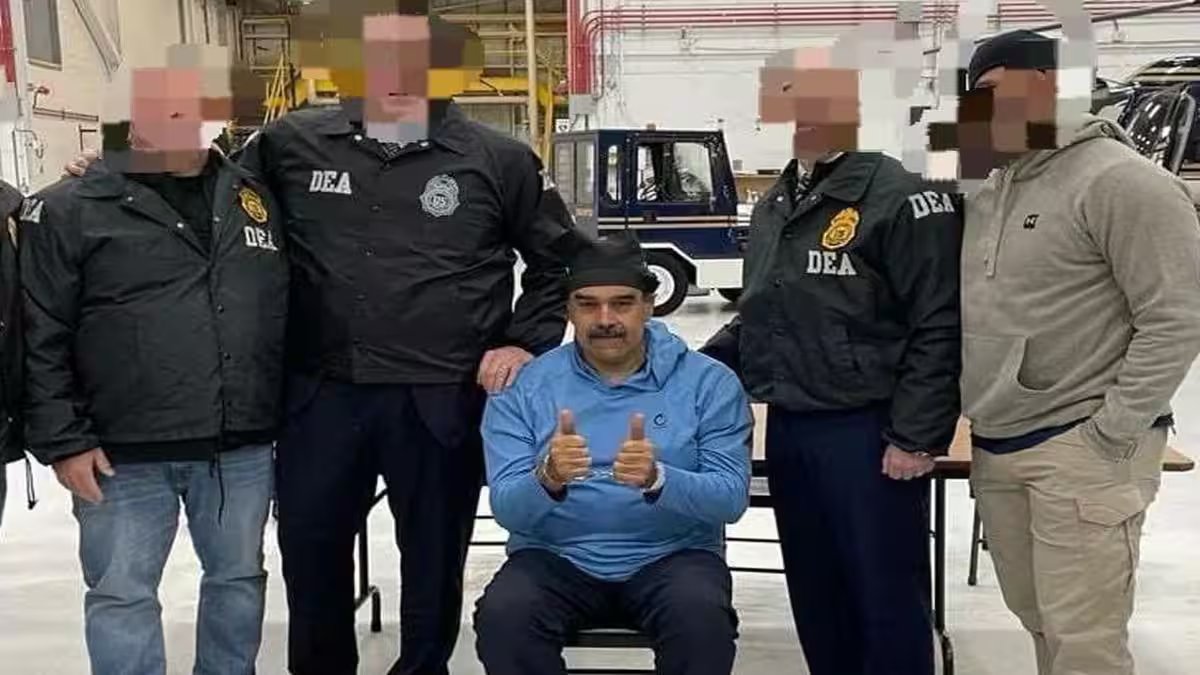
A daring operation by US troops has culminated with the capture of Venezuelan President Nicolas Maduro and his wife, Cilia Flores. Now, Maduro has been brought to New York where he has been detained and awaiting trial on charges of ‘narco-terrorism’.
Meanwhile, US President Donald Trump declared that America would “run the country” for now.
Experts note that the dramatic seizure of Maduro is beyond even the most high-profile historical examples of aggressive American actions toward autocratic governments in Panama, Iraq and elsewhere.
It has even raised questions about the legality of Maduro’s capture by the US.
Here’s what we know.
What has happened so far?
On Saturday (January 3), US forces attacked Venezuela — at least seven explosions were reported in the South American nation. The New York Times has reported that at least 40 people have died in the strikes, which targeted the Generalissimo Francisco de Miranda Air Base, an airfield known as La Carlota, Fuerte Tiuna, a key military facility in Caracas, Port La Guaira, Caracas’ main conduit to the Caribbean Sea, located in Miranda state, Higuerote Airport, also located in Miranda state, just east of Caracas and Antenas El Volcan, a telecomms towers on Cerro El Volcan, a high peak in Miranda state.
This was followed by the
seizure of Maduro and his wife, Cilia Flores. After being transported to the USS Iwo Jima, located some distance away from Venezuela, the couple was flown to New York City in the US where Maduro has been brought to the Metropolitan Detention Centre (MDC).
Notably, Saturday’s actions
caps months of aggressive US military action in the region, including the bombing of boats accused of trafficking drugs and seizures of oil tankers off the coast of Venezuela. The Trump administration has conducted 35 known boat strikes against vessels, killing more than 115 people since September, and positioned an armada of warships in nearby waters.
What has the US said about its actions?
US authorities said the Justice Department sought military assistance to apprehend Maduro, who had been indicted by a New York grand jury along with his wife, son, two political leaders and an alleged leader of an international gang. They were charged with crimes related to terrorism, drugs and weapons.
US Attorney General Pam Bondi said on social media that the defendants “will soon face the full wrath of American justice on American soil in American courts”.
However, at a press conference, Trump blamed Venezuela for stealing US oil interests and said Washington would take them back and planned to run Venezuela for a period of time, without offering specifics.
What do experts say on Trump’s actions against Maduro?
When asked about Trump’s bombing of Venezuela and the capture of Maduro, international law experts opined that the US president has most likely violated international law. Moreover, the US administration has mixed up legal issues by claiming the operation was both a targeted law enforcement mission and the potential prelude to long-term control of Venezuela by the US.
“You cannot say this was a law enforcement operation and then turn around and say now we need to run the country,” Jeremy Paul, a professor at Northeastern University specialising in constitutional law, told Reuters, adding, “It just doesn’t make any sense.”
Jimmy Gurule, a Notre Dame Law School professor and former assistant US attorney, was also quoted as telling the Associated Press, “This is clearly a blatant, illegal and criminal act.”
Even Matthew Waxman, a law professor at Columbia University specialising in national security law, opined the same. He told Reuters, “A
criminal indictment alone doesn’t provide authority to use military force to depose a foreign government, and the administration will probably hang this also on a theory of self-defence.”
Others also noted that the Trump administration had violated the central provision of the UN charter – known as article 2(4) – which states that countries must refrain from using military force against other countries and must respect their sovereignty.
As Geoffrey Robertson KC, a founding head of Doughty Street Chambers and a former president of the UN war crimes court in Sierra Leone, told The Guardian that the attack on Venezuela was contrary to article 2(4) of the charter. “The reality is that America is in breach of the United Nations charter,” he added. “It has committed the crime of aggression, which the court at Nuremberg described as the supreme crime, it’s the worst crime of all.”
Susan Breau, a professor of international law and a senior associate research fellow at the Institute of Advanced Legal Studies, also told the British media house that the attack could have only been considered lawful if the US had a resolution from the UN security council or was acting in self-defence. “There is just no evidence whatsoever on either of those fronts,” Breau said.
What does the law say?
Firstly, the US Congress has the power to declare war, which it hasn’t in this case. In fact, Trump’s Chief of Staff Susie Wiles told Vanity Fair in an earlier interview that if Trump were to authorise “some activity on land” in Venezuela he would need approval from Congress.
Moreover, international law prohibits the use of force in international relations except for narrow exceptions such as authorisation by the UN Security Council or in self-defence. Drug trafficking and gang violence are considered criminal activity and do not rise to the accepted international standard of an armed conflict that would justify a military response, according to legal experts.
Is there any precedent?
The US has captured criminal suspects in foreign countries, including Libya but it has sought consent of local authorities.
In 1989, the US arrested General Manuel Noriega, then the leader of Panama, in similar circumstances. Noriega had been indicted on drug-related charges and Washington said it was acting to protect US citizens after Panamanian forces had killed an American soldier. Washington had also alleged Noriega was an illegitimate leader and had recognised as the country’s leader the candidate who Noriega had claimed to have defeated in a recent election.
The former president of Honduras, Juan Orlando Hernández, was extradited to the United States in 2022 and later convicted on drug-related charges and sentenced to 45 years in prison. Trump pardoned Hernandez in December.
It’s important in Maduro’s case that the US administration describes him as an illegitimate leader; Washington has not recognised another Venezuelan leader who could have authorised the capture of Maduro.
But wait, doesn’t Maduro have immunity?
As per international law, heads of state have immunity in foreign courts. However, does Maduro enjoy this immunity is a huge question. According to US Secretary of State Marco Rubio, Maduro is not the legitimate president of Venezuela, but the head of a drug trafficking organisation masquerading as a government.
But, Venezuela’s National Electoral Council formally declared Maduro the winner of elections in 2018 and 2024. These results were widely questioned, with many alleging fraud had taken place, and since 2019, the US has not recognised Maduro as the legitimate president.
With inputs from Reuters, AP and New York Times
End of Article