“I watched it, literally, like I was watching a television show. And if you would have seen the speed, the violence… It was an amazing thing, an amazing job that these people did. Nobody else could have done anything like it.”
This is how US President Donald Trump described ‘Operation Absolute Resolve’, the military operation to seize
Venezuela’s President Nicolas Maduro, who has now arrived in New York and will stand trial on drug and weapon charges.
Operation Absolute Resolve is the dramatic culmination of a months-long campaign whose ultimate goal has long been clear to those involved in its planning: to oust the Venezuelan president from power.
Here’s how this complex, dangerous and daring operation unfolded — from planning to execution and extraction.
The planning stages
The operation to capture Maduro was not going to be easy. It was going to be a complex and highly dangerous mission, especially as the US embassy had shut down in Caracas, the Venezeulan capital, giving the Americans no cloak of diplomatic cover.
A New York Times report states that CIA officers had entered Venezuela last August with a plan to collect information on Nicolás Maduro. They moved around Caracas for a month, collecting all the information they could, along with information provided to them by someone close to none other than the Venezuelan president.
As US Joint Chiefs Chairman General Dan Caine said on Saturday about the surveillance, “We were tracking everything. How he (Maduro) moved, where he lived, where he travelled, what he ate, what he wore — what were his pets.”
Based on this information, elite US troops, including the army’s
Delta Force, began planning and rehearsal on how they would storm Maduro’s strongly fortified residence. In fact, for this purpose, a replica of the Venezuelan president’s house was also created in Kentucky where they practised blowing through steel doors at ever-faster paces.
According to Caine, by early December, the US forces were set to undertake Operation Absolute Resolve. However, Maduro hopping from one location to another didn’t make it easy for the US. They didn’t always learn where he intended to stay until late in the evenings.
Then, finally in the days before Christmas, Trump gave a green light to the operation. Then at 10.46 pm ET on Friday, after shopping and enjoying dinner at Mar-a-Lago in Florida, the US president gave the final go-ahead — “Good luck and Godspeed.”
According to comments given by Trump to Fox News, the operation to capture Maduro was to happen “four days, ago, three days ago, two days ago, and then all of a sudden it opened up. And we said: Go.”
The night operation in Venezuela
What followed Trump’s go-ahead was a precise mission — with many noting that it was unprecedented.
More than 150 US aircraft, including B1 bombers, F-35 and F-18 fighter jets and surveillance aircraft took off from 20 locations on land and sea from across the region. US warplanes pounced on Venezuelan air defence systems to allow helicopters and ground forces to approach Maduro’s compound.
“The lights of Caracas were largely turned off, due to a certain expertise that we have,” Trump said. Videos posted on social media appeared to show explosions across the city. The US Space Force and Cyber Command helped clear the way for the operation as the planes approached.
According to Caine, the helicopters came under fire as they reached the “target area” — where Maduro was living. One was hit but remained flyable.
Just before 2 am,
explosions began to rock Caracas. And as the world wondered if it was the start of a widespread bombing campaign of Venezuelan targets, the US troops were beginning to get into place to carry out the last part of their mission — extracting Maduro.
The troops arrived at Maduro’s location shortly after the strikes began. Trump described Maduro’s safe house as a heavily fortified military “fortress” in the heart of Caracas. “They were in a ready position waiting for us. They knew we were coming,” he said.
The US troops took fire when they arrived, but, as Trump said later none of them were killed. “They just broke in, and they broke into places that were not really able to be broken into, you know, steel doors that were put there for just this reason,” Trump said.
The US president added that Maduro and his wife, Cilia Flores, were trying to make it to a safe room. “He was trying to get into it, but he got bum rushed so fast that he didn’t get into that,” the US president added, “We were prepared with massive blowtorches to get through the steel, but we didn’t need them.”
Now, it was time to get out.
Maduro’s extraction and arrival on US soil
General Caine providing details added that Maduro and his wife “gave up” and were taken into custody by law enforcement officers on the mission. Additional helicopters arrived to aid the exfiltration, while fighter jets and drones “provided overhead coverage and suppressive fire,” Caine added.
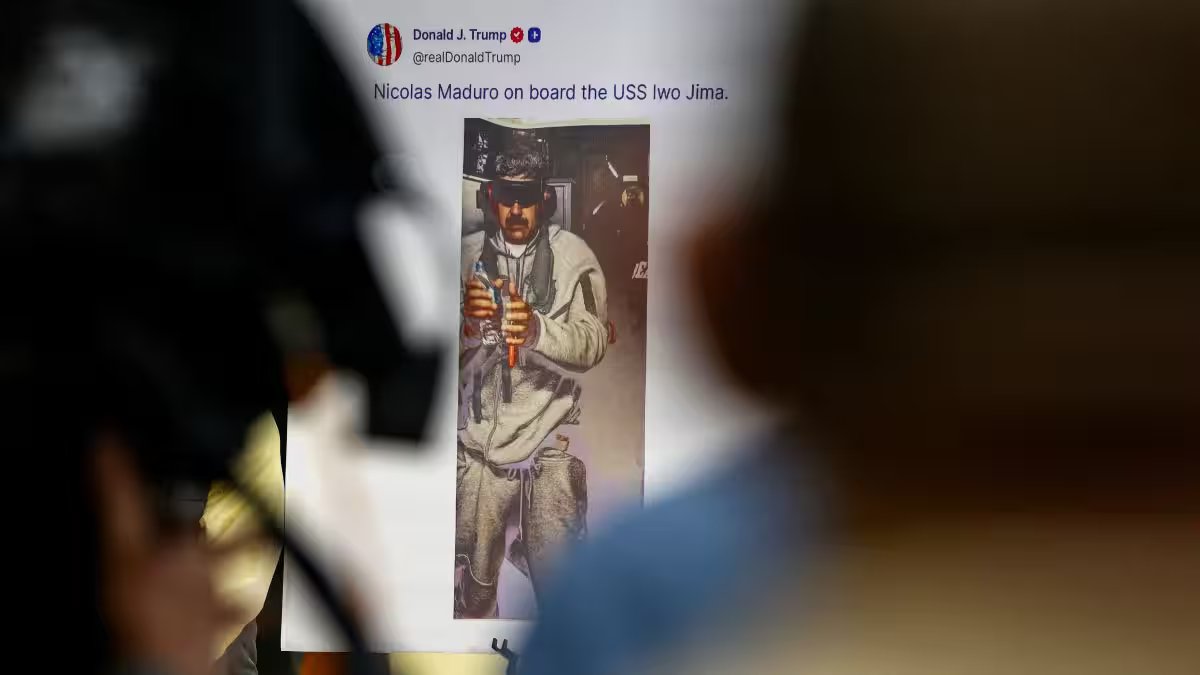
The Delta operatives swiftly loaded the couple into the helicopters, and by 3.29 am, Maduro and his wife were transferred to the USS Iwo Jima, a US warship in the Caribbean stationed some kilometres off the coast of Venezuela during the operation.
Trump, who had been seeing the entire operation unfold from Mar-a-Lago, then broke the news in a post on Truth Social at 4:21 am Washington time.
Minutes later, a senior White House official sent an AFP reporter a message consisting of emojis for a muscled arm, a fist and fire.
Simultaneously, the Venezuelan couple was transferred from the Iwo Jima to the US Navy base at Guantánamo Bay, where the FBI had a 757 government plane waiting to bring him to a military-controlled airport north of Manhattan.
By Saturday evening, Maduro arrived at the Metropolitan Detention Centre in Brooklyn — the same location where rapper
Sean “Diddy” Combs was held during his trial last year, as were other high profile prisoners including
Ghislaine Maxwell.
Now, Maduro is set to face drugs and weapons charges in a Manhattan federal court next week.
With inputs from agencies
End of Article