The country of Venezuela awoke with a start on Saturday when residents of its capital, Caracas, heard explosions and aircraft in the skies. According to reports, at least seven explosions had taken place in the South American nation, plunging parts of it into darkness.
Following the
blasts, Venezuelan authorities confirmed that Caracas had come under attack, as well as three other states: Miranda, La Guaira and Aragua. The country’s President Nicolas
Maduro has declared a national emergency and said it “rejects, condemns and denounces” what it described as “serious military aggression perpetrated by the current Government of the United States of America.”
“This act constitutes a flagrant violation of the United Nations Charter, especially Articles 1 and 2, which enshrine respect for sovereignty, the legal equality of states, and the prohibition of the use of force. Such aggression threatens international peace and stability, specifically in Latin America and the Caribbean, and places the lives of millions of people at grave risk,” read a statement by the Venezuelan government.
President Maduro also urged his countrymen to rise up against the apparent US assault, saying: “The entire country must mobilise to defeat this imperialist aggression”. Notably, US President Donald Trump wrote on Truth Social that Maduro and his wife had been captured and flown out of the country.
This shines a spotlight on the country’s military. Does Caracas have the military might to go up against Washington. Here’s what we know about the South American country’s firepower.
How powerful is Venezuela’s military?
According to Global Firepower’s 2025 Military Strength Ranking, Venezuela places 50th worldwide out of 160 countries assessed in terms of their military capabilities. However, within Latin America, it ranks seven behind militaries of Brazil, Mexico and Argentina.
When it comes to manpower, the Venezuelan military is reported to have around 120,000 personnel on active duty, with another 100,000 troops in reserves, as well as over 220,000 personnel in the National Guard. Its air force is estimated at around 20,000 personnel, the army at 115,000, and the navy at 25,500.
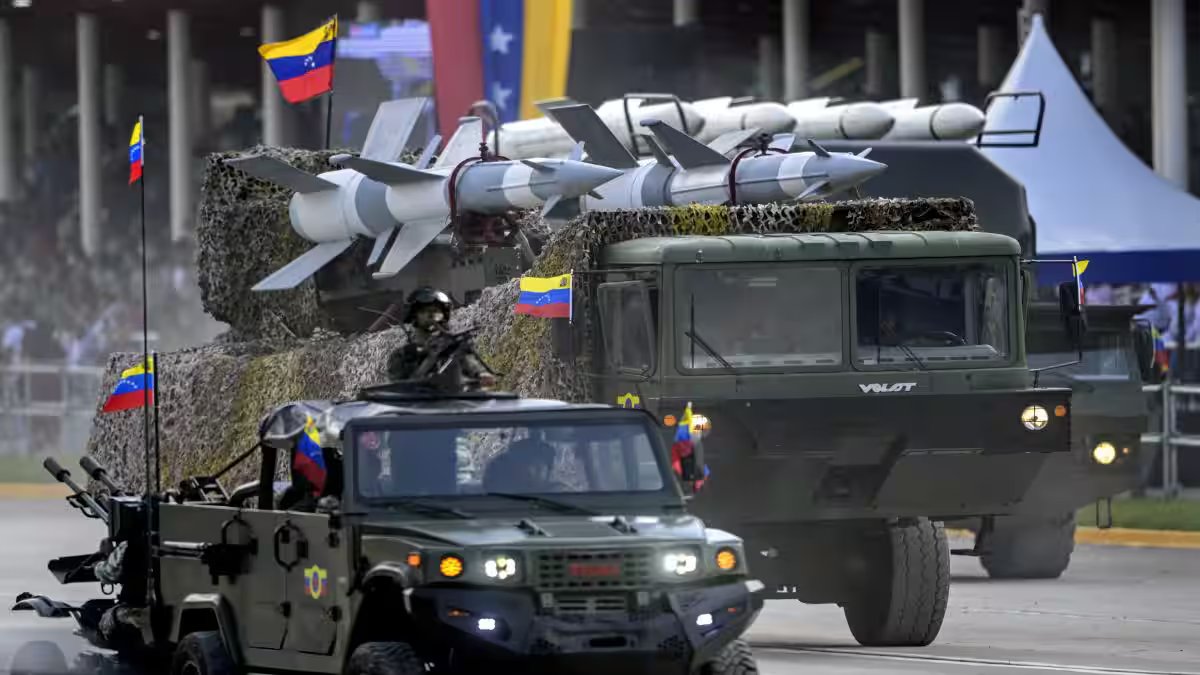
When it comes to weaponry, AFP reports that the South American country has a ragtag collection of Russian fighter jets, Iranian drones, old French tanks and a German submarine. It has 15 F16 fighter jets purchased from the United States in the 1980s, 173 French AMX-13 tanks, 78 British tanks, and a Sabalo submarine acquired from Germany in 1973. Venezuela also has one operational Italian frigate; nine coastal patrol vessels, 25 armed speedboats and three landing vessels for 12 tanks and 200 personnel.
According to Military.com, the South American nation has invested billions in Russian-made weapons systems, including missiles and fighter jets, intended to deter or challenge US ships and aircraft. It has in its arsenal at least 21 operational Su-30s, a Russian fighter aircraft developed in the 1980s. It also has the T-72 battle tanks, S-300, Pechora and Buk anti-aircraft missiles, portable Igla-S systems and Kalashnikov rifles.
What about Venezuela’s militias?
In addition to its military, Venezuela has the Bolivarian Militia, which was formed in 2008 by Hugo Chavez. It is a loyal paramilitary force that, while technically is part of the armed forces, comes directly under the control of the president.
It is unknown as to the number of people who belong to the Bolivarian Militia, but in August, Maduro said he was going to “activate … more than 4.5 million militiamen” taken from “all the factories and workplaces of the country.”
“Missiles and rifles for the working class, so that they may defend our homeland,” he said. He later suggested that the militia has more than eight million members.
Analysts argue this figure is unrealistic. The International Institute of Strategic Studies (IISS) estimates the force at 123,000 soldiers, 220,000 militia — a civilian arm of the military — and 8,000 reservists.
Meanwhile, Andrei Serbin Pont, an analyst specialising in defence at the CRIES think tank, told CNN that those in the militia would be too inexperienced to play a decisive fighting role. “Those people do not have sufficient training. There is no real armed structure to mobilise those elements, and those elements would not be effective in combat,” he told CNN.
How could Venezuela respond to a US attack?
Earlier, sources told Reuters that Venezuela would mount a guerrilla-style resistance or sow chaos in the event of a US air or ground attack.
Officials said the Venezeualan reponse would be a ‘prolonged resistance’ and would involve small military units at more than 280 locations carrying out acts of sabotage and other guerrilla tactics.
What do experts say on Venezuela’s military power?
Venezuela can’t possibly hope to match the US, which remains the biggest spender and most powerful military on Earth, when it comes to a conventional battle.
Experts have claimed that the military is likely ‘in shambles’ with their submarines and surface vessels probably inoperable.
However, its Russian-made missiles and jets could easily target US ships and aircraft. Its militia, in case of a ground invasion, will also look to tie down US forces in the urban environment – which America previously faced in Iraq and Afghanistan.
We will have to wait and watch to see what comes next.
With inputs from agencies
End of Article