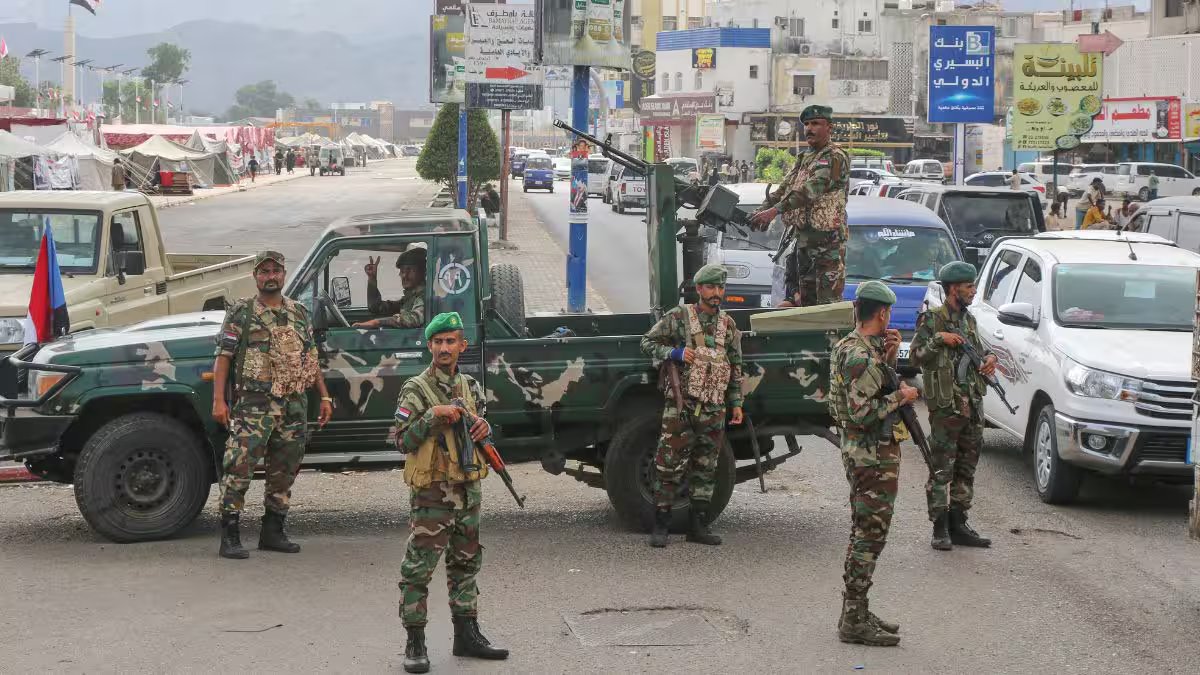
A series of Saudi airstrikes, territorial seizures by United Arab Emirates-backed separatists, and growing diplomatic friction between Riyadh and Abu Dhabi have destabilised southern and eastern Yemen, raising concerns of wider regional conflicts across the Gulf and Red Sea corridors.
The latest escalation has unfolded in a country that sits astride one of the world’s most important maritime trade routes and has already endured more than a decade of conflict.
Developments in recent weeks have fractured the already fragile alliance opposing Yemen’s Iran-aligned Houthi movement.
How Saudi airstrikes marked a big shift on the ground
On December 30, 2025, Saudi Arabia
carried out airstrikes on the port city of Mukalla in eastern Yemen.
The attack targeted what Riyadh described as a weapons shipment originating from the United Arab Emirates and destined for separatist forces operating in the south.
Mukalla, located along the Gulf of Aden, is a vital coastal city positioned near major international shipping lanes, amplifying concerns about the broader implications of military escalation in the area.
Shortly after the strike, the UAE announced it would withdraw its forces from Yemen, a move that added further uncertainty to an already volatile situation.
The attack and subsequent developments highlighted the extent to which divisions among Yemen’s anti-Houthi partners have widened, despite years of coordination against a common adversary.
At the heart of the latest crisis is the Southern Transitional Council (STC), a powerful separatist movement backed by Abu Dhabi.
Over the course of December, STC forces seized effective control over large parts of Yemen’s eastern provinces of Hadramout and Mahra, including key oil facilities and infrastructure.
These advances significantly altered the territorial balance in southern Yemen and disrupted the political arrangement that had existed among factions aligned against the Houthis.
Who controls what in Yemen’s fractured conflict
The Iran-aligned Houthi movement controls much of the country’s northern and most populous areas, including the capital, Sanaa.
In contrast, the south has been dominated by a loose coalition of forces backing the internationally recognised government,
supported primarily by Saudi Arabia and the UAE.
The STC occupies a unique position within this landscape. Established in April 2017, the council serves as an umbrella organisation for groups advocating the restoration of South Yemen as an independent state, as it existed between 1967 and 1990.
Over time, it has emerged as the most influential force in southern Yemen, benefitting from extensive military and financial backing from the UAE.
The council is chaired by Aidarous al-Zubaidi, who also serves as vice president of Yemen’s Presidential Leadership Council — the ruling body of the internationally recognised government.
Despite this formal role within the state structure, the STC has long insisted that any final political settlement must guarantee southern Yemen the right to self-determination.
By the end of December, STC-aligned forces and other UAE-backed groups controlled most of southern Yemen, including strategically significant port cities, islands, and border crossings.
These gains have strengthened the council’s leverage ahead of any future negotiations to resolve the wider conflict.
Hadramout and Mahra: oil and borders
The provinces at the centre of the current escalation — Hadramout and Mahra — are among Yemen’s most strategically and economically important regions.
Hadramout is Yemen’s largest province by area, stretching from the Gulf of Aden in the south to the Saudi border in the north. Rich in oil resources, it serves as a crucial source of fuel for southern Yemen and hosts PetroMasila, the country’s largest oil company.
In late November, the Saudi-backed Hadramout Tribal Alliance, a local coalition of tribes, seized control of the PetroMasila facility.
The move was intended to pressure the internationally recognised government into agreeing to greater revenue-sharing and improved public services for Hadramout’s residents.
STC forces subsequently moved into the province, clashing briefly with government troops and tribal allies before taking control of PetroMasila and other major installations.
The STC appears to have used the earlier seizure as justification to wrest control of the province and expand its territorial footprint.
From Hadramout, STC units advanced eastward into Mahra, a sparsely populated province bordering Oman. There, they took over a key border crossing between the two countries, extending their influence along Yemen’s eastern frontier.
In parallel developments further west, STC-aligned forces seized the presidential palace in Aden, which functions as the seat of Yemen’s Presidential Leadership Council.
How Saudi has responsed to STC
A Yemeni government official told AP that the pullout was part of a Saudi “repositioning strategy,” speaking on condition of anonymity.
As STC forces tightened their grip on Hadramout and Mahra, Saudi Arabia escalated militarily.
Saudi aircraft struck targets in Hadramout in what analysts described as a warning aimed at halting the separatists’ advance and compelling them to withdraw from the two governorates.
On January 2, Saudi warplanes reportedly
struck STC-backed forces again in southern Yemen. The strikes coincided with a Saudi-led operation attempting to take over STC camps in Hadramout, which borders the kingdom.
The confrontation involved the Saudi-backed National Shield Forces, a unit aligned with the coalition fighting the Houthis. These forces attempted to advance toward separatist camps, but STC fighters refused to withdraw.
Ahmed bin Breik, the STC deputy and former governor of Hadramout, said in a statement that the refusal to pull back led to the Saudi airstrikes.
How Saudis have defended their move
Saudi officials have insisted their actions are aimed at restoring order and preventing further destabilisation. Salem al-Khanbashi, the governor of Hadramout appointed by the internationally recognised government to command Saudi-led forces in the province, sought to downplay the confrontation.
“This operation is not a declaration of war and does not seek escalation,” al-Khanbashi said in a speech aired on state media.
“This is a responsible pre-emptive measure to remove weapons and prevent chaos and the camps from being used to undermine the security in Hadramout.”
Saudi Arabia has demanded that STC forces withdraw from Hadramout and Mahra and relinquish their weapons and camps as part of broader de-escalation efforts. The STC has so far refused to comply with these demands.
Diplomatic attempts to mediate the standoff have also faltered. Saudi Arabia’s ambassador to Yemen, Mohammed al-Jaber, accused the STC leadership of obstructing dialogue.
In a post on X, al-Jaber said the kingdom had made “all efforts with STC” for weeks “to stop the escalation” and persuade the separatists to leave Hadramout and Mahra. He added that Saudi Arabia faced “continued intransigence and rejection from Aidarous al-Zubaidi.”
Al-Jaber also accused the STC of blocking a Saudi mediation delegation from landing in Aden, despite prior coordination with some STC leaders to seek a resolution serving “everyone and the public interest.”
Yemen’s transport ministry, which is aligned with the STC, said Saudi Arabia imposed new requirements mandating inspections in Jeddah for flights travelling to and from Aden International Airport.
The ministry expressed “shock” and condemned the reported decision.
A spokesperson told AP that all flights between Aden and the UAE were suspended until Saudi Arabia reverses the measures. Saudi authorities have not confirmed the reported requirements.
How the conflict orignated
Yemen’s current turmoil cannot be separated from the broader conflict that erupted in 2014.
That year, the Houthis advanced from their northern stronghold in Saada, seized Sanaa, and forced the internationally recognised government into exile.
Saudi Arabia and the UAE intervened militarily in 2015 in an effort to restore the government. The war that followed devastated Yemen’s economy, displaced millions, and created one of the world’s worst humanitarian crises.
Despite the devastation, violence had gradually declined since 2022, as the Houthis reached an understanding with Saudi Arabia that halted cross-border attacks in exchange for a pause in Saudi-led airstrikes on Houthi-held territories.
The resulting stalemate reduced large-scale fighting but failed to resolve Yemen’s underlying political fractures.
The STC’s recent actions have now disrupted the internal balance among anti-Houthi forces, threatening to unravel the limited calm that had prevailed.
Also Watch:
With inputs from AP
End of Article